

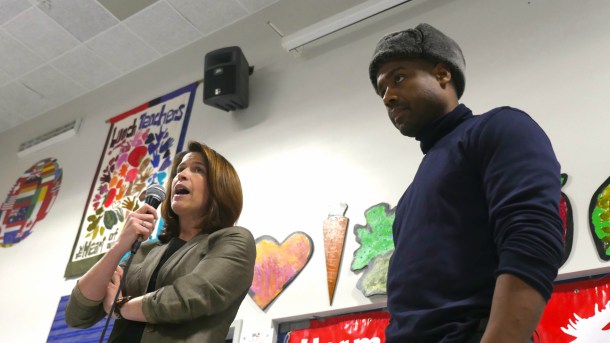
BURLINGTON — Independent mayoral candidate Infinite Culcleasure says he is “all in” until election day, rebutting reports that he may join forces with fellow independent Carina Driscoll.
The prospect of a partnership between Driscoll and Culcleasure was first reported in a Seven Days story profiling the three candidates — Culcleasure, a longtime community organizer, Driscoll, a former city councilor and state representative, and incumbent Democrat Miro Weinberger.
Culcleasure wrote in a blog post on Thursday that he has worked hard to dispel a narrative that validates only a head-to-head contest between “establishment” candidates Driscoll and Weinberger.
“Being coerced to drop out of a campaign for public office has been one of the most anti-democratic adventures I have ever experienced,” Culcleasure wrote.
“We should all be prepared for a little discomfort and not act in fear of a potential Miro victory, but rather in hope of transformative democracy in Burlington,” he wrote.
Culcleasure, who could not be reached for additional comment, told Seven Days last month that he had not ruled out the possibility of merging campaigns, but said the final decision would be made after consulting his campaign team and supporters.
Driscoll said this week that she was looking into the idea of a partnership, but had not discussed the idea with Culcleasure.
“I think there is a ton of overlap and shared common ground with who we want to represent and the work we want to do,” Driscoll said in an interview on Tuesday.
While the level of support for the two candidates is unclear at this point without any public polling data, Driscoll won the endorsement of the Burlington Progressive caucus over Culcleasure in early December by a vote of 116-84.
Driscoll said the math could prove to be difficult should the two candidates split the anti-Weinberger vote. In Burlington, voters elect the mayor under a winner-takes-all system, meaning that voters select one candidate, and the person with the most votes wins.
Burlington used an instant runoff voting (IRV) system for the 2006 and 2009 mayoral elections — elections that were both won by Progressive Bob Kiss — but scrapped the system in favor of plurality voting through a ballot measure in 2010.
Under an IRV system, also known as ranked-choice voting, voters rank the candidates in order of preference. If no candidate gets majority support, the least-popular candidate is eliminated. Then, votes from the least popular candidate get redistributed to the remaining candidates until a majority is reached for one candidate.
“I absolutely think we need to try,” Driscoll said of uniting the progressive vote. “Without IRV, the mayor can win on a plurality.”
After learning of Culcleasure’s post Friday, Driscoll said it’s his prerogative whether to explore a partnership, adding that she does not want to pressure Culcleasure.
“There are a lot of people who are invested in the outcome of this election, who are involved in our campaign and involved in Infinite’s campaign who are pushing this conversation because we don’t want to see our mayor re-elected on less than a majority,” Driscoll said.
Driscoll’s campaign manager, Elise Greaves, said she sent an email to the Culcleasure campaign asking if they would be interested in a meeting, but has not heard back.
Proponents of the IRV system say that because voters can pick and rank their choice of candidate, the system will produce a fairer choice because it will more accurately represent the will of the voters, and more votes will be end up being used to select a winning candidate.
University of Vermont political science professor Anthony Gierzynski did a study of both Burlington IRV elections, and found that the system has major flaws — for instance, the most popular candidate in the 2009 race lost the election to Kiss.
“One candidate who lost 2009 the election, Andy Montroll, was preferred over all other candidates in a head-to-head matchup. That is, a majority of voters ranked Montroll ahead of the winner Bob Kiss, and ahead of the second place finisher, Kurt Wright, yet Montroll lost the election,” the study says.
Gierzynski also notes that his view of IRV is held by a wide swath of his colleagues.
“It would be about as easy to find one such expert in support of rank order voting as it would be to find a qualified climate scientist who thinks global warming isn’t taking place,” he wrote.
Driscoll said that despite the problems with IRV, the potential result of a winner-takes-all system in which a candidate wins with a plurality was worse.
“Because then you have someone who has been elected, or re-elected, without the majority of the people who live here,” she said.
