

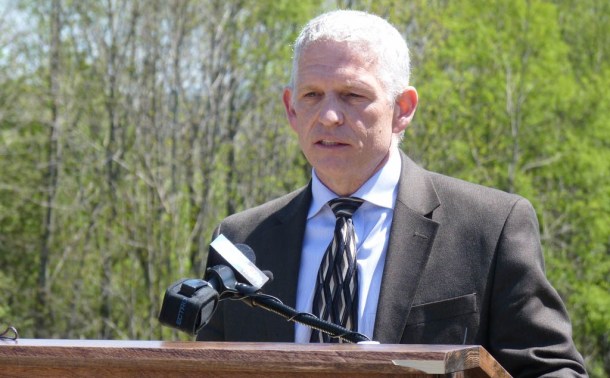
[T]he Vermont Attorney General’s Office will not file criminal charges against the former head of the state’s aviation division following an investigation over allegations of inappropriate use of funds.
Guy Rouelle, who led the aviation program in the state Agency of Transportation from 2011 until resigning in June, had been the focus of a Vermont State Police investigation after his departure.
The attorney general’s office declined to prosecute Rouelle because the evidence provided shows that his “conduct did not violate any explicit and established expenditure rules laid out by VTrans at the time of the alleged offenses.”
“Additionally, Mr. Rouelle appeared to be truthful, though obscure, regarding the purpose of some of the expenditures,” the attorney general’s office said in a statement. “Given the lack of evidence of an obvious violation of the expenditure rules and no provable misrepresentation, there is not sufficient evidence on which to base a criminal charge.”
Bram Kranichfeld, chief of the attorney general’s office criminal division, said the word “obscure” was used because “it’s clear that’s Mr. Rouelle could have included more information than he did in some of his disclosures surrounding these expenses.”
“But we did not find any evidence that he misrepresented anything or perpetrated fraud,” he added.
Rouelle offered little comment when contacted Thursday afternoon.
“They went through, did a review, and found that there was no wrongdoing,” he said. “It’s good news and other than that, no comment.”
The investigation centered on allegations involving Rouelle and the improper use of funds for helicopter training for himself and later for a helicopter rental.
Rouelle took helicopter lessons while managing the aviation program and received a commercial pilot’s license paid for by VTrans, the Vermont Agency of Transportation, through a combination of state and federal grant funds.
In addition, after obtaining the helicopter pilot’s license, Rouelle rented helicopters three times. The attorney general’s office statement said the helicopter rental for two of those occasions were “confirmed” to be “fly-in” events where local youth interested in aviation could meet pilots and view aircraft.
The third helicopter rental involved a visit to a proposed helipad where people were “purportedly” testing the sound pollution of a helicopter takeoff and landing, according to the statement.
Rouelle spent about $27,000 on professional training for a helicopter license in 2016 that he says he needed for airport planning. All invoices and expenditure he made for tuition and helicopter training was approved, Rouelle said in December.
In that interview, Rouelle called the allegations against him a “smear campaign,” adding that his supervisors were aware of everything he was doing, and had never raised an objection.
Documents obtained by VTDigger show that Michele Boomhower, the director of policy, planning and intermodal development for the Transportation Agency, and Trini Brassard, the agency’s assistant director of operations, signed off on the invoices for Sharkey’s Helicopters in Lebanon, New Hampshire.
State Transportation Secretary Joe Flynn said in a previous interview following Rouelle’s departure the agency had “some concerns about potential activities in the aviation program,” prompting an investigation into the matter.
The transportation secretary added that the aviation program review led to an agency-wide assessment of practices and the implementation of tighter financial controls. The aviation program has also since been merged with the transportation agency’s rail division.
Flynn, in a statement issued Thursday, said of the AG’s probe into Rouelle, “While there is insufficient evidence to bring criminal charges, it is clear the agency’s previous internal controls were abused and our changes are intended to prevent it from occurring again.”
A internal memo from the Agency of Transportation obtained by VTDigger late last year talked of improper use of purchasing cards and questioned the handling of funds and contracts in the aviation program. The memo contained an outline of allegations and notes, many not written as complete sentences.
The memo also used the terms “misappropriation of funds” and “shell game.” Asked about those allegations, Rouelle late last year called them “total horse crap.”
