

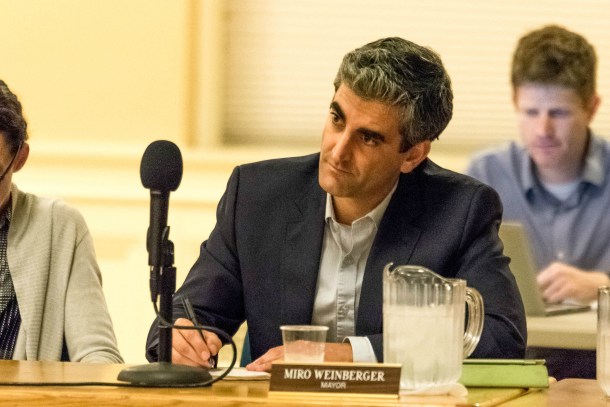
[B]URLINGTON — Parent-teacher organizations are pushing Mayor Miro Weinberger to come up with new ways to support Burlington’s schools.
For years, the city split its PILOT funds — an acronym for payments in lieu of taxes, money that comes from sources like water and electric ratepayers and tax-exempt institutions like the University of Vermont — with the Burlington School District, providing the district with about $1.4 million a year.
But in 2014, the state Agency of Education intervened, telling the Burlington School District it violated equality provisions in the Vermont Constitution, and Acts 60 and 68, by taking money from a municipal fund that isn’t available to other Vermont school districts.
Since then, city and district leaders have been trying with mixed results to find ways to cover the district’s lost revenue with the money the city continues to receive, while avoiding the legal issues associated with getting the district city money.
Now, with the Burlington School District proposing a budget that is about 1 percent larger than last year’s — but requiring a possible double-digit property tax increase largely due to pressures from the statewide education funding system — many in the district are scrambling to find new ways to save money.
Burlington’s parent-teacher organizations sent an open letter to Mayor Miro Weinberger Wednesday, saying that even though the Agency of Education has put serious roadblocks in place, the city should be “creative” when finding a way to support the schools.
“We expect all parties involved to commit to finding creative ways for these funds to contribute to school district needs,” the group wrote.
Despite the legal restrictions, Weinberger has put some money toward programs that will benefit Burlington’s schoolchildren. The largest initiative is a $500,000 per year contribution to Burlington’s Early Learning Initiative, which uses the services of statewide early education organization Vermont Birth to Five to distribute grants to Burlington preschools.
The issue was also raised at a recent mayoral forum, where Weinberger laid out the legal landscape the city is in and defended his use of the money.
“When I came into office in 2015 the Agency of Education and the Burlington School District signed an agreement saying that these PILOT funds could not lawfully, cannot constitutionally continue to be used to fund the school district,” Weinberger said.
But one of Weinberger’s challengers, independent Carina Driscoll, hammered Weinberger for not doing enough to return the PILOT funds to Burlington’s children in one way or another. City bond ratings have increased, in part because of the extra money, a marquee issue for Weinberger, Driscoll said.
The city could have worked to lower the municipal tax rate to offset a subsequent increase in property taxes that will likely come this year, Driscoll said during the forum.
On Thursday, Driscoll said the choice for city hall should be between working around state restrictions to take on costs already borne by the school district, or lowering taxes.
“When the funds that could no longer be sent over to the school district were kept by the city, they either needed to be spent on education expenses to defray the costs of the school district, or used to lower the municipal tax rate,” Driscoll said.
Independent mayoral candidate Infinite Culcleasure, a longtime community organizer, agreed with his two opponents during the forum in identifying state regulations as a major source of Burlington’s funding problems.
On Thursday, Culcleasure said in an email that the PILOT fund issue illustrates a disconnect between city hall and the district.
He said the money “can go a long way in the Burlington schools,” but is insignificant for the city.
He also said the city started to pay for a school resource officer — after the school district decided not to fund the position any longer.
“So while the school was trying to move toward not having police with guns in our schools, the mayor reversed that trend with the use of the PILOT funds,” Culcleasure said.
Weinberger sent a letter in response to the parent-teacher organizations late Thursday, addressing each of their concerns. He wrote that the city has already expended about $450,000 annually on initiatives that the district used to take on, and promised to lobby for a change in state law, and for the Agency of Education to change its position — though he said he is not optimistic the agency will change its mind.
State representatives from Chittenden County introduced a bill (H.795) this month that would give a clearer definition of what an “education expense” is, and therefore expand the city’s options for funding programs that the district already takes on.
Mark Barlow, a Burlington school commissioner who has been working closely on this issue for years, said the legislation would be a clear step forward.
“It would basically say that there are non-educational expenditures that the district currently has on its books,” Barlow said.
Barlow said the district takes on significant programs that, he would argue, are non-educational expenses, such as $500,000 annually to pay for school social workers and “multilingual liaisons,” who serve as translators and mentors for new American students and their families.
“These are all services that a reasonable person would say are non-educational in nature, yet they’re on our general fund budget,” Barlow said.
He said the city deserves some credit for identifying and funding programs that benefit the district, but it’s not enough.
“Even so, that’s like a third of the money that we think think we should be able to have access to,” Barlow said.
