

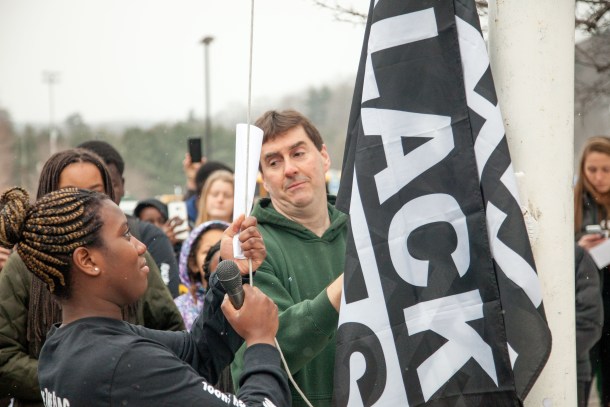
[W]hen Montpelier High raised a Black Lives Matter flag last week, tears began rolling down Katrina Battle’s face. Battle grew up “brown in Vermont,” she said, and seeing the flag go up the pole was momentous.
“I wasn’t expecting tears to fall from my face but in that moment there was a recognition that I exist here, I am valued here, I have a place here,” she said at a press conference in the Statehouse on Tuesday.
The event was held by the Vermont Coalition for Ethnic and Social Equity in Schools to launch a campaign and introduce legislation, which has been referred to the Education Committee, to combat racism and discrimination.
Vermont is consistently ranked among the whitest states — about 95 percent of the population is white, according to the U.S. census bureau — and people often talk as if there are no black or ethnic people here, according to Battle.
“That leaves me to say, what about me? I’m here. I am Vermont,” she said, adding that this kind of thinking has a deep effect on Vermonters who aren’t white, impacting the quality of life for entire communities.
Among the proposals of the coalition is a bill, H.794, that would set up an advisory panel to help the Agency of Education develop grade level expectations, or standards, for coursework in ethnic and social equity studies. It would also require the secretary of education to publish test results showing performance for certain ethnic categories of students, and direct the Vermont School Boards Association to develop policies to help infuse these principles and values into schools.
Rep. Kiah Morris, D-Bennington, wants schools to move past just celebrating diversity to actively fighting discrimination by teaching students how non-dominant groups have contributed to history, culture and the state.
Too many students say “I don’t see myself within the school literature. I don’t hear my voice in the readings. I feel invisible in this state that I love,” Morris said. “We need to know that our lives do matter and this bill seeks to do that.”
And it isn’t just minority populations who are affected. Research shows that ethnic studies curricula produces “higher levels of thinking” in all students, according to the National Education Association.
Another sponsor of the bill, Rep. Kevin Christie, D-Hartford, said there are too many cases where minorities have been omitted from prevailing American narratives. When more than six million African-Americans migrated away from the South after emancipation, for example, some went out west and became cowboys — at least 3 percent, according to Christie.
“There are a lot of pieces to this mosaic that we have to fill in for our youth and for all of us,” he said. “We have an obligation.”

