


Legislative leaders gave Gov. Phil Scott’s proposed budget mixed reviews Tuesday. They labeled some of his ideas “workable” and extensions of their own. Others they dismissed outright as simplistic.
Their biggest criticism was of what he failed to mention.
The strongest blast came from the chair of the Senate Education Committee, Philip Baruth, who charged Scott with a “profound lack of courage” for failing to recommend a specific way to deal with education costs, including an $80 million hole in the education fund and a projected 7 percent average increase in property tax rates.
Earlier in the day, Scott’s administration secretary, Susanne Young, defended that no-proposal approach, saying the administration’s education cost-control ideas last year were roundly rejected. This year, she said, the administration decided to lay out several ideas, hoping the administration and lawmakers could cooperatively develop a plan.
In a news conference after Scott’s speech, leaders of the House and Senate expressed a desire to work with the governor and noted areas of easy agreement with the administration: the need for two new facilities to hold criminal mental health patients and workforce development efforts. Rep. Janet Ancel, D-Calais, chair of the House Ways and Means Committee, said Scott’s proposal to waive income taxes for some Social Security recipients was explored by her committee last year.
House Speaker Mitzi Johnson, D-South Hero, gave a response reflecting the fact that lawmakers received the detailed budget book only moments before Scott started his speech.
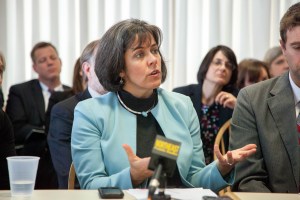
“We heard a lot of general principles and a lot of general ideas,” Johnson said. She said she welcomed the administration “laying out some of the specifics” and she said on some proposals, including education funding, lawmakers were already working on their own ideas.
Senate President Tim Ashe, D/P-Chittenden, said the proposal was “last year’s budget with some new initiatives around the edges.”
The Senate president pushed back on what he called Scott’s “gloomy portrayal of Vermont where demographic trends and financial policies have put us on a road to ruin.”
Ashe highlighted positives — a strong credit rating, a reduction in the crime rate and prisoners, a “top five” in the country education system, a “gold standard” response to the opioid crisis, few Vermonters without health insurance — that were “inherent” in Scott’s speech, he said, and the result of previous efforts by the Legislature, which has been controlled by Democrats for more than a decade. Ashe also gave credit to the Democratic administration under Peter Shumlin, whom Scott replaced in 2016.

“We hear a lot of discussion from some in the administration about the sins of the past, that legislators had been spending on inappropriate things, and what was unique in today’s address was there were very few criticisms of any actual thing that has been in those past budgets,” Ashe said.
“This budget is largely a carry-forward of the vision that has been in those budgets that we have passed in recent years,” he said, suggesting they could find common ground.
Ashe said the Legislature’s ability to hold the line to Scott’s demand for budget growth of a little more than 2 percent was “not so difficult” but will depend on whether appropriations from the federal government are cut or Vermont tax revenues are negatively impacted by the recent federal tax cut. Ashe cited Scott’s failure to discuss the looming possibilities from Washington as a hole in the speech and urged the governor to work with the Trump administration to hold Vermont harmless.
Sen. Jane Kitchel, chair of the Senate Appropriations Committee, said achieving Scott’s goal to hold down spending would be easier this year than in the past when lawmakers faced bigger gaps in funding and more pressure to spend. This is the second year in a row Scott has demanded lawmakers hold spending to the growth of wages and threatened to veto the budget if they don’t hold the line. Last year, Scott vetoed the budget in an impasse over teacher health care.

“This is not a tough budget year,” said Kitchel, D-Caledonia. “We are not dealing with tough economic conditions in the way we did in 2008,” when social services programs saw more clients. She added health care costs were not rising as quickly as five or 10 years ago.
“There are a number of things helping that can go either way depending on circumstances,” she said.
Ashe said lawmakers were being cautious, for example, in not viewing a bump in revenue announced last week as money to be spent because they consider it “soft.”
Sen. Anthony Pollina, D/P-Washington, panned the speech. The issues Scott failed to mention, he said, including how to pay for the cleanup of Lake Champlain. He also said Scott should have been “more specific” about education money-saving ideas and should have laid out details of the plan to build a new large-scale correctional facility.

“There were a lot of big issues that are going to be big issues for the Legislature, no doubt which he chose to ignore in his budget speech,” Pollina said. “And I think that’s kind of disappointing because it shows a lack of willingness to provide the real leadership when it comes to the budget.”
Overall, Pollina said the governor “nibbled around the edges on some really important issues and really didn’t lay out a path that’s going to change our economy very dramatically.”
On education, Scott’s failure to endorse a specific plan means he “expects us to do all the heavy lifting as usual,” the state senator said.
“I don’t know whether the menu idea is an improvement over last year’s idea, which was ‘I’ll just dump it all on you at the end of the session,'” Pollina said. “So at least this year … he’s dumping the menu early in the session but he’s not really doing anything to move it along.”
Scott came under fire last year for presenting his money-saving plan to negotiate teachers’ health care insurance on a statewide basis late in the session.
Baruth, who was at the leadership news conference, criticized Scott for a “profound lack of courage” for failing to mention any of his “menu” ideas in the budget speech.
“This was his budget speech and he urged — I would even say lectured the Legislature — to have the courage to consider all the ideas on the table,” said Baruth, D/P-Chittenden. “But you heard none of those ideas in his speech, which to me is a profound lack of courage, so I’m going to note that.”

He blasted some of Scott’s “menu” suggestions as “wrong-headed,” such as the idea of developing a statewide commission to find schools to consolidate. Baruth said the Legislature promised local communities years ago that the state would not make those decisions top down and leave the decisions to local districts.
House Minority Leader Don Turner, R-Milton, praised Scott’s budget for holding the line on spending and taxes and fees.
He also applauded the governor for asking the Legislature to help develop ways to cut spending in an education system with about 75,000 students and that costs $1.6 billion a year.
“I like that he extended the olive branch,” Turner said. Some questioned “why didn’t he just make a plan, and I said we’ve seen that before and it’s ‘that’s dead on arrival’ or whatever and get into political posturing.”
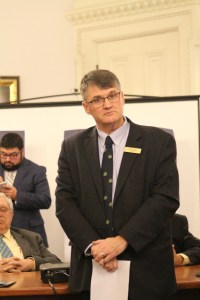
The governor presented cost-saving ideas, Turner said, and lawmakers will, too.
In addition to the immediate financial pressures, Ancel’s committee has also been discussing changing the education funding formula, with ideas ranging from making it based more on income than property values, to lowering the tax rate and making it more costly for communities to raise funds beyond a base amount.
“It’s not going to be easy,” Turner said. “I don’t think that’s going to be an easy conversation. Everybody’s base will get fired up and want to protect their little piece of the pie, but we’ve got to make education financing sustainable.”
Senate Majority Leader Becca Balint, D-Windham, said she aims to keep the focus of the discussion about education about children “and not dollars” and criticized Scott’s idea to increase the staff-student ratio to cut costs as simplistic.
“It’s not one-size fits all, which is why local people want to make those decisions,” Balint said.
For example, she said lawmakers need to develop ways to deal with a major education cost, special education services, “but it may not come down to a ratio change as much as who’s delivering those services.”
Balint agreed that after two decades, it might be time to change the education funding formula.
She argued the wealthy were not paying their share of property taxes and that some of the complaints about “affordability” masked concerns about equity and people “wanting to know they have as much skin in the game as the neighbor next door.”
