

(This story by Jordan Cuddemi was published by the Valley News on Jan. 9, 2018.)
[L]aw enforcement officials in Vermont are urging lawmakers to put the brakes on a fast-moving marijuana legalization bill that is poised for Senate passage this week.
The bill, which would legalize the possession of up to an ounce of marijuana and allow Vermonters to grow up to six plants, is set to go before the Senate on Wednesday, and Republican Gov. Phil Scott has indicated he would sign it into law.
Representatives from the Vermont Police Association, the Vermont Association of Chiefs of Police and the Vermont Sheriffs’ Association all say legislators should wait — at the very least — until a Scott-established commission releases its study on public health, safety and other topics related to marijuana legalization.
The commission was formed after Scott vetoed a similar bill in May, and its preliminary report was set to be released next week. The legislation now under consideration includes some revisions Scott sought, including increasing penalties for providing marijuana to minors.
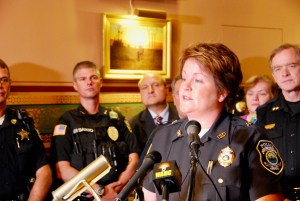
Orange County Sheriff Bill Bohnyak, who is the president of the Vermont Sheriffs’ Association, said some of the main concerns law enforcement officials have include people driving while impaired and an officer’s lack of tools to test for marijuana. There is no roadside test for marijuana akin to a Breathalyzer, which police use to test motorists’ blood alcohol content to determine if they are intoxicated.
Instead, a blood test for marijuana must be administered or a drug recognition expert must be involved, for example.
Even if there were a quick test, the Legislature hasn’t indicated a threshold for the amount of marijuana in a person’s system that would be considered “over the limit,” Bohnyak said in a telephone interview Monday.
“We are really just concerned because (Scott’s) own words last year were he would veto any bill for marijuana if it doesn’t include the impaired driving aspect of it,” Bohnyak said.
In addition to roadway safety, Scott instructed the commission to look at taxation, education and prevention, with a focus on youth.
“There is nothing on a statewide level that has addressed the marijuana issues with young children,” Bohnyak said.
For similar reasons, Woodstock Police Chief Robbie Blish expressed opposition. Hartford Police Chief Phil Kasten previously has expressed his disapproval of marijuana legalization, as well.
“I think some of these legislators have already made up their minds and they don’t care what the facts and statistics might say, one way or the other,” Blish said on Monday. “I suspect that they already know that (the report) is going to contain information that isn’t going to speak well of their vote and I think they just want to get it passed.”
Blish said he finds it “disturbing” that the law allows each person over the age of 21 to have two mature and four immature plants. If several adults are living inside the same home, that means numerous mature plants could be inside, and the amount of “consumable cannabis” will quickly add up, potentially to “trafficking” amounts, Blish said.
“And who knows what the feds are going to do,” Blish said, alluding to U.S. Attorney General Jeff Sessions’ recent repeal of Obama-era guidance discouraging enforcement in states where marijuana is legal.
“By decriminalizing marijuana in Vermont, we could actually make Vermonters federal criminals,” Blish said.
U.S. Attorney for the District of Vermont Christina Nolan was unavailable for comment Monday. But last week she told The Burlington Free Press that Sessions’ remarks offered clarification of her office’s discretion: “We’re going to use the principles we’ve long used in all drug cases to prioritize our finite resources.”

“The report is going to tell us things that we already know,” Benning said. “There is nothing about the report that cures the problems that are presented.”
Benning also said he doesn’t think legalizing marijuana will worsen the existing problem of drugged driving. Vermont is a state with a high per-capita consumption of marijuana, he said.
“The problems exist whether we legislate or not, and there is nothing about the report that will change the fact that there is no breath test,” said Benning, a criminal defense attorney.
The commission recently was briefed that the state has about 50 drug recognition experts, or DREs, police officers trained to recognize impairment in drivers under the influence of drugs. That number should be adequate to cover the state, the commission was told, according to Benning, who said there may be a need for additional DREs.
“I think it’s time we get this conversation over with and move on,” he said, calling the approval of the bill, H.511, a “baby step,” and one that likely will shape the conversation about taxation and regulation.
State Sen. Dick McCormack, D-Windsor, a longtime lawmaker, said he too would vote in favor of legalization.
“I am a libertarian in that regard. … I think the government really ought to stay out of it,” McCormack said. “Prohibition is more of a problem than marijuana is.”
The Vermont House passed the bill last week on a vote of 81-63. The Senate could pass it as soon as Thursday, Benning said. If Scott signs it, the measure would take effect July 1, he said.
Meanwhile, the New Hampshire House on Tuesday approved a bill legalizing small amounts of recreational marijuana.
