

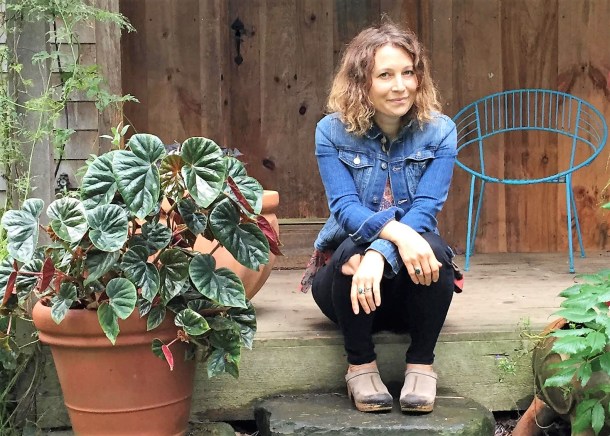
Then the 2016 presidential election hit her with an equally hard wallop. Could a leader of the free world actually doubt the science behind her book, the Marlboro writer wondered, and who would want to read fiction when reality had turned so surreal?
Nevertheless, she persisted.
“I realized this is very relevant,” MacArthur says, “because it’s about how we find spiritual substance during dark times.”
This week the author is reaping praise upon the release of “Heart Spring Mountain,” which tackles global warming — as well as heroin addiction and women’s struggles — at the most local level.
“The resulting narrative is nuanced, poetic, and evocative,” Publishers Weekly said in a starred review. “MacArthur empathetically depicts each of her characters in their wounded but hopeful glory.”
MacArthur credits two elder generations of her family for her sense of purpose and place — starting with her grandmother, the late Vermont folk singer Margaret MacArthur, whose work is preserved by the Library of Congress and Smithsonian Institution.
“Music,” the author says, “taught me what poetry was and how to write stories and characters.”
Robin MacArthur spent a decade performing with her husband, Tyler Gibbons, in the duo Red Heart the Ticker, which recorded four albums, toured nationally and appeared on public radio’s “A Prairie Home Companion.” But the self-described “wallflower child” has favored the solitude of writing ever since childhood, when she turned a shed into a poetry studio.
“I would mash up leaves,” she recalls, “to pretend to make tea.”
She went on to pen short stories as a teenager and take her first writing class in her 20s. But juggling marriage, music, two young children and a hammer to build a family house, she kept her words confined to her computer.
Then HarperCollins offered to publish a collection of her short stories, 2016’s PEN/New England Award-winning “Half Wild.” The agreement called for a follow-up novel.
“There is no better way to force oneself to write a novel,” she says, “than to have a contract to write one.”
And so the author came up with a three-generation family of characters — including a farming widow, a back-to-the-land dreamer and an owl-loving hermit — and a plot set in the days and weeks after the Aug. 28, 2011, storm that ravaged her southeastern Vermont hometown.
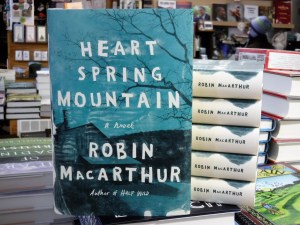
That said, MacArthur doesn’t label the book “cli-fi” but instead “a meditation on what we do with this spiritual malaise.”
“I wrote the first fragments of this book nine years ago when I was first becoming a mother. The concerns then were how to love and give of oneself and do so well. I picked the book up six years later and my concerns were different. All I could think about were the ailments of the world and how they were linked. How the machinations of capitalization had led to a loss of connection to one another and to the natural landscape, to the wisdom of our ancestors. At that point the question of the book became we are so broken, everywhere. How do we heal?”
The 368-page hardcover is set to debut this week with public readings Wednesday at 7 p.m. at Norwich Bookstore and Thursday at 6 p.m. at Brattleboro’s 118 Elliot, as well as events Jan. 20 at 6 p.m. at Manchester’s Northshire Bookstore and Jan. 27 at 7 p.m. at Putney’s Next Stage Arts Project.
Library Journal may sum up her novel as “soberingly relevant,” but the book also contains what Kirkus Reviews calls “a sliver of optimism.”
“We find community and connection where we are,” MacArthur says. “We find communion in the most old-fashioned of ways — with food, and wine, and music, and art and candlelight. Ultimately, this is a story about hope. Dark times are here, and more dark times await us, but love and connection and resiliency can be found, and will hold us when they are.”
