

(This story by Nora Doyle-Burr was published by the Valley News on Jan. 6, 2018.)
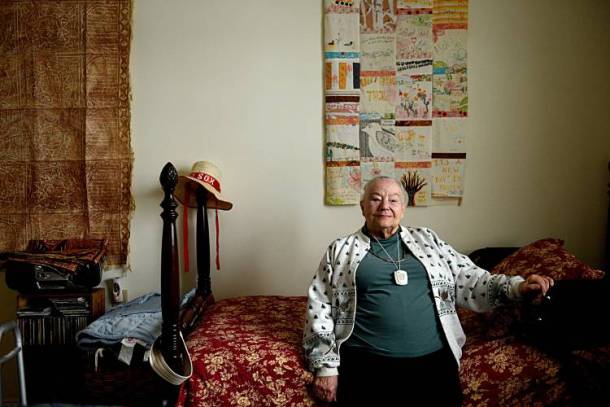
[W]ILDER — A combination of medications including Tylenol and a muscle relaxant has enabled Shirley Griggs, an 89-year-old retired nurse educator, to manage her chronic back pain, which stems from a car accident more than two decades ago.
Recently, however, her pain has worsened, which she thinks might be related to her bones becoming more brittle. On the advice of her providers at Dartmouth-Hitchcock Medical Center’s Pain Management Center, Griggs this fall sought to participate in Vermont’s medical marijuana program in hopes that she might reduce her pain without resorting to opioids.
“I don’t want to go on opioids because I don’t want to change the way I think,” she said in a recent phone interview.
On the other hand, she said, “I don’t believe in people being in pain.”
But she halted her application process to the Vermont Marijuana Registry at the request of officials at Valley Terrace, the Wilder assisted living facility where she lives. They fear that their federal funds might be threatened should residents participate in the program.
Griggs, who said she has never used marijuana intentionally but “had a cookie or two inadvertently when the kids were home,” said she wants to follow the rules.
“I don’t want to do it without their thinking it’s all right,” she said.
Griggs is not alone. Although medical marijuana is legal in both New Hampshire and Vermont, a number of obstacles stand in the way of some who wish to use it, including the conflict between state and federal law, a hesitancy among some doctors to recommend it, and a limited number of dispensaries where it is available.
Despite the fact that 29 states have legalized its medicinal use, marijuana is listed by the federal government as a Schedule I drug, meaning there is “no currently accepted medical use and a high potential for abuse,” according to the Drug Enforcement Administration’s website.
Possession of the drug, however, has been decriminalized in several states, including all of New England. Marijuana is still illegal in most states, but residents in some, including Maine and Massachusetts, have voted to legalize recreational marijuana. Vermont may soon follow if a bill to that effect, which the Vermont House approved on Thursday, becomes law.
Though research into marijuana’s potential medical benefits and risks has been limited due to the drug’s illegality, the chemicals it contains — or cannabinoids — have shown some benefits.
Tetrahydrocannabinol, or THC, which produces the euphoric high, can increase appetite and reduce nausea, according to the National Institute on Drug Abuse. Cannabidiol, or CBD, which does not have a psychoactive effect, may be useful in reducing pain and inflammation, controlling epileptic seizures and possibly treating mental illness and addictions, according to the institute.
As of last month, 5,310 patients in Vermont and 4,750 patients in New Hampshire had registered with their states’ respective medical marijuana programs. To participate, people must have a health care provider sign a form stating that the patient has a qualifying condition such as chronic pain, cancer or HIV/AIDS.
But as Griggs’ example illustrates, there may be more people who would like to take advantage of the programs who cannot because of the conflict between state and federal laws.
Terrace Communities, a company based in Manchester Center that operates assisted and senior living facilities in Vermont including Valley Terrace, does not allow the use of medical marijuana, said Terry Berube, who is vice president of residential services for the company.
“It’s not something that we are doing at this moment,” Berube said, noting that marijuana is still illegal under federal law.
Terrace Communities is not alone in confronting this challenge.
“We’ve heard of issues with access at these facilities,” said Lindsey Wells, the administrator of Vermont’s marijuana program. “I would say that it’s infrequent.”
While preventing access to a state program might seem like a health care access issue, Wells said there is no requirement that facilities allow residents to participate and they are within their rights to establish their own policies.
Role of dispensaries
One of the challenges people seeking medical marijuana on the Vermont side of the Upper Valley might run into is that there is no dispensary closer than Montpelier or Brattleboro, Wells said, though Hartford may soon become the site of a satellite dispensary.
Dispensaries in Vermont, however, can under the law deliver marijuana products to people participating in the program. But that might not help residents of assisted living facilities, Wells said, because she suspects they wouldn’t allow delivery.
Another challenge is that nurses at these facilities are often responsible for dispensing medication to residents, Wells said. Doing so means the nurses might be inclined to take possession of the marijuana, place it in a lockbox and treat it like a “regular medication,” she said.
But “it’s not a medication,” she said. “It’s a hard thing for them to deal with.”
Medical marijuana in either state is not prescribed by a health care provider. Instead, providers fill out a form certifying that a patient has a qualifying condition, and that document goes to a state registry for approval. Patients and caregivers then receive cards that allow them to procure marijuana at a dispensary.
Dispensaries provide program participants with marijuana in its plant form that can be smoked; they also offer a wide range of other products containing different levels of THC and CBD, including capsules, patches, salves, lozenges, gummies, cookies and chocolate.
Conflicting policies
Concern about the financial consequences of flouting federal law is not isolated to operators of assisted living facilities in Vermont. It is shared by other institutions in New Hampshire and Vermont that receive federal funds, including nursing homes, federally qualified health centers, the Veterans Health Administration, hospitals and federally subsidized housing.
Because nursing homes are federally regulated and surveyed, they “would be at risk of losing their ability to serve Medicare and Medicaid residents were they to allow the use of an illegal Schedule I drug by residents,” said Brendan Williams, the CEO of the New Hampshire Health Care Association.
Officials at the Centers for Medicare and Medicaid Services are not aware of any “facility that has specifically lost funding or been penalized for permitting the use of medical marijuana,” Courtney Jenkins, a CMS spokesperson, wrote in an email Friday.
The agency, however, has issued citations in situations that could be related to medical marijuana such as fire safety issues caused by smoking marijuana in a resident’s room and safe storage of medicines, Jenkins wrote.
CMS, however, would cite a facility if another agency, such as the Department of Justice, found that a facility was out of compliance with federal law, Jenkins wrote.
U.S. Attorney General Jeff Sessions has indicated he intends to enforce federal law as it pertains to marijuana, Williams noted in his email.
On Thursday, news broke that Sessions would rescind an Obama-era memo that directed federal attorneys not to stand in the way of states that legalize marijuana, as long as state officials prevented the drug from migrating to places where it remained outlawed, such as federal property, and out of the hands of criminal gangs and children.
By rescinding that 2013 memo, Sessions will allow U.S. attorneys across the country to decide which federal resources to devote to marijuana enforcement based on what they see as priorities in their districts, The Associated Press reported Thursday.
The federal law means providers at federally qualified health centers and the White River Junction VA Medical Center are not allowed to sign the forms required for people to participate in their respective state’s medical marijuana program, said Jessa Barnard, the executive vice president of the Vermont Medical Society. Health centers in the Upper Valley include Gifford Health Care based in Randolph, Springfield Medical Care Systems, and Little Rivers Health Care in Bradford, Wells River and East Corinth.
In May, Secretary of Veterans Affairs David Shulkin — a physician — said of medical marijuana: “My opinion is, is that some of the states that have put in appropriate controls, there may be some evidence that this is beginning to be helpful. And we’re interested in looking at that and learning from that.
“But until the time that federal law changes, we are not able to be able to prescribe medical marijuana for conditions that may be helpful.”
Hospitals are often reliant on federal funds and federal surveys to continue to operate, so when people participating in a medical marijuana program are admitted, they may not be allowed to continue to consume cannabis products, said Dr. Gilbert Fanciullo, an emeritus professor of anesthesiology at Dartmouth’s Geisel School of Medicine. He is board certified in pain medicine and hospice and palliative care and is affiliated with Prime Alternative Treatment Center, a marijuana dispensary in Merrimack, New Hampshire.
Such is the case at Dartmouth-Hitchcock Medical Center where, according to the hospital’s policy, patients who have medical marijuana are required to hand it over to hospital officials for safekeeping during their stay, said spokesman Rick Adams.
Patients “can’t walk around with a bag in your pocket,” Adams said.
The drug, in whatever form the patient possesses, is returned upon discharge, he said.
Fanciullo, like Williams, also said it remains unclear what the federal government’s response to state medical marijuana programs will be. As a result, providers have to be careful. “Think about what you could lose,” he said.
Owners of federally subsidized housing are also concerned that openly allowing residents to participate in medical marijuana programs could jeopardize their funding.
Andrew Winter, executive director of Twin Pines Housing Trust in White River Junction, said his organization has a policy about the use of medical marijuana on its properties, but it’s unwritten due to the discrepancy between state and federal law. He declined to detail the substance of the policy, but did note that Twin Pines’ buildings are smoke-free, so residents are not allowed to smoke any substance.
Navigating a gray area
Despite the issue of federal law, Williams said, health care providers want to do what they can to help patients get access to a therapy that might be helpful. “Most providers that I know wouldn’t begrudge any form of palliative care, and I personally saw the benefits of medical marijuana in easing chemotherapy symptoms and pain for a relative with fatal cancer,” he wrote.
Some providers have found ways to navigate this gray area. New Hampshire’s medical marijuana law allows facilities — assisted living, nursing homes, hospitals or hospice centers — to become certified to assist patients in the use of cannabis products. Facilities that do not rely on federal funds, such as those that only accept private-pay patients, might feel more inclined to allow marijuana use.
But Michael Holt, the administrator of the program, could not say how many facilities are taking advantage of this provision because the state does not track the number of facilities participating in the program and facilities are not required to participate, he said.
Other solutions might include having a family member regularly bring the cannabis product to the patient, Wells said.
“A lot of times it’s just trying to figure out the best way to handle it,” Wells said. “Some of (the facilities) are more willing to problem-solve with patients.”
Another option for Griggs might be to try a CBD product derived from hemp, which can be purchased legally, Wells said. But Griggs said she is hesitant to try such products without more information about the appropriate dosage.
For his part, Fanciullo, the New Hampshire dispensary operator, described CBD-based products that can be purchased online as “snake oil.”
All hope may not be lost for Griggs. Berube said leaders of Terrace Communities, spurred by requests from several residents, are discussing how they might allow patients to participate in the state program, without running afoul of federal law. She couldn’t identify specific residents due to medical privacy laws.
“I feel like it could probably help people, and that’s what we’re about,” Berube said. “… Right now, we have to abide by the laws.”
