


[T]he public safety communications project known as FirstNet has been criticized — even by some of the officials closely involved with it — as being shrouded in too much secrecy.
Now the leak of two consultants’ reviews of plans for the public safety broadband buildout has state officials and corporate lawyers scrambling to find the leaker and demand that the recipient of the leak return copies and not disseminate them further.
The reviews were aimed at advising Gov. Phil Scott whether to opt in or out of the plan to improve public safety communications that is being spearheaded by FirstNet, a program of the U.S. Department of Commerce, and the telecom giant AT&T. Scott announced Nov. 29 he had decided to opt in. Last week New Hampshire Gov. Chris Sununu announced his state would be taking the opposite course.
State officials and a lawyer for AT&T argue that the redacted materials encompass trade secrets and are proprietary and exempt from disclosure under Vermont’s Public Records Act. State Auditor Doug Hoffer questioned the exemption in an email. And a review of the redacted and unredacted reports by VTDigger indicates that at least some of the areas blacked out are not likely to be competitively sensitive but could cast the FirstNet-AT&T plan in a negative light.
One criticism of the FirstNet-AT&T plan is that Vermont could not seek redress from AT&T if it failed to deliver a robust public safety network that could withstand weather or other disasters. The contract describing the plan, which is secret even from state officials signing their states up to participate for the next 25 years, is between FirstNet and AT&T. If Vermont were dissatisfied with AT&T’s performance, its only recourse would be to complain to FirstNet, officials have said.
“Without a documented disaster plan and especially an escalation plan for outages, the state will be exposed to non-availability without authority to properly manage the vendor,” the fine print in the report reads.
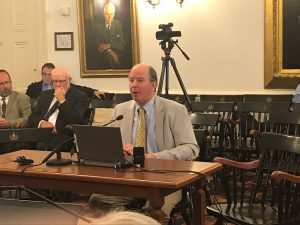
The extraordinary battle over the documents began Nov. 29, at a meeting of the House Energy and Technology Committee. Stephen Whitaker, a frequent critic of Vermont’s telecommunications development efforts who has been trying to scuttle the state’s current FirstNet plan, approached the committee and tried to hand its chairman, Rep. Stephen Carr, an unredacted copy of the consultant’s report that he said he had obtained from a confidential source.
John Quinn, the state’s chief information officer and secretary of the Agency of Digital Services, objected, warning that the unredacted report contained trade secrets, and that releasing it could put the state at risk of a lawsuit.
Carr, a Democrat from Brandon, then refused to take the copy of the report Whitaker tried to hand him.
“This email is to address the recent leak of a(n) unredacted copy of an independent review (IR) on the FirstNet decision to Stephen Whitaker,” Quinn wrote. “The release puts the state at risk of a lawsuit with financial (consequences). You are in this email because you are one of just a few people to have received a copy of the report.”
Quinn then admonished the leaker, demanded the person step forward and said the attorney general’s office, which frequently investigates and prosecutes criminal behavior, would be involved in the response.
“It is not up to any of you to decide what is released and what is not,” Quinn wrote. He added that Broadband Commission Chairman Terry LaValley “was very clear that the report was not public and the specific reasons that the IR (independent review) was withheld. … If you were the one who turned over a copy of the report, I would appreciate an email letting me know. We can work with the AG’s office on the circumstances of why you released the IR.”
Quinn’s message also contained an unusual element of transparency jiujitsu. The Vermont Public Records Act most often is used by members of the media and public who want information on government activities so they can cast a critical eye on them. In this case, Quinn said he expected the law to be used to shut down the flow of information by exposing the whistleblower.
“I fully expect a public records request of all commission members and members with access to the report, to turn over any communication between commission members and Stephen Whitaker,” Quinn wrote. “You are all subject to the records law as a commission member.”
Quinn said Friday the whistleblower’s identity remained undetermined. He said “each person on the email (recipient list) wrote back and assured me that it wasn’t them. No one came forward.”
Quinn’s Monday email was followed two days later by a letter to Whitaker from Vermont’s largest corporate law firm, Downs Rachlin Martin. Attorney William Dodge, representing AT&T, wrote that “we have learned you are in possession of an unredacted report commissioned by the Vermont Agency of Digital Services … regarding FirstNet.”
“Legally you should not be in possession of, or use, this information without permission from AT&T, which has not been granted,” Dodge wrote. “We are concerned that you may disclose (if you have not already done so) the unredacted report to the media, including VTDigger. In light of the trade secret and proprietary information contained in the unredacted report, we insist that you immediately take the following steps:”
The steps included making no more use of the report, destroying any copies and refraining from disclosing any information from the report.
Hoffer, the state auditor, responded to Quinn’s email with apparent annoyance.
“I can assure you, I did not share the document with Mr. Whitaker,” Hoffer replied to Quinn. “I know you’re just doing your job, but I’m disappointed that you felt it necessary to include me in this email because I deal with confidential data regularly and take that public trust very seriously.”
“BTW (by the way) — For the record, having read the report, I really don’t understand why it is deemed confidential at all, but that’s not my call,” Hoffer wrote.
