

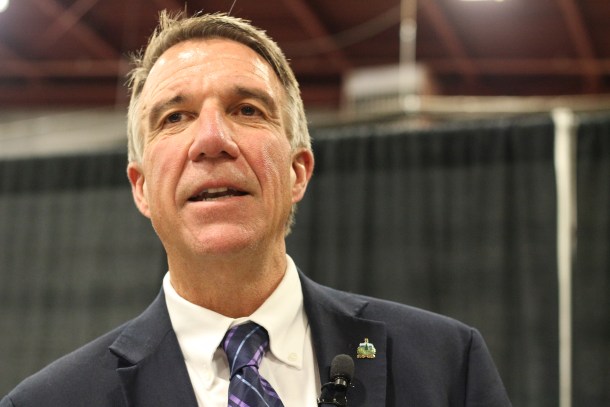
[T]hirteen days after a legislative lawyer warned that it would be an unconstitutional encroachment on the General Assembly’s authority, Gov. Phil Scott made a unilateral decision about the future of public safety communications in Vermont anyway.
And interviews with key lawmakers — along with two instances of inaction by a House committee last week — indicate the Legislature isn’t going to do much about it.
Scott’s office announced Wednesday that the governor had decided the state would join FirstNet, a federal project in conjunction with telecom giant AT&T to strengthen public safety communications around the country. Scott’s decision followed an opinion from Jaye Johnson, the governor’s counsel, that he was within his rights to act unilaterally.
States had been invited to opt in or choose to use federal grant money to find their own vendor and build their own public safety networks, providing they met the standards of the federal program. Critics of the AT&T proposal had complained that too little was known about what the company was offering, due to secrecy surrounding the project, and that the national project might not meet Vermont’s needs.
FirstNet is expected to encompass $100 million or more in spending in Vermont during the next 25 years to strengthen and expand existing cellphone and broadband coverage. Police, fire and other first responders will be given priority, but regular users are to be allowed access to the network between emergencies.
Vermont had been expected to opt in. There were strong incentives to do so, including what a confidential FirstNet document showed were penalties of up to $173 million if Vermont opted out and then failed to build a system up to federal standards.
The eight-member panel met again Thursday with a quorum of five members present. It voted 3-2 against opting in, and 3-2 against opting out, effectively deciding to take no action. Committee Chairman Stephen Carr, D-Brandon, cast the tie-breaking no vote both times.
Carr explained in an interview it is the job under Vermont law for the Joint Fiscal Committee, not his panel, to review decisions made by the governor when the Legislature is not in session.
But Joint Fiscal Committee Chairwoman Janet Ancel, D-Calais, said her panel was unlikely to take action either. She said the committee goes into action in the legislative off season only when the governor notifies it that there is a financial decision to be made — for example, about acceptance of a grant.
“We don’t have a plan to meet at this point,” Ancel said Thursday. “I think I would be waiting for someone to set this in motion.”

Royle wrote that “a decision by the governor to either opt in or opt out, without the opportunity for legislative review, would unconstitutionally contravene the legislative authority of the General Assembly.”
The governor’s office learned of Royle’s opinion on Nov. 20, said Scott’s spokeswoman, Rebecca Kelley.
Johnson, the governor’s counsel, or chief lawyer, replied in a memo to the Senate that the governor has the authority to act alone.
Johnson wrote that the governor’s job entails corresponding with other governments’ officials. “A decision to opt in does not commit State resources; there is no contract between the state and FirstNet. There is no appropriation required,” she wrote.
Scott’s decision came after a recommendation by the Vermont Public Safety Broadband Commission that the state opt in.
Kelley said, “Gov. Scott made his decision based on what was in the best interest of Vermont and came to that determination based on the recommendation of the (broadband) commission.”
Former Gov. Jim Douglas, too, had been pushing hard for Vermont to join the FirstNet program. Douglas, like Scott a Republican, is a member of the national FirstNet board and has appeared in YouTube videos promoting the project. Last week after Scott’s announcement, Douglas said FirstNet is “a win-win-win for the state, its public safety community, and everyone who lives, works or visits in Vermont.”
