

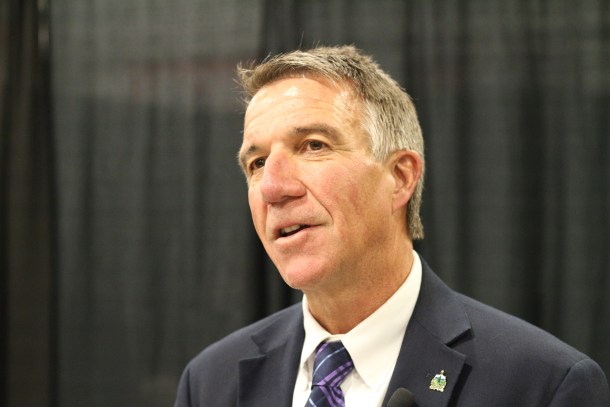
[G]ov. Phil Scott announced Wednesday that he had decided the state will join a national program headed by a federal agency and telecom giant AT&T to strengthen, expand and streamline communications among first responders.
“It is important that Vermont’s first responders have the best service and access to an interoperable network that is expected to advance and adapt with new technology through the next 25 years,” Scott said in a statement issued by his office after a legislative committee meeting in which the panel was told of the decision.
“Vermont faced the choice of building its own network or using the federal solution,” the governor said. “After thoroughly considering the technological, financial and operational aspects of both options, I believe the federal plan will more quickly and sustainably provide our public safety community with the network it needs to continue its valuable service to Vermont.”
Vermont would have been eligible for up to $25 million in federal aid to build its own network with the vendor of its choice.
Scott’s announcement came a month ahead of the state’s deadline for making such a decision. It was announced to the House Energy and Technology Committee as the panel began a hearing at which it was expected to weigh whether to recommend that Vermont opt out of the plan drawn up by the federal FirstNet program and AT&T.
Committee members expressed surprise at the announcement, coming as it did before the deadline FirstNet and AT&T officials faced to answer detailed questions from Rep. Peter Welch, D-Vt. Those questions followed a Nov. 1 hearing of a U.S. House subcommittee on the FirstNet plans, of which Welch is a member. Welch had said his goal was to provide the maximum available information to Scott and other state officials.
A lack of sufficient information has been a constant concern among critics of the FirstNet-AT&T plan. Members of the Vermont House committee continued to focus questions Wednesday on the fact that the contract between FirstNet — a program of the U.S. Department of Commerce — and AT&T has never been made public, so state officials can’t be certain what they’re to get under the program.
Scott’s decision also came 13 days after a staff attorney with the Legislative Council, which provides legal research and analysis to the Legislature, questioned in a legal memo whether the governor can make the decision unilaterally. Scott’s announcement before that question was resolved was seen as setting up a possible separation-of-powers confrontation between the legislative and executive branches.
“There is no explicit delegation of decision-making power to the governor in either the Vermont statutes or the Constitution authorizing him to act unilaterally here,” wrote the legislative lawyer, Maria Royle, in her legal memorandum.
John Quinn, secretary of the Agency of Digital Services, who provided the legislative committee the news of the governor’s decision, said in an interview outside the meeting that FirstNet officials had urged a quick decision, saying AT&T would build more cellular towers in Vermont than planned, if the decision could be made by the end of November.

He agreed that the offer appeared to be a pressure sales tactic and said it helped spur the governor’s quick decision, a week after a special state commission recommended Vermont opt in.
“It’s my understanding the governor felt comfortable enough with all the information that he had that he was able to make the decision and keep the sweetener, keep the additional towers,” Quinn said.
The genesis for a national, streamlined public safety communications network came on Sept. 11, 2001, when police and firefighters responding to the attacks that day had difficulty communicating with one another. It was a recommendation of the 9/11 Commission that investigated the attacks; Congress passed a law to set up the program in 2012.
States were told they could opt out of the national network and use federal grants to build their own that could be linked with it. But there were numerous incentives to opt in — some so powerful that critics charged they essentially amounted to bullying by AT&T and the federal program.
One incentive was the threat that if Vermont built a public safety network of its own that failed to meet FirstNet’s standards, the state could face up to $173 million in penalties imposed by the federal government.
That possibility prompted State Treasurer Beth Pearce to express, both in a letter to the special Public Safety Broadband Commission and in testimony to the committee Wednesday, deep reservations about Vermont opting out. She argued that a potential liability of $173 million could hurt Vermont’s credit rating.
But Brian Carney, a vice president with Rivada Networks, a company that had hoped to compete for the work of building Vermont’s network, told the legislative committee that that threat was specious. “There’s no financial risk” of opting out, other than AT&T withdrawing the sweetener of the extra six towers, Carney said.
