

[W]ASHINGTON — With details of Republican tax plans still in flux in Congress, Vermont officials and advocates are watching warily for potential negative impacts on programs dear to them.
Stakeholders from a variety of constituency groups in Vermont are watching to see whether certain provisions make it into the final package — which they say could have big implications for health care, affordable housing, higher education and more.
At a weekly press conference Tuesday, Senate Republican leadership hit back at Democratic criticism of the proposals.
“The fact is very simple that middle income families are going to receive tax relief as a result of this tax reform bill,” Sen. John Thune, R-SD, said, citing the proposals to double the standard deduction, expand the child tax credit and more.
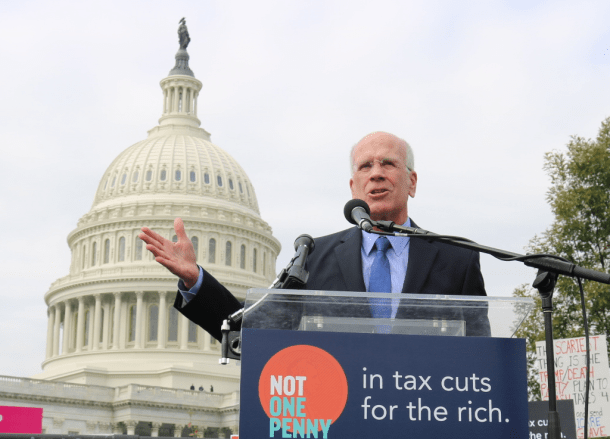
Democrats contend that many items proposed as part of the Republican legislation will end up increasing taxes for many Americans, as Rep. Peter Welch, D-Vt., said at a rally against the bills on the Capitol lawn Wednesday.
“President Trump, I know you like oligarchs,” he said to cheers. “What do you got against students?”
Welch argued that a number of provisions in the bill will increase the financial burden on students, such as eliminating a deduction for student loan interest.
Welch also criticized House Speaker Paul Ryan for what he says is a lack of transparency.
“This bill was written in secret,” Welch said.
The House is expected to vote on the tax bill later this week. The Senate is poised to vote on its version after Thanksgiving. Republicans in Congress and the White House hope to pass a final bill by the end of the year.
Vermont Tax Commissioner Kaj Samsom said state officials are waiting for a clear package to take shape to fully project the implications for the state.
Vermont state revenue may be affected by one of the core components of the GOP proposal — the doubling of the standard deduction for people who itemize their taxes.
About a third of Vermonters itemize deductions now, according to the Tax Department. The state expects that to decrease to 15 percent with the change proposed by Republicans in Congress.
Initially Samsom anticipated that Vermont could see a decrease in state revenue as a result of that change because it decreases Vermont taxable income. However, based on other proposed changes, it’s possible that there would be an increase in Vermont taxable income overall, he said.
When it comes to the impact the proposals will have on Vermonters, Samsom said it is hard to predict how different families’ tax bills will change because there are a number of factors up in the air.
“It’s going to be all over the map,” Samsom said.
Vermonters may see their federal tax bills go up or down in different ways depending on how many children they have, what their property tax burden is, whether they itemize, and other elements, he said.
Stephanie Yu, a policy analyst at the Montpelier-based Public Assets Institute, referred to models that show that the bulk of tax cuts would go to the wealthiest people in the state.
“Vermonters at the top are going to do better and everyone else, not so much,” Yu said. “The whole package is just tilted towards higher-income people and corporations.”
A report by the Institute of Taxation and Economic Policy found that the richest 1 percent of Vermonters would get a tax cut of about 2.7 percent of their income in 2027 if the House plan is enacted. The poorest 20 percent of Vermonters would see their taxes reduced by 0.6 percent that year.
The Senate bill would similarly provide a larger portion of tax cuts to the wealthiest people in Vermont, according to the institute.
Republicans in Washington have bristled at the conclusions drawn by analysts.
White House Budget Director Mick Mulvaney told reporters Tuesday morning that he is wary of reviews of the tax bill, saying that groups bring their biases to their reports.
“We don’t put much credence in the larger studies from the groups that we know don’t like what the president’s trying to accomplish,” he said. “There’s a lot of people that have a vested interest in seeing this fail.”
Asked about disparate impacts that the tax bill could have across state lines, Mulvaney argued that the Republican plan will make taxes more fair across the country.
“As a taxpayer I don’t really care what my state gets, right? I care about my taxes… And one of the things I should care about I think is (making) sure what I’m paying in taxes is fair.”
Mulvaney said that the White House is willing to back most packages Congress is considering, so long as the final bill achieves the core objectives of lowering and simplifying taxes for “ordinary Americans,” and reducing the corporate tax rate to 20 percent or lower.
“As long as those two things are preserved, we’re inclined to support anything,” Mulvaney said.
According to experts in different industries in Vermont, provisions that are on the table in one or both chambers could have significant reverberations.
Private Activity Bonds
Organizations in Vermont focused on affordable housing, higher education finance and economic development have raised concerns about a provision in the House bill that would remove the tax-exempt status of private activity bonds.
Scott Giles, president of the Vermont Student Assistance Corporation, said the bonds are “a core part of our practice.” VSAC uses bonds in order to make loans available for students in Vermont.
Under current law, the interest on the bonds VSAC issues is tax exempt, and therefore investors are willing to pay a lower interest rate. Giles said that the savings there get passed on to students and families who borrow for higher education.
Giles estimated that removing the tax exempt status would increase interest rates for students paying back loans by 1 percent nationally.
Removing the tax-exempt status may also have big implications for affordable housing too, some argue.
According to a memo compiled by Vermont Treasurer Beth Pearce’s office, the Vermont Housing Finance Agency uses bonds as a source of money for its programs that help people purchase homes and increase access to affordable rentals.
Other groups said bonds that would be affected by the tax changes support a range of projects, including construction of education and health facilities.
The Senate bill currently does not make any changes to the bond interest tax-exempt status. It’s not clear whether the proposal will make it into the final package.
Higher education
Other provisions would affect higher education finance, too, according to Giles.
The House bill eliminates the deductibility of student loan interest, which, under current law, allows people paying off their education loans to deduct up to $2,500. The Senate bill does not change the policy.
According to the Vermont Tax Department, about 50,000 Vermonters use this deduction.
People who get tuition benefits because a family member works at a university and graduate students who have tuition waived would have to pay taxes on the full tuition amount under the House bill.
The bill the House is considering would repeal a lifelong learning tax credit, which tends to be used more by adults who are taking training or professional development courses.
“This bill would eliminate or reduce some of the tax provisions that help make education more accessible and affordable,” Giles said.
Housing
Meanwhile, housing advocates say changes proposed in the bills could have major impacts.
Erhard Mahnke of the Vermont Affordable Housing Coalition said initiatives to increase housing stock in Vermont communities could be hindered by the elimination of the new markets tax credit and the historic rehabilitation tax credit.
Other factors, such as reducing the corporate income tax, could weaken the low income housing tax credit, according to the coalition.
Mahnke said that the changes to the federal programs could mean the $35 million housing bond the Legislature approved and Gov. Phil Scott supported earlier this year will not go as far as anticipated.
“I think the overall impact on all of these is a one, two, three punch basically,” Mahnke said.
Health care
Senate Republicans signaled Tuesday that they plan to include a repeal of a key provision of the Affordable Care Act in their bill.
Republican leadership argues that repealing a mandate that requires Americans to pay a tax penalty if they do not purchase health insurance would reduce a burden on low-income people who may not get health care because they can’t afford the plans.
Vermont health officials say that repealing the law could result in fewer people enrolling in health care plans — particularly people who are younger and healthier. With those people out of the pool, health care plan costs may go up.
Any changes “could have an impact on the number of Vermonters who have health care and how many are uninsured and what the costs of health care are for everybody else,” a deputy director at the Department of Vermont Health Access said Wednesday.
Sen. Bernie Sanders, I-Vt., joined Democrats in slamming the GOP-led move.
“They want to make massive cuts to Medicaid, throw 13 million Americans off of health insurance and substantially raise premiums in order to provide even more tax breaks to their wealthy campaign contributors and the top one percent,” Sanders said in a statement. “The last thing we should be doing is providing tax breaks for billionaires paid for by throwing millions of Americans off of health insurance and raising premiums on middle class Americans.”
