

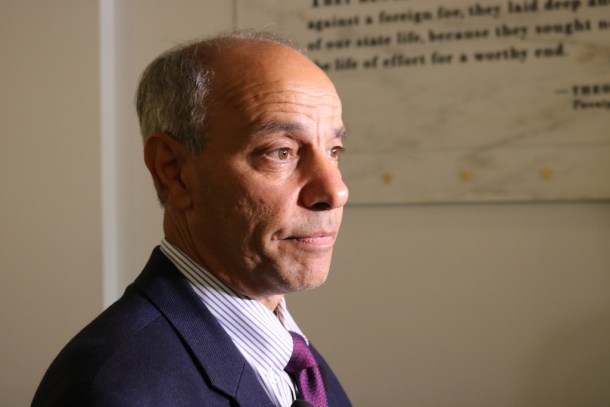
Adam Greshin, the commissioner of the Department of Finance and Management, told lawmakers Thursday that the state will likely face a $45 million gap between state revenues and expenditures in the coming budget cycle.
In the first round of budgeting, Greshin has asked departments and agencies to level fund expenditures next year. While revenues have matched the forecast provided by state economists, overall growth in tax receipts has been slow. Sales and use and meals and rooms taxes have been up by 4 percent, income taxes have grown by 1 percent. The outlier is the corporate tax which has been running below expectations, Greshin said.
Meanwhile budget pressures continue to increase. Greshin says retirement obligations, debt service, anticipated increases in state workforce pay and increases in public education costs.
“Revenues are doing what we thought they would do, they are growing slowly some might argue more slowly than you might anticipate after the 8th and 9th year after the recession,” Greshin said. “The gap is because expenses are growing at a faster pace than revenues.”
So far, this fall as departments prepare budgets for the coming year most decisions have been “reasonable,” he said, but some have been “rugged.”
“We’re trying to shape a budget that could be challenging within the revenue growth we have,” Greshin said. “We’re thinking we’re going to have some hard discussions over the next three to four weeks.”
Greshin says departments are using the governor’s priorities — affordability, economic development and protecting the most vulnerable — as guiding principles for the budget. He also said the Scott administration wants to shore up the state’s mental health system and clean water initiatives as part of the Lake Champlain clean up efforts.
One of the big unknowns is how much of an increase there will be in state workers pay. The union, the Vermont State Employees Association, and the Scott administration are in contract negotiations and have entered into mediation. Both parties anticipate they will not find agreement and will have to go to fact-finding and a Labor Relations Board decision.
“Our hope is we will enter the new year with certainty, but we have not been able to reach agreement with the union and we are currently in mediation,” Greshin said.
The Scott administration will not hold public hearings on the budget this fall. Over the past four years, the Shumlin administration held televised public meetings.
Matt Riven, the deputy commissioner for the Department of Finance and Management, said attendance at the hearings was low and the meetings were an administrative burden for the department. Instead, the Scott administration is encouraging citizens to submit comments about the budget process by email.
Rep. Bill Lippert, D-Hinesburg, is concerned about the state maintaining an open process.
“The public approaches us because they believe we have the ability to shape the governor’s budget, which is a misnomer, we don’t have much input,” Lippert said. “I’ve been approached in a number of settings around the continued crisis in the mental health system.
“Much of our public counts on advocacy groups to be their voice,” Lippert said. “I want to caution us not to minimize those voices as we try to set our priorities.”
Greshin told lawmakers that the Scott administration has found $5 million in savings in the current budget. Most of the reduction, about $1.8 million, is in efficiencies found in the workers compensation program. Other savings have come from an overage in the Low Income Heating Assistance Program of $520,000 and a variety of cuts.
