(“Then Again” is Mark Bushnell’s column about Vermont history.)
[T]he case of Lucille Miller raises difficult questions. Was she the victim of a government trying to suppress her radical, often fringe, political beliefs? Or did her illegal behavior justify the rough treatment the government meted out? Was her persecution an inevitable result of her stances, or a reflection of the times in which she lived?
The Bethel woman came to national prominence, albeit briefly, during the 1950s. The McCarthy era was in full swing, with arch-conservatives claiming to have uncovered communists trying to infiltrate every level of American society.
Miller eagerly joined the fray. She was certain that a communist nexus existed in the Bethel-Randolph area, where she had grown up and was then raising a family. She alerted Westbrook Pegler, a conservative columnist for the national Hearst newspaper chain, about her concerns. Soon Sen. Joe McCarthy, R-Wis., was warning the nation that communists had even made inroads into staid old Vermont.
Miller was particularly concerned about the presence of Owen Lattimore, an expert on China for the U.S. State Department who had been accused of intentionally “losing China” to the Communists. Lattimore and others were accused of sympathizing with Mao and the Communists and helping them defeat the U.S.-backed Chiang Kai-shek.
Lattimore and his wife had bought a farm in Bethel with Vilhjalmur Stefansson, an Arctic explorer also accused of having communist leanings. The FBI put the farm under surveillance and began opening Lattimore’s mail.
When the Senate initiated hearings into Lattimore, he and his wife were forced to sell their share of the farm to pay their legal bills. Stefansson found a buyer for Lattimore’s share, but unfortunately for Lattimore the buyer had actual communist leanings. Lattimore tried to back out of the deal, but it was too late, and his accusers used the sale as evidence against him.
Miller began writing letters to the editors of various newspapers, attacking people she believed were communists. Soon anti-communists from around the country began writing letters of encouragement to her.
This correspondence convinced Miller to find a new outlet for her beliefs. If she were alive today, Miller might have become a blogger. But since this was the 1950s, she created a newsletter, the Green Mountain Rifleman. Her dispatches were spare — usually just a page or two of typed text, which she and her husband would mimeograph and mail to a list of about 500 like-minded people across the country.
The Millers used the Rifleman to hammer away at the issue of communism but also highlighted other issues, particularly those where they suspected conspiracies were at work. They voiced their opposition to the United Nations, the supposed infiltration of the U.S. government by a Jewish communist cabal, the proliferation of nuclear weapons and the use of fluoride in public drinking water.
Miller’s strong beliefs eventually ran her into trouble with the authorities. But it wasn’t her writings in the Green Mountain Rifleman that sparked the confrontation; it was her private letters to young men, counseling them to resist the draft. Though these men would fight against communist North Korea, Miller hated the idea of their fighting as part of a U.N. coalition.
“Beneath the blue UN flag, American soldiers have marched to their death for no purpose except to carry out the policies of the Blue Communist conspirators,” she wrote in the Rifleman. She believed there were plenty of communists to confront right here in Vermont.
Unfortunately for Miller, a federal grand jury believed her actions violated the federal military draft law, which made it a crime to urge anyone to dodge the draft. The panel indicted her on 18 counts.
Miller’s case, which started with hearings in Burlington and ended with a trial in Brattleboro, was overseen by U.S. District Judge Ernest Gibson Jr., a decorated war hero, former U.S. senator and former Vermont governor. Gibson must have found it awkward to hear the case. He had been the target of some of Miller’s written attacks. Then again, Miller had accused everyone from Vermont superintendent of schools John Holden to President Dwight Eisenhower of being either a communist or a sympathizer.
Miller, acting as her own lawyer, argued that the military draft was unconstitutional. Her behavior in court alarmed Gibson, who ordered her sent to the Brattleboro Retreat for psychological evaluation.
When Miller returned, she faced another competency hearing. This time, according to one press report, two psychiatrists, including Retreat Superintendent J. Butler Tompkins, testified that she was “insane (but) capable of understanding the charges against her.” They classified her as suffering from a manic-depressive condition, which they believed was recurrent. Tompkins recommended she be removed from “stimulative conditions” and given sedative baths and electroshock treatment.
Gibson ordered Miller sent to St. Elizabeth’s psychiatric hospital in Washington, D.C., for further evaluation. On May 2, 1955, federal marshals arrived in Bethel to take her there. Miller’s husband, Manuel, met them, brandishing a rifle, and ordered them to leave. The marshals bided their time, waiting 12 hours before firing tear gas into the home and forcing the Millers out.
Marshals took both Millers into custody. Manuel Miller was charged with resisting federal marshals. He was later convicted and served time in federal prison. (Bethel residents continued to trust him, however. Years later they elected him town moderator of their town meeting, a post to which they re-elected him annually over the course of 20 years.)
Lucille Miller was taken to St. Elizabeth’s, where she said many of the patients were given electroshock treatments. She, however, was not. In an open letter to the director of St. Elizabeth’s, Lucille Miller wrote that “this cruel punishment” would “break” people but “like a rubber hose leaves no external mark. Gibson and Tompkins said you would do this to me but you didn’t because Americans were watching you.”
Once officials at St. Elizabeth’s found her sane, she was returned to Vermont for trial. A jury found her guilty of all 18 counts of violating the military draft law. Judge Gibson ordered her to serve one year for each count but suspended the sentence and released her on probation.
Soon afterward, the Millers returned to publishing their newsletter, as they had promised to do, and kept publishing it until 1969.
While the court battle was raging, conservative publications cast the Millers, particularly Lucille, as victims of an overreaching federal government. They claimed the Millers were persecuted for their political beliefs and that Lucille Miller had been railroaded by a biased judge.
The American Civil Liberties Union, which has intervened on behalf of people across the political spectrum, declined to get involved in the Miller case. In its 1955 annual report, the ACLU explained that Lucille Miller had not been convicted for her political views, but for suggesting people dodge the draft.
The ACLU also rejected her claims that Gibson had shown bias, noting that Lucille Miller had never asked Gibson to recuse himself. Furthermore, the ACLU said Gibson had urged her to hire a lawyer.
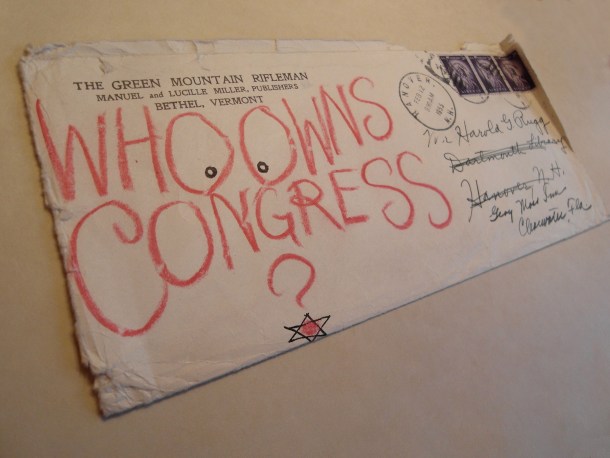
Issues of the Green Mountain Rifleman from this period now reside at the Vermont History Society library in Barre, thanks to collector Harold Rugg, who in 1953 persuaded Lucille Miller to send him copies. Rugg also donated the letters she wrote him.
She was suspicious of Rugg’s motives. In one letter, she asked how he was related to a Harold Rugg who had written “all those poisonous pro-socialist textbooks.” Rugg’s reply made it clear he was not that “Harold Rugg” and included his genealogy.
Lucille Miller was impressed: “(Y)our qualifications, as far as ancestry goes, were rather better than mine.” Most of her father’s family was from New Hampshire “or worse,” she wrote, “and therefore unacceptable to a xenophobe like me.” Although she remained wary of Rugg’s intentions, she was apparently willing to joke with him at times.
She continued to grill Rugg about why he wanted the newsletters, since he had never supported right-wing causes. She didn’t realize Rugg was a collector of historical items related to Vermont, so-called Vermontiana.
Ultimately, she decided to show Rugg she was “not afraid to take a chance” and mailed him a set of the newsletters.
“It is quite a chance I’m taking, too,” she wrote, “since you admit you are far from a right winger so how do I know you won’t file them thusly: FASCISTS, native, writings of … or, BIGOTRY, spontaneous upwellings of, or, LUNATIC FRINGE, as represented by pamphlets, and so on.”
Rugg told her he was going to donate the newsletters to the historical society and its director, Arthur Peach. Lucille Miller wrote back: “I hope Dr. Peach won’t turn green when he sees these Vermontiana. Have him file them in an asbestos lined file. You said the vaults were fire proof, which reassured us.”
Lucille and Manuel Miller knew their often-incendiary views would outlive them.