

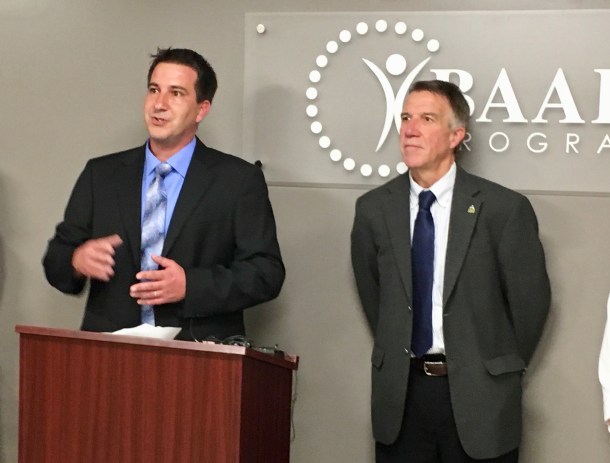
[S]T. ALBANS — A long-anticipated opiate treatment hub to serve Franklin County has roughly 235 patients a month after its opening, with more streaming in every day, according to its regional director.
Jason Goguen, with BAART Programs, said the clinic is accepting between 10 and 14 new patients per week. The site is capable of serving more than 700 people, but Goguen estimated demand would level off at close to 450.
For years, health officials and Franklin County politicians had bemoaned the lack of a drug treatment hub in the region. Then-Gov. Peter Shumlin first announced plans for a St. Albans hub in June 2016, suggesting at the time it would open in January.
At a news conference Thursday with Gov. Phil Scott, Goguen briefly alluded to “permitting issues” that had delayed the opening for months. He thanked Northwestern Medical Center CEO Jill Berry Bowen for allowing BAART to open a temporary clinic at the hospital in June.
That temporary fix allowed nearly 100 Franklin County residents to stop making daily trips, often via public transportation, to the hub clinic in South Burlington and an additional 40 to stop making the same trip to Newport for treatment.
At a September news conference, Scott had lauded the temporary hub at Northwestern as a major reason the Howard Center, which operates the South Burlington clinic, was able to largely eliminate its waitlist — previously the longest in the state.
Scott said Thursday that with the permanent hub in St. Albans continuing to add patients, Vermont is making good on its pledge to offer timely treatment to anyone seeking it.
“Ensuring timely access to treatment is important because it saves lives. People in treatment are much less likely to die of overdose,” Scott said.
Scott and representatives for Vermont’s congressional delegation, who also spoke at Thursday’s event, sought to strike a balance between lauding the state’s innovative hub-and-spoke treatment model — which was recently praised in a Vox article headlined “I looked for a state taking the opioid epidemic seriously. I found Vermont” — and acknowledging there’s more work to do.
The governor said several times, as he did during his September announcement about more timely access to treatment, that this too was “not a spike-the-football-in-the-end-zone moment.”
In response to reporters’ questions, Scott said he would support legislative efforts to provide greater access to medication-assisted treatment in Vermont’s prisons, though he did not provide specifics.
Advocates say Vermont’s policy — which allows treatment in prison only for those who were receiving it before being incarcerated, and limits its duration to 90 days — fuels overdoses when prisoners addicted to opiates are released.
Asked how Vermont might measure success in combating the opiate epidemic, BAART’s Goguen said for his organization, that’s best done case by case.
“It’s going to be different for everyone,” Goguen said. “If I have a gentleman that shows up here who has been using eight bags of heroin a day for 10 years, if in six months or a year from now he’s only testing positive for the drugs we give him, that’s success right there.”
With near-daily news coverage of the opiate epidemic, it’s easy to miss the many positive stories where people succeed in their recovery, Goguen said.
“We see it every day,” he said. “We see people who come in who are sleeping under the bridge, doing whatever they can for that next fix, and in a year from now — with help from our community partners — they’re stable, they’re providing for their family, they’re working, and most of all they feel like a human being.”
After that positive note, the next question reminded the room full of treatment workers, public officials and reporters of the stark nature of a still-deepening epidemic.
Winton Goodrich, superintendent of Franklin Northwest Supervisory Union, wanted to know what BAART’s policy is for treating minors.
Goguen said that in rare cases, teenagers younger than 18 show up for treatment at the clinic, but typically when that happens it’s a stopgap before a stint in a residential clinic, often out of state.
Those young people are generally in Department for Children and Families custody, and it requires approval by a parent or legal guardian, Goguen said.
Then the drug treatment program director made a sobering statement: “It’s not so much the 16- and 17-year-olds we’re seeing, but our population is getting younger — much younger.”
Goodrich said he attended Thursday’s news conference because he needs to be informed in order to communicate with students about what help is available.
Though he too believes people are starting to abuse opiates at younger and younger ages, raising awareness isn’t just to help students who might become addicted, but often their parent, older sibling or another family member.
There are 300 students in Franklin County who need foster or respite care in Franklin County – many due to DCF pulling them from homes of parents addicted to opiates, according to Goodrich. That’s nearly 4 percent of the roughly 7,750 public school students in the county.
“The more information we can get out, the better off everyone is going to be,” Goodrich said.
Correction: An earlier version of this story misstated the frequency that new patients are entering the St. Albans hub.

