

[W]ASHINGTON — Executives from Google, Facebook and Twitter testified before Congress Tuesday about their role in a massive internet misinformation campaign pushed by Russian propagandists to influence the 2016 presidential election.
The Senate Judiciary Committee grilled the tech giants about how their platforms were used by Russians to disseminate propaganda through fake news stories last year.
Senators complained that Google, Facebook and Twitter waited nearly a year to disclose the propaganda campaigns and the extent to which the companies profited from ads bought by Kremlin-linked companies.
American intelligence agencies have said that Russian President Vladimir V. Putin used propaganda on social media to sway the election in favor of Donald Trump, according to the New York Times.
The internet giants have been reluctant to accept responsibility for giving Kremlin-backed groups a platform to influence American elections. While executives were conciliatory at the hearing, few promises were made to prevent the phenomenon from happening again.
Sen. Lindsey Graham, R-S.C., who chaired the meeting, said, “You had a foreign government apparently buying thousands of dollars of ads to create discontent and discord in the 2016 election.”
“The bottom line is, these platforms are being used by people who wish us harm, and wish to undercut our way of life,” Graham said.
Representatives from all three companies acknowledged that entities associated with the Russian government used their platforms to spread posts and paid ads to American social media users last year. The posts occurred during the campaign, as well as after the election, apparently intended to stoke questions about the legitimacy of President Donald Trump’s victory, the three company officials confirmed under questioning.
“That foreign actors hiding behind fake accounts abused our platform and other internet services to try to sow division and discord and to try to undermine the election is directly contrary to our values and goes against every thing Facebook stands for,” Colin Stretch, general counsel for Facebook, told the panel.
Facebook bore the most scrutiny for its indiscriminate dissemination of fake news in last year’s election. More than 126 million users on the social media platform are believed to have seen inflammatory political ads bought by the Internet Research Agency, a Russian “troll farm” based in St. Petersburg. After the election, Facebook CEO Mark Zuckerberg has dismissed criticism that his platform gave Russia a vehicle for interfering in American politics as “a crazy idea,” according to the New York Times.
When the scope of the Russian propaganda campaign came to light 11 months after the election, Facebook promised Congress it would hire 1,000 people to review ads for political content and identify who is paying for the promotions, the Times has reported.
A bipartisan proposal under consideration would require Google, Facebook and Twitter to report who pays for political ads. Lobbyists are pushing to make that requirement voluntary.
Asked about the proposal Tuesday, none of the representatives committed to backing it.
Google, Facebook and Twitter make money on viral content, including fake news, and ads that can be purchased by anyone. Putting controls in place would be a shift in the business model for all three companies, which have allowed content to flow unfettered on their platforms.
Facebook alone has 5 million advertisers a month, and executives admitted at the hearing that the company does not track advertisers that post material on the platform. More than 1,000 videos were uploaded by the Internet Research Agency on YouTube, Google told the subcommittee. More than 131,000 messages from the agency were published on Twitter.
The three internet giants are not regulated by the federal government.
In a pointed exchange, Sen. John Kennedy, R-La., asked Google’s Law Enforcement and Information Security Director Richard Salgado whether the company is a media organization or a “neutral technology platform.”
Salgado responded that Google identifies as a technology platform.
Kennedy pressed on, noting the massive amounts of information transferred to users around the world.
“You don’t think you’re … the largest newspaper in 92 countries?” he asked.
“We are not a newspaper,” Salgado said. “We are a platform for sharing of information that can include news from sources such as newspapers.”
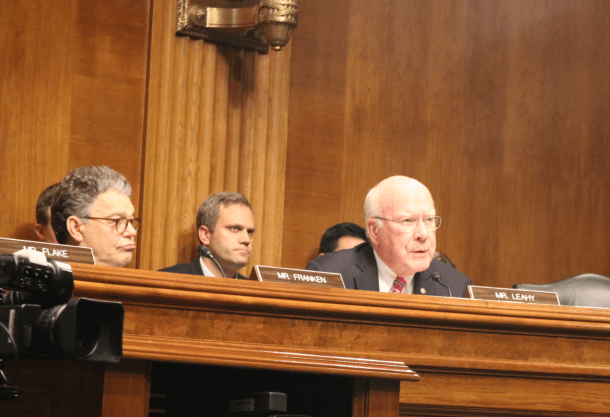
Sen. Patrick Leahy, D-Vt., criticized Facebook’s reluctance to address the problem. “There’s a lot I think you could have done earlier,” Leahy said.
Leahy shared a poster with images depicting a Confederate flag, a “Bernie supporters for Trump” logo, and other images, all of which resemble pages that were sponsored by Russia’s Internet Research Agency.
Stretch said “with absolute certainty” that none of those pages were sponsored by Russian government interests. Leahy countered that they look very similar.
Leahy also raised questions about more recent Facebook activity, questioning whether the social media platform is being used as a platform for spreading propaganda against the Rohingya, an ethnic group that has been the target of violence and killings in Myanmar.
Throughout the hearing, several senators raised questions about whether other countries, like Iran or North Korea, had similar operations targeting the American public over social media.
“It really is a global threat,” Stretch said.
Representatives from the companies did not identify other foreign interests. Stretch acknowledged such interference could be possible.
“Certainly potentially,” he said. “The internet is borderless.”
Sen. Chuck Grassley, R-Iowa, said the information sponsored by Russian actors did not consistently align with one political party.
“Russia does not have loyalty to a political party in the United States,” Grassley said.
Meanwhile, Sen. Ted Cruz, R-Texas, raised concerns that in cracking down on social media companies they would be targeting the content of a certain political party.
“The prospect of Silicon Valley companies actively censoring speech or the news content is troubling to anyone who cares about a democratic process with a robust First Amendment,” Cruz said.
Cruz asked whether the platforms were “neutral” public forums, citing a study that Democrats tended to have more positive and fewer negative results on the first page of a Google search.
Executives for Twitter and Facebook said their platforms are open to all discourse, within certain boundaries, such as hate speech.
Leahy left the hearing after his questioning to go directly to a vote on the Senate floor.
“I’m satisfied we’ve got one heck of a problem,” he said of the hearing, as he briskly navigated the elevators and the underground hallways of the Capitol.
The issue, he said, cuts “right to the basis of our democracy,” but also has broader implications, pointing to the violence now playing out in Myanmar.
“I’m concerned,” he said. It’s “not just elections that can be manipulated, but people can die.”
Asked if he believes there is a need for Congress to take legislative action on the issue, Leahy said he did not know.
“I think that we’ve done is raise consciousness in a way I wish had been raised before the elections,” he said. “But maybe it’ll be helpful in the future.”
