

[T]he presence of armed game wardens at a public hearing last week in Franklin County quieted the loudest voices and made the meeting more productive, a state official says. Critics say local residents were intimidated by the officers.
Emily Boedecker, the commissioner of the Department of Environmental Conservation, asked two wardens to attend a hearing held last Thursday at a residential center for seniors in Franklin. The purpose of the meeting was to hear from local residents who are concerned about a toxic bacteria bloom that led to the months-long closure of nearby Lake Carmi.
Boedecker said she brought the officers, wardens from the Fish and Wildlife Department, in part because she and staff from the department didn’t like the tone of previous meetings. The presence of the officers made the meeting more productive, she said.
“For the last three meetings there have been a small number of participants in the meeting who’ve really dominated the conversation, and so definitely staff and a number of volunteers on the committee, they were concerned about the tone,” Boedecker said. “And a number of other people who are community members who live there felt they couldn’t take part in the conversation, so having the wardens present — and the wardens, you know, go to Fish and Wildlife meetings and things like that — really just adds a calming effect and a reminder that it’s a public space.”

Louis Porter, the commissioner of the Department of Fish and Wildlife, said he granted Boedecker’s request for the officers and didn’t ask why she wanted the wardens at the meeting. Game wardens attend Fish and Wildlife meetings and have been used as security for Department of Environmental Conservation and Department of Forests, Parks and Recreation enforcement actions. Porter said last Thursday was the first time wardens have attended a public hearing for DEC.
Franklin resident Judith McLaughlin said the officers intimidated members of the audience.
“The only way I could describe it was as a show of force,” McLaughlin said. “As soon as people stood up to talk, and if they spoke with emotion, the wardens could come over and hover over them.”
McLaughlin, a former lieutenant colonel in the Vermont Army National Guard, said she voted for Gov. Phil Scott and expected more from his administration.
“We voted for you, thinking you were going to do something,” she said. “And what did you do? You had one of your appointees come down locked and loaded.”
McLaughlin spoke with the officers and asked why they were there. “They said they were there to cuff, cite and remove if anybody got out of line,” she said. “What’s out of line? If you disagree with Ms. Boedecker?”
Boedecker said the officers didn’t hinder anyone from speaking freely. “I did not feel the law enforcement officers in any way restricted anyone’s ability to participate in the meeting,” she said. “We actually had a more productive meeting than we’ve had for the last three months.”
Michael Colby, a writer and farming advocate, said the officers were used to quell open discussion. “They came right out and said, ‘We’re here to enforce the agenda,’” Colby said. “They said if people interrupt, they’re charged with removing them and citing them.
“It’s a poor way to engage the public,” he added.
Sen. Dustin Degree, R-Franklin, said it’s not unheard-of for officers to show up at protests, but it strikes him as odd that wardens were brought in for a public hearing.
“I certainly hope the purpose of having wardens present was not to intimidate,” Degree said. “That’s not appropriate at all.”
Anson Tebbetts, the secretary of the Agency of Agriculture, Food and Markets, said that there has been spirited discussion at previous meetings and he compared the debate to a good old-fashioned town meeting “with lots of engagement.” Tebbetts said his agency recognizes that they need to communicate better with Franklin residents.
“I field calls from residents on a daily basis, and I’m happy to do that,” Tebbetts said. “We are all concerned about what they went through last summer and this fall.”
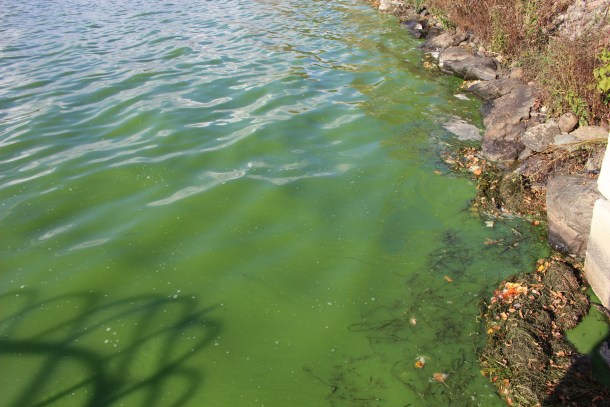
In August, Lake Carmi, located near the Canadian border, was hit by what many say is the worst cyanobacteria bloom in memory. The bacterial bloom was caused by an excess of phosphorus in the lake. Eighty-five percent of the phosphorus comes from nearby dairy farms that use manure and chemical fertilize to grow crops, according to the EPA. Franklin County is home to 25 percent of all the cows in Vermont, and dairy farms are the largest driver of the local economy.
Rep. Steve Beyor, R-Highgate Springs, spent Tuesday morning with constituents in Franklin, and he said “they are really upset.”
“They don’t feel the state is moving anywhere near fast enough on the pollution controls,” Beyor said. “This year has been absolutely horrible. [Residents] can’t stand the smell, they can’t swim in it, they can’t let their dogs in — they don’t even want to go out on the lake in a boat.”
Degree said the cyanobacteria problem is understandably frustrating for nearby residents.
“I understand the lack of patience,” Degree said. “[But] it’s not realistic to shut down every farm in Franklin County. This is what we do. This is who we are.”

