[E]nvironmentalists are taking the state to court over four wastewater treatment plant permits they say would allow too much pollution into Lake Champlain.
The Conservation Law Foundation filed an appeal Monday with the state’s environmental court to block five-year permits the Agency of Natural Resources recently issued for facilities in South Burlington, Montpelier, St. Albans and Alburgh.
The latest permits aren’t any more permissive than they have been, according to the ANR. But the federal government set new limits last year on the overall amount of phosphorus going into Lake Champlain from sources such as wastewater plants and Vermont’s farms.
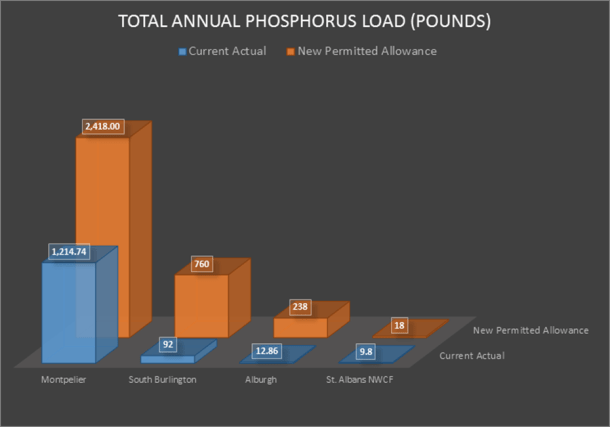
The four municipalities currently discharge no more than about half the phosphorus they are permitted. But because of the federal order, it’s illegal to let municipalities increase pollution unless other contributors cut back, the Conservation Law Foundation argues.
“It’s not consistent with the (new federal limits) and it’s not lawful,” said the group’s vice president and Vermont director, Chris Kilian.

Since the 1990s, phosphorus concentrations in several areas of the lake have increased, leading to toxic algae blooms. In the northern section of the lake, algae has closed beaches and threatened Burlington’s water supply.
Cleanup efforts are estimated to cost hundreds of millions of dollars, and lawmakers have yet to identify a long-term funding mechanism.
Of the four facilities whose permits CLF appealed Monday, Montpelier’s contributes by far the greatest amount of phosphorus to the lake — about 1,215 pounds a year.
But that’s a tiny fraction of the amount that Vermont’s farms and dirt roads — to name just two prominent sources — send into the lake each year, said Montpelier Mayor John Hollar.
All of Vermont’s wastewater treatment plants combined contribute about 3 percent of the total phosphorus that flows into Lake Champlain each year, according to the Environmental Protection Agency’s order requiring the state to keep phosphorus pollution below certain levels.
Montpelier makes an easy target because all of its phosphorus comes from a single, obvious and identifiable source, Hollar said.
“This is really about the larger issue,” Hollar said. “We’re a very small contributor, but we’re easy to get at.”
Alburgh sends about 12 pounds of phosphorus into Lake Champlain each year, and the permit authorizes up to 238 pounds a year from its wastewater treatment plant.
The town’s water and sewer superintendent, Jason Beaulac, said the plant won’t reach that limit unless the town expands by a factor of 10 or so.
But permits can’t authorize towns to discharge more phosphorus than they already do, even if communities don’t anticipate that additional pollution to come anytime soon, Kilian said.
The EPA order on Lake Champlain assumes wastewater plants won’t pollute any more than they do now unless phosphorus pollution is dialed back somewhere else, Kilian said.
For ANR to legally authorize more pollution than currently occurs, the agency would need to show that other sources, like Vermont’s farms, are polluting less than they were when the federal order was approved, he said.
Measures to reduce agricultural pollution won’t have any measurable effect for years, Kilian said, and every polluter in the Lake Champlain watershed is effectively capped at current levels until progress is achieved.
ANR representatives declined to be interviewed for this story.
By email the agency’s general counsel, Jen Duggan, said the permits had been approved by the EPA. Duggan also said the permits are no less stringent than what had been in place already.