


(Editor’s note: Jon Margolis writes political columns for VTDigger.)
[J]ohn W. McCormack was a very important fellow. From 1929 through 1970 – that’s from Calvin Coolidge’s presidency to Richard Nixon’s – he served in the U.S. House of Representatives. He was majority leader for seven years, speaker of the House for nine, and for 14 months was next in line to be president of the United States.
And is now all but forgotten.
Well, he was not the most colorful politician who ever lived. One colleague explained that he was leaving his House seat to run for the Senate so he would no longer be “bored by John McCormack.”
That colleague was named John F. Kennedy. Those Boston Democrats didn’t always get along. Kennedys and McCormacks feuded for generations.
McCormack was not a Vermonter. He seems to have had nothing to do with the state. In the extensive new McCormack biography, there is no mention of the three Vermonters who served with him in the House, and just passing references to Sens. George Aiken and Ralph Flanders.
But Garrison Nelson, the author of that biography, is a Vermonter. A professor of political science at the University of Vermont — and now retiring in his 50th year there — Nelson might even be considered a Vermont legend. After 20 years of research and writing, Nelson has produced his magnum opus with the plainest of titles: “John William McCormack: A Political Biography,” published by Bloomsbury Academic, a division of the company that publishes the Harry Potter books.
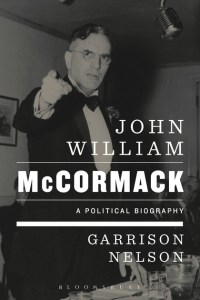
So while this book is not without flaws, one of those flaws is not that it is too short. The last numbered page is 910. But that includes the index, bibliography and list of sources. The actual last page of text is 793, but that includes 154 pages of notes, conveniently placed at the end of each chapter.
So it’s really a book of a mere 639 pages, which need not take the typical reader more than a month.
That month could be well and enjoyably spent, even if Nelson’s wry prose can’t quite turn McCormack into an interesting fellow. That’s because this book is not just a McCormack biography. It is in a sense three books in one: a biography, a selective but rambling history of early 20th-century Boston and mid-20th-century Washington, and a detective story.
The detective story is as much about the writer as it is about his subject, as Nelson recounts how he uncovered McCormack’s secrets. Unlike many of the other Irish politicians of his day, McCormack was neither a crook, a drinker nor a womanizer.
He was just a fraud.
From the start of his political career, he portrayed himself as the oldest of three brothers of a poor family of Irish Catholic immigrants supported by a widowed mother after her husband died when John was 13.
The family was poor, and before John’s 14th birthday, Mary Ellen O’Brien McCormack was the only adult in the house. But father Joseph McCormack was not dead. He had run off, probably in one of the alcoholic hazes that so often surrounded him (perhaps explaining son John’s abstinence).
Joe McCormack was an immigrant, but not from Ireland. He had been born on Prince Edward Island to parents who were not even Irish but part of a community of Scottish Catholics who had come to the New World late in the 18th century.
At least they were Catholic. But either the Scottish heritage or the Canadian origins – much less both – could be politically fatal in early 20th-century Boston, where ethnic borderlines were strictly observed. To the “gatekeepers” of the Irish Catholic Democrats, Nelson says, “a Canadian heritage was a potentially career-ending problem.” So was a Scottish heritage.
McCormack knew all that and lied accordingly, even “disappearing” his older siblings from his official biography, weaving a very tangled web that forced him to dissemble even more when one of his older brothers died.
Nelson does not merely expose all this. He recounts how he got the information by painstaking searches through town, village and cemetery records in two countries.
He recounts it in what some will no doubt consider too much detail. But it’s an interesting search, and effective instruction for the would-be historic researcher or investigative journalist.
Nelson’s inability to restrain himself from telling stories is what makes the book both very long and an intriguing overview of 20th-century America. Looking for tidbits about the lives and times of Franklin Roosevelt, Harry Truman, Dwight Eisenhower, Adlai Stevenson, Sam Rayburn, J. Edgar Hoover, Joe McCarthy, Jack Kennedy, Lyndon Johnson, Richard Nixon and more? This is the place.
McCormack connects with – and Nelson delivers short courses in – the New Deal, World War II, the Korean War, McCarthyism, the New Frontier, the Cuban Missile Crisis, the Great Society, the civil rights movement and the ominous beginnings of U.S. involvement in Vietnam. It’s like a smorgasbord of appetizers in 20th-century history. Readers can sample them all, then go elsewhere for the full-course version of the dishes they liked best.
Meanwhile, there is the biography, and if McCormack never becomes scintillating, he emerges as consistently decent, enlightened and productive. For more than 40 years, as Nelson puts it, McCormack was often “in the room” where history was made – helping write the laws that changed America during FDR’s “100 days,” managing what would become the Lend-Lease Act through the House, attending Truman’s swearing-in as president after FDR died, helping put together the Kennedy-Johnson ticket in 1960.
McCormack was never the main character, the initiator, the star. But he was often there, giving Nelson the opportunity to describe what was going on.
Not that McCormack was never wrong. He was among the authors of the now-discredited Smith Act outlawing membership in any organization that advocated overthrow of the government. He was, as Nelson put it, “always very careful with civil rights legislation,” voting for it, but quietly, lest he disturb the “delicate balancing act” between his conservative and liberal allies in the Democratic Party. He was so cautious and wedded to the establishment that in 1969 Rep. Morris Udall, of Arizona, challenged his re-election to be speaker.
McCormack easily prevailed. Still, there has to be something wrong with anyone who could displease Mo Udall.
Being conventional, being part of the establishment, may have been a McCormack weakness. But it was also the source of his strength. A modest, predictable gentleman who played by the rules and shocked no one, he was able to keep people talking to one another, to get things done.
This book is the story of someone who practiced politics. Who practiced politics as usual. Nelson seems to think that’s not a bad thing. In light of what is going on these days, a position to ponder.

