


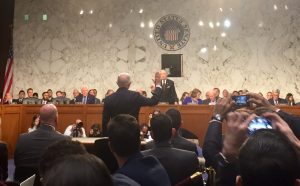
[W]ASHINGTON — Before taking his seat to testify for the first time before the Senate Judiciary Committee, Attorney General Jeff Sessions greeted his former colleagues of both parties behind the dais where the panel sits.
For some, at least, the conviviality did not last long.
One early tense exchange came about an hour into the hearing Wednesday amid questioning by Sen. Patrick Leahy, D-Vt., who later described Sessions’ answers as vague.
During the four-hour hearing before the committee he once sat on, Sessions fielded queries about his position on so-called sanctuary cities, the firing of FBI Director James Comey, and the investigation into Russian collusion in the 2016 election.
Throughout, Sessions maintained his trademark measured drawl, even as he elicited at times visible frustration from Democratic senators. Republican committee members, in contrast, frequently voiced their support for Sessions and the positions he’s taken on issues including immigration and religious liberties.
Leahy sparked a tense back-and-forth when he pressed Sessions on his answer to a question about contact with Russian officials that Leahy asked during confirmation hearings in January.
In March, it emerged that Sessions had met Russian Ambassador Sergey Kislyak multiple times during the 2016 campaign, which many senators felt contradicted his testimony in January.
“Now I’ve never accused you of colluding with Russians, but you clearly in your answer know you concealed your own contact with Russian officials at a time when such contacts were of great interest to the committee,” Leahy said at the hearing Wednesday.
Leahy pressed on, referring to Sessions’ time serving on the committee.

Sessions responded by reading the transcript of Leahy’s question. He said he understood the question to be about meetings in the context of the intelligence community’s belief that Russia colluded in the campaign, and felt he had answered honestly.
Leahy went on to ask if Sessions has been interviewed for the investigation into Russian involvement in the election led by special counsel Robert Mueller.
“I’d be pleased to answer that. I’m not sure I should without clearing that with the special counsel,” Sessions said.
Shortly thereafter, he answered anyway: “No.”
He told the committee he has not received requests for interviews from the Mueller team. Asked by Sen. John Kennedy, R-La., if he would meet with the special counsel if asked, Sessions said he would.
After the hearing, Leahy expressed disappointment in Sessions’ response to his questions. Leahy said he spoke with the attorney general briefly before the hearing and told him he would ask about Sessions’ meetings with the Russian ambassador.
“I could not help but think after serving on that committee for years with Jeff Sessions, he would not find acceptable a Democrat giving as vague answers as he was giving,” Leahy said.
More broadly, Leahy said he had concerns that Sessions was unwilling to answer questions that reflected poorly on the Trump administration — a trend Leahy found troubling. Leahy said Sessions seemed to be claiming executive privilege when the president had not done so.
“He’s not Trump’s lawyer,” he said. “He’s the people’s lawyer.”
Throughout the hearing, Sessions refused to relay conversations and communications with President Donald Trump on many subjects.
“I don’t think it’s been fully understood the significance of the error that Mr. Comey made on the Clinton matter,” Sessions said.
Sessions said it was unusual that Comey announced the closure of the investigation. Rosenstein also took issue with Comey’s public statements that he would handle the situation the same way if he had a chance to do it again, Sessions said.
Sessions stood by his decision to end the Deferred Action for Childhood Arrivals program, which President Barack Obama had created through executive order. Under questioning, he expressed skepticism about creating a path to citizenship for unauthorized immigrants who were brought into the country as children — a concept that is being considered by some.
Sessions also defended his position on sanctuary cities — jurisdictions that limit collaboration with federal authorities on enforcing civil immigration law. He stood by Trump administration positions to limit federal resources to cities that do not cooperate with immigration authorities.
Later in the hearing, Sen. Al Franken, D-Minn., resumed Leahy’s line of questioning and accused Sessions of changing his story about meetings with Russian officials.
“So confronted with the truth, you started to qualify your answer,” Franken charged.
Sessions began to respond, but Franken, whose time for questioning was running out, tried to rush him. Sessions protested.
“Mr. Chairman, I don’t have to sit in here and listen … without getting a chance to respond,” Sessions said.
Committee Chair Chuck Grassley, R-Iowa, played referee.
Sessions went on to defend his answer from January about meetings with Russian officials as “a good faith response.”
After Franken concluded, Sen. Ben Sasse, R-Neb., who was up next to ask questions, apologized for causing a stir during the tense exchange.
“I was paying enough attention there that I dumped a Dr. Pepper on Sen. Cruz,” Sasse said.
