


Vermont’s role in advancing marriage equality was celebrated with the dedication of a new state historic marker on the Statehouse lawn Tuesday morning.
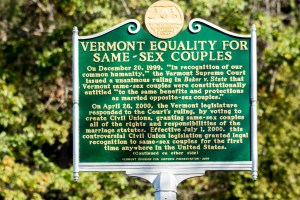
The green and gold aluminum sign stands halfway between the Statehouse and the Vermont Supreme Court building and commemorates the state law that allowed gay couples to form civil unions in 2000 and the enactment of same-sex marriage in 2009.
Vermont was the first state in the country to allow civil unions and the fourth to legalize same-sex marriage.
In a speech on the Statehouse lawn to about 50 lawmakers and advocates, David Schütz, the Vermont state curator, explained that all three branches of government — judicial, legislative and executive — achieved marriage equality.
The Vermont Supreme Court ruled in 1999 that same-sex couples were constitutionally entitled “to the same benefits and protections as married opposite-sex couples,” but left it to the Legislature to determine how to implement the ruling.
Four of the six plaintiffs in the case, Baker v. State of Vermont, were present for the commemoration.

Stan Baker, standing next to his husband, Peter Harrigan, recalled why they sued for the right to have their union recognized by the state.
“Peter and I knew that marriage was a core institution of our society, and being barred from it was akin to not having the right to vote,” Baker said. “We also understood that if any person or couple is excluded from a right that others have then no one’s rights are safe.”
Rep. Bill Lippert, D-Hinesburg, was vice chair of the House Judiciary Committee when lawmakers struggled to implement the ruling in the spring of 2000.
“We actually created the term ‘civil unions,’” Lippert said. “We did not have the votes then to do full marriage.”
The contentious debate that precipitated civil unions was remembered as an impeccable example of civic engagement.
“Those who were there will never forget what happened to the Statehouse in the year 2000,” Schutz said. “The building was crammed beyond capacity, and it was a nightmare, in some respects, but at the same time it made me incredibly proud that I lived here.”
Baker lauded the willingness of lawmakers and the public at large to debate the issue. “While the discussion was difficult and often vitriolic, Vermonters had a conversation that they otherwise never would have experienced,” he said. “Regular folks found themselves using words they never used before — homosexual, gay, lesbian, bisexual, transgender, same sex. People who before were able to maintain a veneer of tolerance suddenly had to face their own heterosexism.”
In some districts, legislators faced losing upcoming November elections if they supported civil unions. Lippert remembered one colleague’s resolve in the face of that risk. “Our friend and legislative colleague, the late representative Marion Milne, stood on the house floor amidst the civil union debate and in her unique and powerful voice Marion proclaimed, ‘I will not be silenced by prejudice and fear,’” Lippert said. “Even as Marion recognized that she could be ending her legislative career by taking her stand.”
In the spring of 2000 civil unions legislation passed the House and Senate and was signed into law by Gov. Howard Dean on April 26.
Milne did lose her re-election bid that year. In all, 16 incumbents who supported civil unions were not re-elected. Control of the House chamber went to Republicans for the first time in 14 years.
In the years that followed, Democrats regained control of the House, and resistance to same-sex unions mellowed. Gov. Jim Douglas vetoed gay marriage in 2009, and the Senate and House overturned the veto, legalizing same-sex marriage in 2009.
Gov. Phil Scott, who ran against civil unions as a state senator, said, “The historic marker will fittingly celebrate Vermont’s commitment to advancing civil rights.”
“Upon reflection, passing the civil union legislation in 2000 was the right thing to do,” Scott said.
In his 2000 race for Senate, Scott said the law gave “special rights for a select group of people,” according to a story by The Times Argus. Scott co-sponsored a bill in 2001 that would have allowed justices of the peace to refuse to officiate civil unions. Finally, he was absent for the 2009 Senate vote that overturned Gov. Jim Douglas’ veto of same-sex marriage legalization.
Scott has since recanted, telling the Burlington Free Press during the gubernatorial election last year that his original position on same-sex marriage had shifted because it was “unequivocally” wrong.
The new marker is the 240th dedicated under the state’s Roadside Historic Site Marker program administered by the Vermont Division for Historic Preservation. Criteria for commemoration under the program include that “the site be associated with an event that has made a significant contribution to the broad patterns of history.” The dedication of a marker commemorating events within the past decade is unusual.
“To have something like this in one’s lifetime is an amazing thing and to me Vermont is an amazing place where a private citizen is close enough to the seat of government and the governor and the Legislature and what I’d like is for everyone in Vermont to know that they can make a difference,” Baker said.
State Historic Preservation Officer Laura Trieschmann said most of the events commemorated by the historic markers happened at least 50 years ago. “We have a solid chronological boundary for historical perspective, [but] there are notable exceptions, and this is definitely one of them,” Trieschmann said.
“Sufficient time has passed to allow for a full understanding of the activities and actions leading to civil union and marriage equality legislation and the resulting consequences were overwhelmingly important for Vermont,” Trieschmann said. “These recent-past events rise to a high level of state and national significance that warrants commemoration in a permanent way.”
Below is the text of the new marker:
VERMONT EQUALITY FOR SAME-SEX COUPLES
On December 20, 1999, “in recognition of our common humanity,” the Vermont Supreme Court issued a unanimous ruling in Baker v. State of Vermont that same-sex couples were constitutionally entitled “to the same benefits and protections as married opposite-sex couples.”
On April 26, 2000, the Vermont legislature responded to the Court’s ruling, by voting to create Civil Unions, granting same-sex couples all of the rights and responsibilities of the marriage statutes. Effective July 1, 2000, this controversial Civil Union legislation granted legal recognition to same-sex couples for the first time anywhere in the United States.
Over the next nine years, from 2000 to 2009, 1,600 Vermont same-sex couples, and more than 7,000 couples from 48 states and dozens of foreign countries travelled to Vermont to be legally joined in Civil Unions.
On April 7, 2009, Vermont became the first state to enact same-sex marriage through a vote of the legislature rather than through a court ruling. In voting to override the governor’s veto, the legislature made Vermont the fourth state to legalize same-sex marriage.
On September 1, 2009, Vermont achieved full marriage equality for all Vermont couples.
