

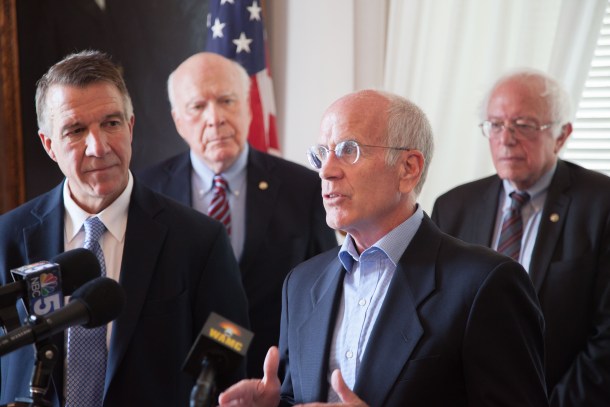
Rep. Peter Welch was one of three congressional Democrats to co-sponsor 2016 legislation that has come under fire for restricting the ability of federal authorities to stem channels through which prescription drugs are diverted to the black market.
A joint report by The Washington Post and “60 Minutes” found that the pharmaceutical industry lobbied strongly for the law.
The legislation passed both the House and Senate by unanimous consent. President Barack Obama signed it in April 2016.
The story quotes from a forthcoming article by DEA Administrative Law Judge John Mulrooney, who has been documenting the impact of the law.
“If it had been the intent of Congress to completely eliminate the DEA’s ability to ever impose an immediate suspension on distributors or manufacturers, it would be difficult to conceive of a more effective vehicle for achieving that goal,” Mulrooney wrote.
Welch initially signed on in 2015 to back the measure, which was spearheaded by Rep. Tom Marino, R-Pa.
In the aftermath of the media report, published Sunday, Welch wrote to the heads of the two committees he sits on to encourage them to review the law to determine whether it should be changed or repealed.
Welch said in an interview Tuesday that he co-sponsored the legislation at the urging of the Burlington Drug Co., a Milton-based business that specializes in storing medications and distributing them to pharmacies around Vermont. The company was family-owned for nearly a century, but was sold late last year, according to a customer service agent.
According to Welch, there were ambiguities in federal policies guiding the handling of prescription opioids, and companies including Burlington Drug sought clarification.
“The goal was to have a collaborative relationship with the Drug Enforcement Agency and the legitimate licensed distributors,” Welch said.
The goal was to provide clarifications to aboveboard actors in the pharmaceutical industry for handling prescriptions, while enabling federal authorities to clamp down on operations that funnel drugs into the black market, he said.
Welch said the measure passed into law without opposition from within the House, Senate, DEA, Department of Justice or White House.
“It indicates that (from) the information that all of us were operating on at that time, we thought that this was an appropriate thing to do,” Welch said.
According to the nonpartisan Center for Responsive Politics, Welch received $88,204 in campaign donations from the pharmaceutical and health products industry between 2013 and 2016. He said contributions from the pharmaceutical industry had no bearing on his support for the law.
Welch, who has backed prescription drug pricing reform efforts for years, said he has a reputation as an “adversary” of the industry.
Other lawmakers who backed the bill received higher sums from the industry. Sen. Orrin Hatch, R-Utah, who sponsored the Senate bill, received $177,000 from pharmaceutical political action committees between 2014 and 2016, according to the article.
Asked if he regrets supporting the legislation, Welch responded that he was concerned by the details in the Washington Post and “60 Minutes” investigation and believes the law should be scrutinized.
Others have also asked for review of the law.
Rep. Judy Chu, D-Calif., who also co-sponsored the bill, wrote a letter Tuesday describing a meeting with the acting administrator of the DEA in July 2016, after the passage of the bill, when she learned there had been internal controversy about it. The official told her the legislation “did not interfere with the DEA’s ability to successfully stop bad actors.”
She asked for hearings to look into whether she was misled.
Welch said he would like to hear from the DEA directly about the law in a committee hearing and that Congress should then consider taking whatever action would be appropriate — whether changing the law or repealing it.
“I’m fully committed to taking a second look at this,” Welch said. “Whatever it is we have to do, I’m quite eager to do.”
