


[B]URLINGTON — When Dr. John Brumsted talks about health care reform, he describes trying to get all the health care providers in Vermont and New York to sit around the same dining room table.
Brumsted, the CEO of the University of Vermont Health Network and the UVM Medical Center, says getting all the providers into one family, together at his table, is the only way he can make progress on improving the health of the region’s population.
“I’ve worked my entire career, as an academic physician, trying to improve the quality of services and to change the way we approach certain clinical situations,” Brumsted said. “And I’ve gotten groups of clinicians together from this geography and nationally.”
“When you bring altruistic clinicians together, and you talk over what the pattern of care should be, and you do that over a few days, everybody’s, ‘Rah, rah! Here we go! We’re going to get it done!’ and, almost always, people go back to their day jobs and nothing changes.”
“If you’ve got something that you want to improve, or something that needs to change, and you’re all coming to the family dining room table, the irascible teenager may run from the room, go upstairs, slam their door,” Brumsted said. “But they’ll be back at the dining room table the next day, and you will be forced to come to a decision.”
That’s the idea, he said, behind the 2011 creation of the UVM Health Network, which has grown to control six hospitals in Vermont and New York, and will soon include a new clinic in Ticonderoga, New York, and is in discussions to control the largest visiting nurses association in the state.
That’s also the idea behind the network’s other initiative, OneCare Vermont. It is a health reform company partly owned by the UVM Medical Center that will soon coordinate insurance money and patient care across a large and diverse group of health care providers in the state.

Brumsted said the expansion of the UVM Health Network and the growing number of relationships that OneCare has formed with other health care companies are about improving patient care, not about taking over as many health care companies as possible.
“It’s not a matter of a big map that we’ve got on a wall in a darkened room where I go in and we’ve got pins stuck,” Brumsted said. “What we’re trying to do is improve the health of the population that we’re serving. That’s the driver, and we’re seeing ways to do that.”
“We’re really trying to improve things for the people that are in this region and doing everything that we can think of to engage and collaborate to do that,” Brumsted said. “And it doesn’t include some sort of growth strategy for growth strategy sake.”
“It’s all about, are there collaborative relationships that we can have … where coming together we can provide more value for the people that (we) are serving and, secondarily, more value for the organizations?” Brumsted said.
Defining population health
The state of Vermont endorsed many of the concepts behind Brumsted’s vision when officials signed an agreement with the federal government in October 2016 to create what policy wonks call the all-payer model.
The model encourages doctors to work together — regardless of what company they work for — to achieve four population health goals: Increase the number of Vermonters with primary care providers, reduce the prevalence and morbidity of chronic diseases, reduce the rate of drug overdoses, and reduce the rate of suicides.
The contract runs from 2017 to 2022. While the agreement is legally binding, the state and federal government consider the goals an experiment, and the contract contains no punitive consequences for not achieving the population health goals.
On the financial side, officials are in the process of transitioning the participating health care providers from payments for services to monthly payments from Medicaid, Medicare and commercial insurance companies for preventive health care programs. That system goes live Jan. 1.
The idea is that monthly payments will allow providers to perform procedures that are appropriate for the patient to help Vermonters become healthier, as opposed to being locked into reimbursement levels for services set by the government and insurance companies.
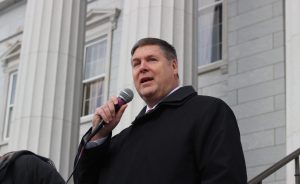
“There’s a movement in medicine, across the United States … that team-based care across the care continuum leads to better health outcomes than not,” Gobeille said. “And so (these new payment systems) pay for and measure the quality of that care. That’s the goal of this.”
Gobeille said people with complex health problems come to him all the time saying it’s logistically difficult for them to get the care they need. He said there’s an array of primary care doctors, specialists and subspecialists who create a maze for people seeking treatment for cancer and diabetes.
“It’s just not tied together,” Gobeille said. “It’s not tied together from a mental health and physical health perspective. It’s not tied together from a primary care to tertiary care perspective because the system (is paying doctors for each procedure). … It’s basically, you come in to me for something. I fix it. You go home. That does not lead to coordination.”
He added: “There is not anyone who would argue that when a loved one of yours is ill, that you would want uncoordinated care. That’s just not — it’s not a legitimate position.”
The accountable care organization
The main vehicle for delivering improvements in population health is OneCare Vermont, an accountable care organization, or ACO, jointly owned by the UVM Medical Center and Dartmouth-Hitchcock Medical Center in New Hampshire.
Authorized under the 2010 federal Affordable Care Act, ACOs are companies that allow providers who work for once-competitive companies to coordinate patient care and payments without violating federal antitrust laws.
“If we are talking about population health, you do not solve population health as individual clinics or hospitals or agencies,” Sarah DeSilvey, a nurse practitioner at Northwestern Medical Center, said at a OneCare briefing for lawmakers in June.
DeSilvey spoke about the importance of addressing community problems like domestic violence, mental illness and obesity. With a coordinated team, she said, it’s easier to find and help the people who are missing follow-up appointments or who aren’t coming to the clinic for their care in the first place.
In Vermont, OneCare will start rolling out a population health model on Jan. 1 to about 120,000 patients. The more than 160 participating companies include 10 hospitals, 19 nursing homes, eight home health agencies, six designated mental health agencies, two area agencies on aging, two community health centers, nine specialty providers and 54 private doctors offices.
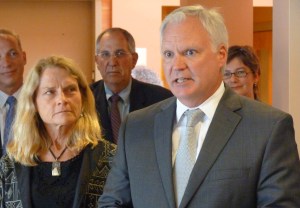
OneCare could still grow if more providers come into the network in future years. For about a year, OneCare was on track to merge with a smaller ACO called Community Health Accountable Care, owned by community health centers that specialize in serving Medicaid patients.
The two groups have now abandoned that merger, and OneCare has begun to consolidate operations with an ACO in New York that is jointly owned by an affiliate of the UVM Health Network and a group of New York-based community health centers.
However, the state has questioned Community Health Accountable Care’s ability to meet population health goals.
Brumsted says competing ACOs in Vermont is a terrible idea.
“(In an) urban environment, I can see how you can have competing ACOs,” Brumsted said. “I can see how you can have competing academic medical centers, and they certainly do.”
“I’m kind of a competitive guy at my core, but in a rural environment, competition in not-for-profit health care is the dumbest thing you could possibly do,” Brumsted said. “It’s just dumb. It just increases costs and probably reduces the quality.”
Vermont’s chance to fix health care?
Eileen Whalen, the president of the UVM Medical Center, said she came to her job in 2013 from Washington state in large part because of the statewide efforts to coordinate care across different health care companies.
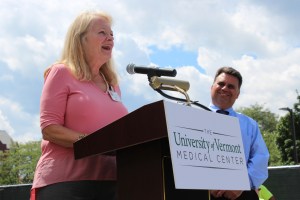
Dr. Fred Kniffin, the CEO of Porter Medical Center in Middlebury, which is now part of the UVM Health Network, said in June that the reforms are confusing and time-consuming, but it’s worth the effort.
“Everybody in this room feels (the current system is) unsustainable. We just can’t go on the way we are,” Kniffin said. “We want to do something different. We want to do something better for our patients.”
Kevin Mullin, the new chair of the Green Mountain Care Board, said no one has offered a better idea to control costs while improving health care.
“There are other ways that you could bend the cost curve, but they could involve just cutting reimbursement and things like that, but that doesn’t improve quality, whereas the all-payer model is based on quality,” Mullin said.
“I think it’s good to be skeptical, but at the same time I don’t think anybody has put something at the table that could possibly help improve quality of care and bend that cost curve in a different manner,” he said.
