

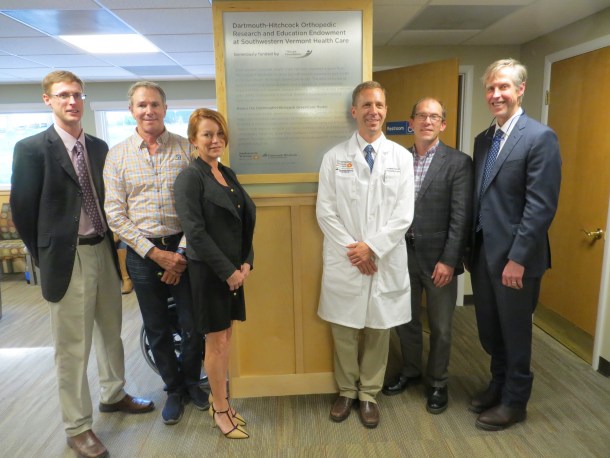
[B]ENNINGTON — The newest medical collaboration for Dartmouth-Hitchcock and Southwestern Vermont medical centers is focusing on orthopedic patients facing arthritis-related joint replacement surgery.
The GreenCare model, a data-gathering research initiative at Dartmouth-Hitchcock Medical Center in Lebanon, New Hampshire, is being implemented for patients of Southwestern Vermont Medical Center’s orthopedics facility on Dewey Street. The program began locally in July and now involves about 55 patients.
Officials from the care organizations and from the Aircast Foundation, which is providing grant funding, said it could eventually serve as a model for other community hospitals around the nation, as similar programs typically are too expensive to develop outside a major regional medical center.
Dr. Jonathan Cluett, medical director at SVMC Orthopedics, said patients considering surgery are asked to first fill out standardized surveys about their lifestyle, level of pain and activity, goals for the procedure and similar topics. Patients then repeat the survey process during future appointments.
The responses will help create a database meant to better determine which patients — given age, activities, lifestyle and other factors — might benefit from a specific operation or might want to consider other treatment options.
Bringing the GreenCare initiative to Bennington shows how Dartmouth-Hitchcock and Southwestern Vermont Health Care “continue to partner on multiple initiatives,” said Dr. Trey Dobson, chief medical officer for SVMC.
Those joint efforts include formation of a multi-specialty medical group in 2012, he said, and subsequently shared medical services or initiatives through partnership agreements.
A $100,000 grant from the Aircast Foundation “allows our orthopedic patients to participate in Dartmouth-Hitchcock’s data-gathering program,” Dobson said, adding that SVHC “will be one of the first locations outside the Dartmouth-Hitchcock system to implement this model.”
“This is another example of why SVMC is affiliating with Dartmouth-Hitchcock,” said Thomas Dee, president and CEO of the Bennington care organization. “This a small community hospital partnering with a national academic medical center.”
Concerning the Aircast Foundation grant, he added, “A small hospital could not afford to make those kinds of investments on its own.”
The data is collected anonymously through volunteer surveys with questions that have been vetted nationally. The stated aims of the initiative are to increase health care quality and patient satisfaction while decreasing health care costs associated with unnecessary or unsatisfactory procedures.
Dr. Michael Sparks, an orthopedic surgeon at Dartmouth-Hitchcock, said collecting such data for analysis and comparison and sharing data on outcomes with patients has become an important component of health care at the New Hampshire-based center.
In the past, he said, physicians had to make recommendations primarily based on evaluations and testing, while patients had to make difficult decisions without such a database of the experiences of prior patients.
While the regional center now has that information available, “it is also important that it works in all places,” Sparks said, referring to the decision to implement a similar program in Bennington.
Dr. Nicholas Paddock, the director of orthopedics at Dartmouth-Hitchcock, said the center began surveying patients in 2011 and now has data on more than 4,000 who have gone through the process.
“What that has allowed us to do is begin to aggregate that data and begin to understand — OK, what is the experience of a patient,” he said. “So you could say to someone, let’s say, maybe 50, female, with certain health care characteristics; we can look at that population and say how that sector of the population experiences care as they tell us about their experiences. And that’s the key, from the patient’s perspective.”
The program can provide data on a given set within the patient population, he said, with information on their experiences and surgical or treatment outcomes.
“We are trying to add that data to the clinical data that we’ve got, to then do new quality improvement efforts in the future,” Paddock said.
He added that Dartmouth-Hitchcock is one of the few centers in the country that “has really adopted this as a standard of care.”
The effects on the overall cost of health care could be significant, Paddock said, because well over half of all surgical procedures are performed in community hospitals, and joint replacements make up a large percentage of all surgical procedures.
Sparks said the Bennington effort will include developing data collection methods that function across medical records systems that are different from the embedded survey format at Dartmouth-Hitchcock.
Barbara Houle, a patient of the orthopedic group who had joint replacement surgery, said she had suffered a knee injury in 1950 when the typical surgery involved removal of cartilage. Afterward at times, she said, “the noise was worse than the pain” when she moved, prompting her to finally opt for joint replacement surgery in August.
Houle said she wished she had access in 1950 to information on other patient outcomes and best surgical practices. Filling out the survey was “relatively easy,” she said, and the process helped her decide to have the operation.
Jack McVicker, president of the Aircast Foundation, said the foundation and the Aircast company “have a particular affection for southern Vermont and New England, because the company really started with a ski injury.”
He said the business founder, the late Glenn Johnson, suffered a leg injury in 1972 skiing at Stratton Mountain. While in a plaster cast he began to think about what became the aircast design, allowing more rapid healing and mobility during recovery.
The foundation, established in 1996, has funded 76 medical research grants, McVicker said, totaling $4.68 million, and has worked with 31 academic institutions.
Leslie Keefe, vice president of corporate development at the SVHC Foundation, said foundations at the two hospitals hope to match by Dec. 31 the $100,000 from the Aircast Foundation through other grants and fundraising.
In addition, she said, a long-term goal is to raise money to endow a dedicated research fellow position and use the data to test patient-level predictive outcome models, refine predictive models and comparative performance data sets, and publish the findings.


