

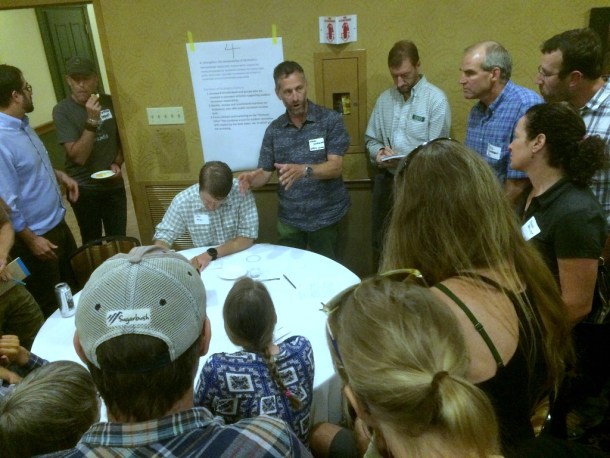
[W]ATERBURY — Nearly 100 enthusiasts gathered here to help a new state collaborative capitalize on outdoor recreational opportunities in Vermont.
The Vermont Outdoor Recreation Economic Collaborative is meant to unite disparate recreational groups as part of an effort to improve tourism prospects. The collaborative is an economic development initiative launched by Gov. Phil Scott last summer.
Last week’s workshop was one of seven that will be held in different parts of the state. A 15-member steering committee comprised of government officials and business and nonprofit leaders are leading the charge.
It’s not the first time Vermonters have attempted to highlight Vermont’s natural setting, but this go-around looks different, said Tom Stuessy, executive director of the Vermont Mountain Bike Association.
“It was a very busy room,” said Stuessy, who is a member of the steering committee. “To have that much enthusiasm in the conversation sends a signal that this is a conversation we clearly need to be having.
“We knew it would be well-attended, but we didn’t anticipate more than 80 people,” he said. “But as noisy as the room was, it’s not noise — in fact it was signal. People want to be heard.”
The steering committee is headed by Department of Forests, Parks and Recreation Commissioner Michael Snyder, who is encouraging Vermonters to weigh in, either by attending a workshop or by completing an online survey.
“We don’t know the answers,” Snyder said.
Snyder said he hopes to deliver recommendations to the governor from the workshops this fall in time for lawmakers to take action in the 2018 legislative session.
The first of workshop resulted in a large number of suggestions, he said, and the next six are likely to be similarly productive.
“I thought (the Waterbury event) was fantastic, because that’s what a lot of people kept telling me,” Snyder said. “The room was not big enough, but it’s a good problem to have. I think we’re really onto something here.”
One of the collaborative’s goals is to garner involvement from a wide array of recreational factions — from snowmobilers, to hikers, hunters and bird watchers. Vermonters have sought to tie outdoor recreation to the economy for a long time, Snyder said, but what’s new “is that we’re saying, ‘Let’s work together, and make this good for everybody.’”
Cindy Locke, executive director of the snowmobiling group Vermont Association of Snow Travelers, said VAST is one of the oldest nonprofit outdoor groups in the state. She hopes to work with other groups as part of the collaborative.
“It’s our responsibility to work with the other trail groups that’re smaller, to add our resources and value to the efforts Governor Scott is requesting from all of us,” Locke said. “I am encouraging people to go out to these public meetings in a positive way to voice their opinions.”
Other states have tried similar initiatives, according to Mike DeBonis, executive director at the Green Mountain Club. The question is whether Vermonters will be open to new ideas that integrate different types of recreation.
DeBonis, a member of the collaborative’s steering committee, said early signs look encouraging.
“You want it to be a good use of time … and I think we all want something meaningful to come out of it,” he said. “The next few months are going to be telling: Can we take these ideas … and make them actionable?
“From what I’ve seen, there’s a will to do it,” DeBonis said. “I’m happy to participate, with the idea that we’re going to come out of it with something to be proud of.”
The next VOREC workshop will be held in Island Pond on Sept. 25; further workshops will be held each following week in Rutland, St. Albans, East Dummerston, White River Junction and Arlington.
No workshops are scheduled in Chittenden County. Snyder said the most populous county receives a lot of attention, and the meetings were designed to draw input from places typically less heard from. Chittenden County residents can attend the St. Albans meeting, he said, and they can also submit ideas online.
