


[T]his Labor Day, the line of vehicles at the U.S. border from Quebec into Vermont stretched five lanes wide — each with a backlog of many dozen cars. The queue moved toward the Highgate Springs Station with the slow motion jerkiness of a wound-down robot.
What began as routine inconvenience would end with border agents seemingly misrepresenting the law and committing a possibly illegal “seizure or detention.”
After about 30 minutes in line, I had grown restless and, inspired by a few dog walkers, left our stationary car.
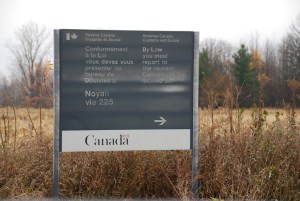
A month earlier, I shot photos at several remote Canada-United States border posts in the Northeast Kingdom and chatted with the customs officials who, with one cranky exception, seemed to welcome the distraction from what must be a tedious job.
I figured that while I was stalled Labor Day weekend at Highgate Springs, one of the country’s largest northern border crossings, I’d add to the series with a few photos of the distant customs building and the ranks of vehicles in front and behind, laid out like a mall parking lot.
Back in the car, and a half hour or so later, we pulled up at the U.S. Border and Customs Protection booth. The officer asked for our passports and the purpose of the trip (shopping), and then turning to me, asked: Did you take photos? Yes, I replied, of the building and cars. I said that I was a journalist and had photographed stations in Norton, Canaan, and Derby Line. He then demanded that I give him my phone so he could delete the photos.

No, I said. I used my camera, not my phone, and in any case, I had the right to take photos. But my friend who was driving, frequently crosses the border for business, and was worried that if I made trouble, she could land on a list that would make cross-border travel time-consuming or worse.
So bending my instinct to balk at an apparent invasion of rights, I said, “Look you don’t have the right to demand this, but, here, I’ll delete the SD card in my camera.” He checked the display to confirm that all photos were gone.
Now give me your phone, he ordered. “No,” I said, as my friend released a barely audible groan.
Many people trying to enter the United States have good reason to comply with questionable, or even illegal, orders.
On July 12, Highgate officers detained Ghassan and Nadia Alasaad, who were returning from a Canadian vacation to their Revere, Massachusetts, home.
After demanding that they unlock their cell phones, a Border and Customs Patrol officer poured through the devices. The government “not only pried into our private life, they destroyed parts of it,” Ghassan told VTDigger.org, by deleting videos of their daughter’s graduation.
Ghassan is now lead plaintiff in Alasaad vs. Duke. The class action suit, filed a week after my border encounter, by the American Civil Liberties Union and the Electronic Frontier Foundation in U.S. District Court in Boston challenges the Border and Customs Patrol policy of searching electronic devices without a warrant.
The number of such searches is growing. There were about 15,000 warrantless electronic searches in the first half of the current federal fiscal year, October through March, ACLU lawyer Jessie Rossman told VTDigger. If the trend holds, this fiscal year will see triple searches in 2015.
Because of the protections accorded journalists, and a WASPy-sounding last name, it was easy for me to be defiant. The officer countered my refusal to hand over my phone by snapping: “Park there and report to the building.” He kept our passports.
Inside a large narrow room with hard, plastic chairs we joined several clusters of travelers who had also been pulled over. My friend and I, both American citizens, sat alongside a group of Latinos, a family that appeared to be Middle Eastern, a group of South Asians with a well-behaved baby, one white woman in a spangled jacket and a group of five large young men who were laughing and having a great, good time as they waited.
The lines in the waiting room moved in an unhurried echo of the traffic, as agents questioned and selectively fingerprinted the travelers. Outside, officers went through a vehicle with Quebec plates belonging to the five guys, opening the trunk, checking under the seats, and with an agile push-up-like motion, glancing at the undercarriage.
After a while, the man who had demanded my phone and the deletion of my photos walked in and talked to other agents behind a chest-high counter. Then, across from where we sat, two officers huddled at a computer, exchanging glances, pointing at the screen, typing, and looking up occasionally. At me?
Eventually, Supervisor Mayo, who had been plying the computer, called my name. He could not have been more polite and pleasant if I had dropped in to wish him a Happy Birthday. After asking about my journalism bona fides, and mentioning heightened security concerns, he reiterated that photography was prohibited. He asked me to show him that the photos were deleted. He then handed back our passports, smiled, and said next time, just ask and he’d be happy to set up a tour. He did not mention my phone.
I asked under what regulation he had ordered me to delete images on my camera, and he waved a readied print-out, offering to make me a copy. I took down the code: § 102-74.420.
Back home in Vermont, I discovered that, in fact, the code offered no grounds for denying my right to photograph or for deleting my photos.
“Except where security regulations, rules, orders, or directives apply or a Federal court order or rule prohibits it,” § 102-74.420 read, “persons entering in or on Federal property may take photographs of … [b]uilding entrances, lobbies, foyers, corridors, or auditoriums for news purposes.
If there are applicable “regulations, rules, orders, or directives, Mayo did not present them to me. The Boston field office confirmed that “photography of federal facilities from outside is not prohibited for news purposes,” but because of travelers’ privacy and possible security risks, “our officers may ask individuals not to take photos or ask to see the photos that have been taken.”
I was given neither of those options, but was instructed, rather, to delete my photos.
Another Department of Homeland Security (DHS) document, “Photographing the exterior of federal facilities,” confirmed that “there are no written regulations prohibiting photography of the exterior of FPS facilities,” and advises personnel: “Furthermore, it is important to understand that this regulation does not prohibit photography.” [Emphasis in original.] The information was in a Federal Protective Service Information Bulletin. The Federal Protective Service is Homeland Security’s police division.
That bulletin did affirm the right of agents to conduct a field interview to determine if I was casing the joint (rather than just checking the detailed views of the station available on Google Earth and Flickr.) But barring evidence of “criminal behavior or terrorist reconnaissance,” it declared, “photography should be permitted to proceed unimpeded.” Curiously, the bulletin establishing the right of the media to photograph had started out as “Classified,” and carried specific instructions not to show it to media.
And here come the best part: “Because the initial interview is voluntary, officers should not seize the camera or its contents and must be cautious not to give such ‘orders’ to a photographer to erase the contents of a camera as this constitutes a seizure or detention.” By press time, BCP was “still looking into this.”
It appears, then, that the officer who ordered the deletion of my photos, was by Homeland Security’s own rules, exercising a power he did not have.
“Often government officials are not aware of First Amendment rights and feel free to violate them,” said Gregg Leslie, legal defense director of the Reporters Committee for Freedom of the Press.
A small denial of rights — in this case taking a photo of a public building — hardly seems worth the trouble to complain. But like all policing violations — if unchallenged, it allows authority to remain ignorant of or arrogantly above the law, and thus to overreach and bully with impunity.
