

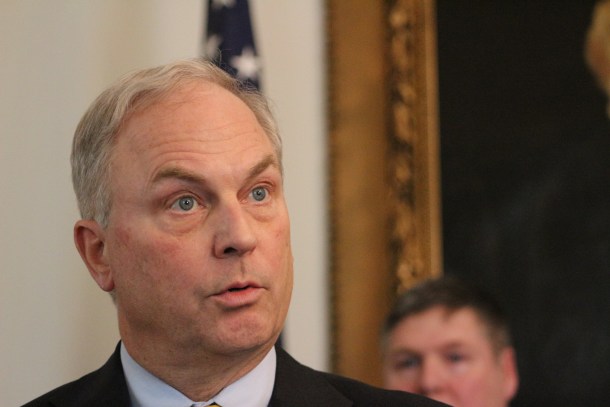
“There almost certainly will be things that come up during fiscal 18 that we decide to do as far as investments either in New York or in Vermont that would be the normal course,” Dr. John Brumsted told the Green Mountain Care Board as it reviewed the hospital’s Fiscal 2018 budget.
“Obviously if there’s something that trips a (certificate of need) … you would automatically get that as part of the CON process,” Brumsted said. “As we sit right now, there’s nothing in that budget.” He mentioned new programs or capital expenditures as things that might require a CON.
Brumsted’s comments followed those made by the UVM Health Network’s vice president for finance, Marc Stanislas, to the board a week earlier. On Sept. 7, board Chairman Kevin Mullin asked Stanislas whether money from the network’s Vermont hospitals would subsidize its affiliates in New York. “In our 2018 budget there are no subsidy dollars,” Stanislas replied.
Brumsted suggested regular updates, perhaps twice a year, in which UVM Health Network officials could notify the board of expenditures at New York hospitals.
The UVM Medical Center CEO testified at the meeting at the request of the board, which has been asking questions about how the Burlington-based UVM Health Network and its flagship hospital, UVM Medical Center, may be providing financial support for struggling hospitals in New York.
In the past five years, Champlain Valley Physicians Hospital in Plattsburgh and Alice Hyde Medical Center, located near the Canadian border, have posted operating deficits totaling more than $25 million, according to information the UVM Health Network provided to VTDigger.
Brumsted said in an interview Alice Hyde Medical Center has only around 15 days in cash on hand, but that it has not defaulted on any loans.
The UVM Medical Center CEO attended the meeting with a team including Todd Keating, the chief financial officer for the UVM Health Network, Eric Miller, the deputy general counsel for the UVM Health Network, and Michael Carrese, the spokesperson for the UVM Medical Center.
The UVM Health Network gave the board a spreadsheet showing that the Vermont hospital system receives revenue from New York patients. In fiscal year 2015, that revenue was $30 million, Brumsted said.
Brumsted told the board that revenue from New York patients is necessary to help offset the fixed costs of major clinical programs at the hospital, such as the neonatal intensive care unit and the level 1 trauma center. Without that revenue, those services “would probably be cost-prohibitive” for Vermonters, he said.
“We believe that people deserve to be healthy and to have access to the highest quality health care delivery services as close to home as possible,” Brumsted said. “That’s the philosophy upon which our vision and our mission is based and it’s the philosophy upon which we make our decisions.”
He said the philosophy “supersedes” many of patients’ demographic factors, “and certainly supersedes state borders.”
Additionally, Brumsted told the board that each hospital is a 501(c)3 nonnprofit organization and has its own reserves. In the case of a loss, the hospital is expected to absorb that loss on its own balance sheet, he said.
“It’s not that it defaults to the rest of the members of the network, including the UVM Medical Center, to cover those losses,” he said.
“It’s only if the organization … were to miss covenants, or really be in a bankruptcy situation that there is obligation of the others to cover that, and we’re not there,” the CEO said.
“Inside-of-the-tent, our vernacular is that’s the organizations floating on their own bottom,” Brumsted said. “Each organization’s balance sheet is expected to cover its losses.”
“And, over time, we expect every organization to be having a positive margin and being able to build their balance sheet and generate the capital that we need for the good of the network,” he said.
Robin Lunge, a member of the Green Mountain Care Board, told Brumsted that the board should take time during next year’s budget process understanding how patients from different states affect Vermont’s hospitals.
“I think the other piece of this is, for example, we know that Dartmouth is keeping one of our Vermont hospitals [Mt. Ascutney Hospital] essentially afloat, as well, so that’s part of the pie as well,” Lunge said.
Brumsted said with a laugh, “Thank you, we really enjoy being special.”
“But in this instance I think if you’re really going to go down this road you’re really going to have to look at the ins and outs because most of the hospitals are not confined in their patient activities to Vermonters,” he said.
“It’s sort of a tangled web if you want to go down there, but as you suggest, Robin, there are some reasons … to do so,” he said.
CORRECTION: This story originally stated erroneously that Dennise Casey was present at the Green Mountain Care Board meeting.
