


[W]ASHINGTON — After a months-long tease, Sen. Bernie Sanders, D-Vt., unveiled legislation to overhaul the American health care system to a Capitol Hill committee room crowded with journalists and activists Wednesday.
“Today we begin the long and difficult struggle to end the international disgrace of the United States, our great nation, being the only major country on earth not to guarantee health care to all of our people,” Sanders said.
It’s certainly not the first time Sanders has offered legislation to create a single-payer health care system — most recently, he put forward a similar concept in 2013. But the idea has since gained steam, buoyed in part by Sanders’ popularity in the 2016 presidential election.
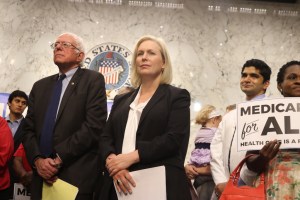
When Sanders unveiled his long-touted legislation Wednesday to a Senate committee room filled with cheering supporters, he was flanked by half a dozen fellow senators.
In total, 16 Democratic senators signed onto the bill as co-sponsors.
While the proposal for a universal health care system has built momentum on the left, the idea still has support of only a fraction of elected officials in Washington — and Sanders’ bill is almost certainly dead on arrival in the GOP-led Senate.
Still, dozens of supporters sported tees from Sanders’ presidential run and pink scrubs embellished with slogans like “health care not warfare” as they rallied in support of the bill. Eruptions of cheers and laughter punctuated remarks from Sanders and other speakers, including a physician, a parent and several other senators.
All federal insurance programs would transition to the universal Medicare program, with the exception of health care through Veterans’ Affairs and the Indian Health Service.
The plan would fully cover virtually all services without any out-of-pocket expense to the patient, from hospital trips to mental health and substance abuse treatment to regular doctor visits. The package would also cover vision and dental services. The only out-of-pocket costs would be for some prescription drugs, which, a bill summary explains, would be to encourage use of low-cost generics.
In his remarks, Sanders nodded to the cost associated with implementing such a proposal, and acknowledged that taxes would increase. But he said the benefits of the new system would balance it out.
“While, depending on your income, your taxes may go up to pay for this publicly funded program, that expense will be more than offset by the money you are saving by the elimination of private insurance costs,” Sanders said.
Specifics on what the plan would cost — and how to pay for it — are scarce.
Sanders staff released a six-page document alongside the bill that briefly outlines several concepts for funding the program, including establishing a 7.5 percent premium to be paid by employers or a 4 percent premium paid by households.
The proposals also include reforming personal income tax to make it “more progressive,” establishing a “wealth tax” on the richest 0.1 percent of Americans, or collecting a fee from the largest financial institutions on Wall Street.
“In my view,” Sanders wrote, “there needs to be a vigorous debate as to the best way to finance our Medicare for All legislation.”
High profile Senate Democrats, some potential 2020 presidential hopefuls, stood alongside Sanders at the event, including Elizabeth Warren, D-Mass., Kirsten Gillibrand, D-N.Y., Kamala Harris, D-Calif., and Cory Booker, D-N.J.
The senior member of Vermont’s delegation, Sen. Patrick Leahy, though not in attendance, co-sponsored the bill. In an interview Tuesday, he said health care coverage needs to expand.
“We know in a nation like ours everybody should have health care, and we know we have challenges in health care,” Leahy said.
Rep. Peter Welch, D-Vt., has co-sponsored a similar measure in the House.
Senate Democratic leadership, meanwhile, has not backed the proposal.
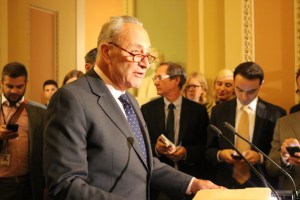
“We want to move the issue forward, we’re looking at all of these,” he said.
Observers said that the lack of a clear funding mechanism is a major weakness of Sanders’ new bill.
Gerald Friedman, an economics professor at the University of Massachusetts who has worked with Sanders on this issue, said that though he sees it as positive that many senators are getting behind single-payer, it is not very meaningful without a funding plan.
“Honestly this is not serious,” Friedman said. “It’s a bumper sticker that ‘We want single-payer.’”
Without a proposal, he said, critics will say that Sanders is not serious about the proposal, that it’s so expensive that supporters don’t want to discuss it, or that proponents couldn’t come up with a way to fund it — which, Friedman said, is not true.
“If you put out numbers, you’ll be criticized,” Friedman said. “If you don’t put out numbers, it’s even worse.”
Ken Thorpe, a health care policy expert at Emory College, said that while he was pleased to see the concept of universal health care gaining support, he hopes there will be efforts in Washington to improve the existing Affordable Care Act.
Thorpe said there are lessons to be learned from Vermont’s ill-fated attempt to implement single-payer health care under the administration of former Gov. Peter Shumlin. There are very different challenges with establishing such a system on a national scale.
“No matter how you design it, you create enormous winners and losers,” Thorpe said.
Sanders’ plan would provide considerably more generous benefits than a plan Vermont lawmakers, led by then-governor Shumlin, attempted to implement.
Shumlin ultimately abandoned the idea in late 2014 citing the high costs. The price tag would come in at an estimated $2.6 billion, which the administration considered paying for with an 11.5 percent payroll tax on employers and income tax up to 9.5 percent.

At a weekly caucus press conference Tuesday, Sen. John Barrasso, R-Wyo., said that “it seems that this complete government takeover of health care is becoming the litmus test for the liberal left.”
Earlier on Wednesday, as a group of Republican senators unveiled legislation that they billed as a “last shot” at repealing Obamacare. Their proposal would replace payments to states under the Affordable Care Act with block grants, as well as making other changes to the law.
During the press conference, Sen. Lindsey Graham, R-S.C., took a shot at Sanders’ bill.
“He won’t tell you what it costs, and he won’t tell you how he’s going to pay for it,” Graham said. He cited projections that estimate costs of Medicaid and Medicare will increase substantially in coming years.
“What Bernie is a doing is a great disservice to our country,” Graham said.
Sanders fired back at his Republican critics when he spoke at the unveiling of the bill, attacking his colleagues across the aisle who voted to repeal Obamacare.
“You the Republican Party have no credibility on the issue of health care,” Sanders said.
But despite the apparent jubilance during Sanders’ event, the mood among supporters was muted.
Paki Wieland, 73, of Northampton, Massachusetts, attended the event while in the capital with the activist group Code Pink. She’s very supportive of moving toward universal health care, but acknowledged there are significant obstacles.
“I would like to be more hopeful,” she said.
