

(“Then Again” is Mark Bushnell’s column about Vermont history.)
[W]hen the storm abated, Louise Andrews Kent took a moment to jot a letter to her husband, who was in Boston and hadn’t seen the devastation in his home state.
“The rain she rain. The wind she blow. The rain she rain some more,” she began her letter on Sept. 22, 1938, the day after what has since become known as the Hurricane of 1938 blew through Vermont. The storm flattened thousands of trees, triggered widespread flooding, caused $12 million in damage and claimed seven lives.
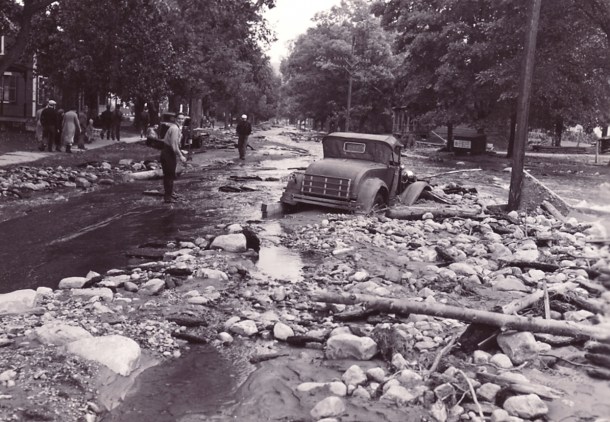
Storm damage was more widespread even than that caused by the Flood of 1927, if not nearly as costly. The hurricane’s fierce winds reached every corner of the state. The flooding caused by the rains it brought was severe, particularly in southern Vermont.
Vermonters could be forgiven if they thought they were immune from hurricanes. Such storms tended to affect coastal areas only. In fact, the last such hurricane to hit the state had been in 1788, according to historian David Ludlum in his “Vermont Weather Book” – not exactly in living memory.
This hurricane was a freak event. It started ordinarily enough as a tropical storm brewing in the Caribbean. It smashed into Florida and proceeded up the coast. While such storms usually swerve out to sea somewhere along the Carolinas, this one just kept coming north. It raked across Long Island, then hit southern New England before roaring up the Connecticut River valley into Vermont.
The storm’s path took forecasters by surprise. They could provide residents of southern Vermont only about three hours’ warning of what was coming.

The winds, fortunately, began to slow just as the storm ventured into the state. That was caused by a combination of the friction generated by the storm passing over Vermont’s undulating landscape and the distance from its source of moisture, the ocean, Ludlum explained. Winds were averaging 118 mph between 5 and 6 p.m. as the center of the storm was about to cross into Vermont. But by the time it reached the center of the state, its sustained winds had dropped to 47 mph.
Still, the winds devastated orchards and maple sugar woods. A sugarmaker in Cabot lost roughly 2,600 of the 3,500 maples he tapped, and a Walden sugarmaker lost 4,000 of his 5,000.
But the damage was worst in southern Vermont, where winds and rainfall were highest. Over the previous eight days, Brattleboro had received 7 inches of rain. The hurricane dropped an additional 4 inches on the area. The wind had grown throughout the day and was fierce by 4 p.m. At 5:30 p.m., just before the center of the storm passed overhead, the town lost electrical power.
The new movie theater at the Latchis Hotel in downtown Brattleboro was supposed to open that night. But instead of filling with patrons, it filled with water. Debris from falling trees and power lines and parts of roofs stripped by the wind littered the roads. Police, aided by National Guard members, rescued residents from neighborhoods cut off by floodwaters. Elsewhere in Windham County, a Massachusetts man was killed by a falling tree and a 2-year-old boy was swept away by floodwaters and drowned.

In Montpelier, the winds blew down a chimney atop the Pavilion Hotel, raining bricks onto frightened guests in rooms below. The restaurant in the hotel’s basement, however, was buffered from the noise. “People were dining and drinking by candlelight, chatting casually and lighting cigarettes from the flames,” one witness later recalled. “It was somehow what you would imagine war days to be like – tenseness beneath light laughter and gaiety. There was rather more drinking in the candlelight than ordinarily – another war-time symptom.” By midnight, the restaurant had run through its liquor supply.
On the day after the storm, with so many trees to clear from roads, so many miles of those roads to repair and so many buildings to fix or tear down, Vermonters tried to get back to normal quickly.
The storm had made it difficult for Bellows Falls Cooperative Creamery drivers to pick up milk from all its member-farmers. But early the next morning, the co-op had its regular milk delivery ready to be shipped to Boston.
Louise Kent also tried to get on with life. She ventured out from her home in Calais. Reaching nearby Middlesex, she found that the storm had taken out a bridge, or perhaps just covered it with mounds of debris — she couldn’t tell which. The water was so high in the Wrightsville Reservoir that it reminded her of Lake Massawippi in Quebec. Despite the high waters, the dam, which had been installed in the wake of the 1927 flood, had held. New dams all along the Winooski River had saved communities from the ravages they had suffered 11 years earlier.
Along her route, Kent saw everywhere a soaking wet world. “Every field is an oozing sponge,” she wrote.
Apparently unaware how widespread the damage was, Kent headed to Tunbridge, where she hoped to take in that town’s famed World’s Fair. But some things were different on Sept. 22, 1938. As she explained to her husband, conditions in Vermont were so rough that “even the World’s Fair was postponed.”
