

Editor’s note: Jon Margolis is VTDigger’s political columnist.
[S]omething new is going on in American politics and Vermont – or at least one Vermonter – gets some of the credit.
Or blame, depending on one’s outlook.
What’s happening is a resurgence of interest in (and some support for) that once-reviled political creed: socialism.
Last month some 2,000 supporters attended the Democratic Socialists of America annual convention in Chicago, and the group now has 25,000 members, according to Joseph M. Schwartz, a political science professor at Temple University, who is on the DSA national political committee.
“It’s the largest democratic socialist organization in America since the 1930s,” Schwartz said.
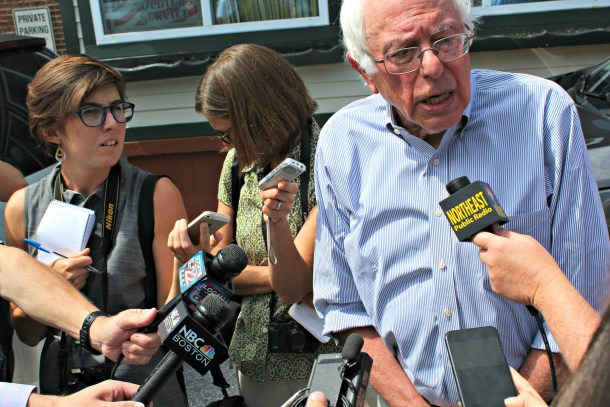
And it wouldn’t have happened without Vermont’s own independent Sen. Bernie Sanders.
Running against Hillary Clinton as an avowed “democratic socialist” last year, Sanders failed to get the Democratic nomination for president. But in the words of a DSA statement, he “exposed countless young people to the idea of democratic socialism for the first time.”
A lot of them, it seems, were and are favorably impressed. And maybe not just young people. Sanders, according to a recent poll, is the best-liked politician in America.
Not that democratic socialism is sweeping the country. Polling makes clear that at least 60 percent of Americans prefer a capitalist system, with no more than 35 percent even having a “positive image” (the Gallup Poll’s wording) of socialism.
But 35 percent is not a tiny minority, and other polls show that while most younger Americans are not socialists, they’re not all that impressed by capitalism, either.
Maybe because they haven’t done very well by it these last few decades.
Besides, for younger people, the word “socialism” is less likely to invoke memories of the tyrannical, terrifying, Soviet Union and more likely to bring to mind universal health insurance, free college tuition, and Bernie Sanders, who is neither tyrannical nor terrifying.
“Sanders legitimated the term,” Schwartz said.
Even though Bernie Sanders is not a socialist. When he was asked to explain his ideology last year, Sanders would often reply that he hoped the United States would become more like Denmark.
A very impressive country, Denmark. It’s one of the world’s richest, and on the most recent “Happiness Survey,” Danes stood as the happiest people on earth. The United States was 13th.
But Denmark is not socialist. Its private, for-profit economy is dominated by multinational corporations such as pharmaceutical giant Novo Nordisk and the Carlsberg beer-brewing firm. The very pro-capitalist Index of Economic Freedom run by the very conservative Heritage Foundation and the Wall Street Journal ranks Denmark 12th, just a smidgen behind the United States. (First and second are Hong Kong and Singapore, where there isn’t much non-economic freedom.)
What Denmark does have is strong legal protection of workers’ rights and generous public benefits such as paid family leave, child care, health care and education. It’s a robust social democracy, which appears to be what Sanders means by “socialism.”
But that’s not what the real socialists mean. They distinguish themselves from others on the political left by espousing “economic democracy,” in which most goods and services are produced by something other than for-profit firms and individuals, though not necessarily by the government.
A socialist economy, Schwartz said, would be full of worker-owned and cooperative enterprises. “The state would own some,” he said, ”but then the question is: Who owns the state? If it isn’t democratic, it isn’t socialism.”
As has been true for decades, today’s socialists lack a precise plan for getting from where the world is to where they want it to be.
“Our vision of democratic socialism is necessarily partial and speculative, and is in no way intended to be a blueprint,” the Democratic Socialists of America said in the “Resistance Rising” document it adopted at its 2015 convention. “The specific contours … will be democratically determined … by those who live it.”
A combination of admirable open-mindedness and a cop-out.
But a certain amount of copping out comes with the territory of any idealistic reform movement, and it isn’t that socialism is devoid of ideas. On the contrary, part of the revived interest in socialism comes from the intellectual vigor of the relatively new (2010) journal Jacobin, which claims 1 million web visits a month, and the quarterly magazine Dissent, founded in 1954 (by Norman Mailer among others), now featuring news and analysis by energetic young scholars and journalists.
And even some advocates of capitalism acknowledge that it may not last forever. Nothing does, and capitalism is a human creation, and therefore flawed.
In an interview on the website Vox, Eric Weinstein, the managing director of an investment firm run by ultra-right-winger Peter Thiel, said recently that “market capitalism … was actually tied to a particular period of time” and could be replaced by “a hybrid model” combining aspects of capitalism and socialism.
If such a change occurs, it is likely to evolve gradually rather than via some political cataclysm. That could explain why socialists advocate social democratic policies – a higher minimum wage, Medicare for all, stronger labor unions — as steps along the way to their ultimate goal. Socialism itself may not have much support in America. Many of its specific proposals do.
Socialists do face one powerful argument against their system: It does not exist anywhere. If it’s a good idea, why haven’t the people of any country freely decided to adopt it? In what professor Schwartz conceded was “something of a problem,” no democracy has chosen socialism. They all prefer a market economy dominated by private enterprise.
Does this prove that socialism is either impractical or undesirable?
Probably, at least for now.
But that applies to other political ideologies, too, and to none more than the one that might be considered socialism’s polar opposite: economic libertarianism, or free-market purism. Just as every modern, prosperous, enlightened democracy has chosen a market economy, every one of them has chosen, to one degree or another, to be a social democracy, where law buffers the roughest edges of the market and protects people from its adverse consequences.
And does this prove that social democracy is necessary?
So it seems.
