

[A]n article in a law journal argues that the private school system as it currently operates violates a landmark Vermont Supreme Court decision.
The article was the subject of considerable discussion at a Monday meeting of a committee charged with examining what rules private schools should have to follow to qualify for state funds.
Whether private schools should be required to provide special education services and other public school requirements has been at the center of a heated debate.
In some Vermont towns where there is not a local school, families send their children to a designated private school with tuition paid by public funds. Some advocates argue that those schools should be required to provide accommodations to students with disabilities.
The analysis by attorney Christina Rainville, published in the summer edition of the Vermont Bar Journal, asserts that the current system does not comply with Vermont law, including the 1997 landmark court decision Brigham v. State, which requires children have an equal opportunity for an education. The case largely focused on how schools were funded and inequities between communities, with some cities and towns having low tax rates and others high.
“It does not appear that an education system that denies students with disabilities the opportunity to attend their taxpayer-funded community independent school can withstand scrutiny under Vermont law,” Rainville wrote.
Rainville is an attorney with a Springfield law firm and a member of the board of the advocacy group Disability Rights Vermont.
Student with disabilities have “a legal right to be admitted to and be accommodated in taxpayer-funded independent schools,” she concluded.
The members of the committee, which includes lawmakers and representatives from independent schools and public education associations, referenced the article as they put forward proposals on how to address the current system.
Jeff Francis, who heads the Vermont Superintendents Association, said after the meeting that he believes if a child’s education is funded by public dollars, he or she should have access to the services available through public education.
“There has not been a court case on this, I don’t know that there ever will be one,” Francis said. “But as a proponent of kids, and in this case kids that are funded with public dollars, it seems that we ought to be looking for the most equitable system we can find through which to serve them.”
Asked if Francis believes the current system is in violation of the Brigham decision, he demurred.
“To me that’s maybe an issue that’s better left to attorneys,” he said.
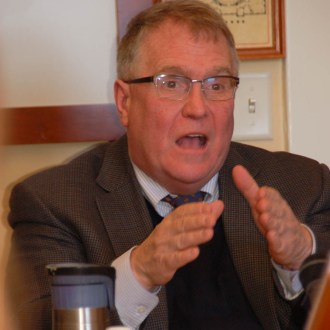
Others, including legislative council attorney Jim Desmarais, disagreed with Rainville’s conclusion.
In April, at a lawmaker’s request, Desmarais reviewed whether independent schools are required to offer open enrollment policies or special education services under federal and state laws. He found that “it is clear” that schools are not required to do either.
Desmarais told the panel Monday that it is possible if a case were brought in Vermont court, a judge would decide that private schools are in violation of state law. However, he doesn’t believe there is enough precedent to decisively say a court would come to that conclusion.
“The article says that it would and I think that’s going too far,” Marais said.
Seth Bongartz, longtime board chair of Burr and Burton Academy in Manchester, said that expecting private schools to provide special education services on par with public schools would be a financial impossibility for many of the state’s smaller schools.
More broadly, Bongartz argued that requiring some private schools to meet the same requirements as general purpose schools would impede their ability to serve students with specific needs — in some cases, the reason the schools were founded to begin with. Many private schools specialize in serving needs of students who don’t thrive in traditional school environments, he said.
Instead of considering whether every school provides the same services, Bongartz argues for a systemic approach. While one smaller independent school may not offer special education services, another school may be able to provide those services.
“We want to make sure that every kid in Vermont has the services that they need, just like everybody else does,” Bongartz said.
Sen. Phil Baruth, D-Chittenden, chair of the Senate Education Committee and a member of the study committee, said the argument over whether the current system is in violation of the law is outside of the committee’s scope.
“Speaking for myself, I think it’s moot in a certain sense,” he said.
The committee was formed to decide “how approved (independent schools) will deliver special ed, not whether,” he said.
