

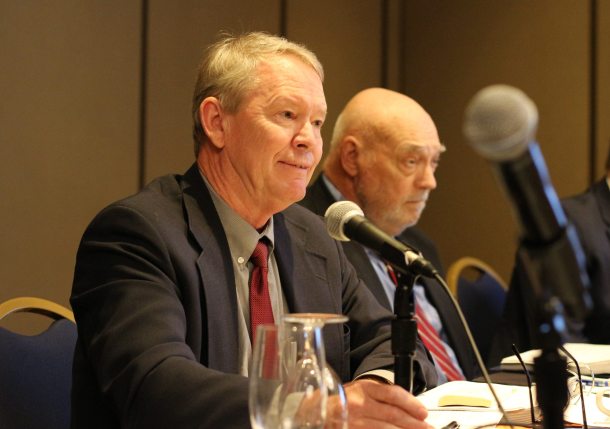
[V]ermont physician groups are asking Gov. Phil Scott to choose a health care provider to fill a seat on the Green Mountain Care Board that will open when Con Hogan leaves his post this fall.
Hogan, who has served on the board since it started in 2011, will complete his term at the end of September. He is known for running the Agency of Human Services in the 1990s and unsuccessfully running for governor in 2002 as an independent.
Now, Hogan’s decision not to seek reappointment has kicked off a campaign in the health care community to ensure that a health care provider sits on the Green Mountain Care Board, which regulates hospital budgets and insurance premiums, among other things.
The process for naming his replacement is spelled out in Act 48 of 2011. That law does not require that one board member be a health care provider, although lawmakers considered imposing that requirement when the Legislature was working on the law.
The board does not currently have a health care provider. Dr. Allan Ramsay, a family doctor, sat on the board from 2011 until his term ended in September 2016, and Betty Rambur, a nurse practitioner, sat on the board from 2013 until she relocated in January.
The current members are chair Kevin Mullin, a former state senator; Robin Lunge, a lawyer and health policy expert; Jessica Holmes, an economist; Maureen Usifer, a financial analyst; and Hogan, a retired human services administrator.
In accordance with the Act 48 process, the Vermont Department of Human Resources posted a job listing seeking applications for Hogan’s position. The deadline was Aug. 4. The department will now forward the applications to the Green Mountain Care Board Nominating Committee.
Ramsay, the head of the nominating committee, would not say how many people applied. He also said pressure from outside groups would not influence who was on the list they send to the governor.
“That can’t and won’t change the way the nominating committee goes about its process,” Ramsay said. “We have to deal with the applications that we receive.”
The committee is a bipartisan group appointed by lawmakers and the governor that is required by law to interview candidates and create a short list of people who are qualified based on the Act 48 criteria. In the fall, Scott will either choose a person from that list to fill Hogan’s seat, or tell the committee to go back to the drawing board.
The Vermont Medical Society and the Vermont Academy of Family Physicians have sent letters to Scott saying that he should pick a health care provider. The medical society, which represents 2,000 physicians and physician assistants, says the person can be any type of health care provider. The academy of family physicians says Scott should pick a primary care doctor.
“The long term credibility and effectiveness of the Board depend on having clinician Board members,” Paul Harrington, the executive vice president of the Vermont Medical Society, wrote in a letter Aug 10.
“A medical professional will bring to the policy arena the experience of having directly seen the impact of prior health care policies both on their own practice environments and on their patients,” Harrington wrote.
“Clinicians can not only help bridge the gap between medical practice and policy but have a unique vantage from which to spot opportunities for innovation and help translate policies into terms other clinicians can understand and adopt,” he wrote.
“Finally, a clinician is ideally poised to help address the critical issue facing Vermont of recruiting and retaining a viable health care workforce, such as by reducing the administrative burdens that have been recognized as a major factor in the epidemic of clinician burnout,” he wrote.
Dr. Fay Homan, the president of the Vermont Academy of Family Physicians, wrote in a letter June 28 that there has been no primary care physician on the board since Ramsay, but “primary care is the foundation on which cost-effective, quality health care is built.”
“While the current board members have strengths in policy and finance, the voice of a primary care physician, who understands the day to day challenges of practice and patient care, is lacking,” Homan wrote.
“This perspective is vital to ensure the success of the regulatory and reform work of the GMCB,” she wrote. “If you wish, we will offer our help in recruiting and identifying prospective candidates.”
Jessa Barnard, the lobbyist for the Vermont Medical Society, said the group spread the word about the board opening with its members to encourage them to consider the job, and “at least a few” have applied.
In the event that Scott does not appoint a health care provider to Hogan’s seat, Barnard said the medical society would seek to change the statute to require a health care provider to sit on the board. “We are open to that being a possibility,” she said.
Barnard acknowledged that it would still be hard for a health care provider to sit on the board because the person would need to stop practicing medicine to avoid having a conflict of interest. In Ramsay’s case, he left a high-level job to sit on the board and instead volunteered at a free clinic in Barre.
“That’s probably one of the reasons why we haven’t seen a clinician take on one of the other recent vacant seats,” Barnard said. “We understand that we may need to cast the net as wide as possible to get somebody who’s had that exam room experience.”
Mullin, the chair of the Green Mountain Care Board, said he would like to see a health care provider sit on the board to increase diversity and credibility, but that a person should not be chosen “just because they are a provider.”
“In a perfect world we’re going to have someone who’s truly dedicated to reducing health care costs in the state and be a provider,” Mullin said. “Without (being a provider), I’d say let’s get the first part first, but I think that a provider would be an excellent fit.”
“It adds some credibility, because the last thing you want is someone working in the field saying ‘Well what do you know? They’ve never worked in a hospital or worked in a doctor’s office,’” he said.
Mullin said the average doctor makes about $200,000 per year, so the board could not afford to hire a health care provider as a staff member, much like the board can’t afford to have an actuary on staff to work on health insurance cases.
The 32-hour-per-week position on the Green Mountain Care Board pays about $97,000 per year and has a term of six years.
