


The mother of a woman who died in a car accident is upset that her daughter’s fiance was able to remove jewelry from the body at the state morgue and snap photos that ended up online.
The state says its Office of the Chief Medical Examiner doesn’t have a written policy for who can view bodies at its morgue in Burlington, but that it makes a point of accommodating visitors.
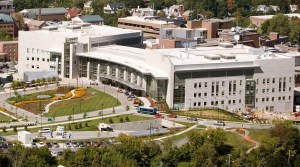
The office, located in the bottom of the University of Vermont Medical Center and run by the Vermont Department of Health, is a medical facility where staff review all deaths in Vermont.
The office is one of the only morgues in the country that regularly allows loved ones — even when they are unrelated or not the next of kin — to view remains, according to Steve Shapiro, the Health Department chief medical examiner.
There is no written policy for who can view a body, according to Ben Truman, the spokesperson for the Department of Health, and the morgue is not required to have one to be accredited. Truman said the people who have been allowed to view bodies in the morgue have included ex-spouses, friends and neighbors.
That lack of a written policy is a factor in a dispute over jewelry that a woman named Amanda Atkins, 33, was wearing when she died in May in a car accident. Her fiance, Timothy Bentley, said he visited the morgue to see her body, took pictures with her, and left with her jewelry.
In an interview, Bentley said Atkins was wearing a necklace that belonged to his grandmother and the engagement ring he gave her. He said staff at the morgue allowed him to take the necklace and ring from her body.
Tracy Krebser, Atkins’ mother and next of kin, said she found out Bentley was able to visit Atkins in the morgue when she saw pictures on his Facebook page of him kissing Atkins’ lifeless face.
Krebser said the funeral director then told her someone had taken the jewelry from her daughter’s body. The Office of the Chief Medical Examiner eventually called the Vermont State Police to retrieve the jewelry but did not treat the incident as a criminal matter.
“We try and be as accommodating as we can to families,” Shapiro said of the practices at the morgue. “It’s really as simple as that. … You could imagine the family dynamics that we have. We just make it work. Most of it, in fact, essentially all of it, goes pretty smooth.”
“People come down and this is the only place that they’re going to be able to see (their loved one’s body), so we make it happen,” he said. In the emergency room just one floor up, Shapiro said, a family member would not be allowed to view a deceased relative.
“We’re one of the few medical examiner’s offices that actually does any family viewings,” he said. “Others say, ‘Call the funeral director.’ We make accommodations to do that, and for the most part — not even the most part, essentially all the time — families are so delighted that we made this happen for them.”
Jeff Levesque, the funeral director for Atkins, said Krebser instructed him to pick up the body and make sure the jewelry was there. “When I got to the medical examiner’s office, I inquired to make sure that I had it, and it was not there,” Levesque said.
He said he has never seen “anything like this at this point” in his career.
Krebser, who said she had planned to cremate her daughter with the things she was wearing when she died, said she also could not find a written record of who viewed the body or removed the jewelry.
Shapiro said in an interview that he was unable to discuss the specific incident involving Atkins. Contacted by VTDigger, the spokesperson for the state police called the incident “a family issue” and said the police would not criminally investigate.
In an interview, Bentley said he told the staff in the medical examiner’s office about his long relationship with Atkins before they allowed him to see her. Bentley said he told the staff when he was leaving that he was taking the jewelry and they didn’t stop him.
Bentley said he has known and loved Atkins since she was a teenager. He said the only reason he was not the one in charge of her funeral arrangements was that they were still engaged, so their marriage license had not been finalized.
But Krebser said the office should have “policies and procedures” to allow next of kin to keep track of who visits their loved one’s remains. And Shapiro, the chief medical examiner, said his staff got the jewelry back to the next of kin as soon as possible.
“It’s a horrible thing that that happened,” Krebser said. “It should not have happened. It shouldn’t happen to anyone else, and I don’t understand why (Shapiro is) so blasé about it.”
Shapiro said patient privacy laws known as HIPAA wouldn’t apply in this case because the incident did not involve sensitive medical records. He said the office does abide by HIPAA.
“There’s really no story here,” he said. “Let’s talk about how we make the worst possible outcomes in people’s existence at least human, and we try and do that here on a regular basis. It boggles my mind.”
Levesque said his funeral home does not allow anyone to interact with bodies other than the legal next of kin.
Brian Peterson, from the National Association of Medical Examiners, said “most offices have standards about viewing, whether by next of kin or others, but this varies widely by office. Often depends on the physical plant and the preferences of the staff with respect to scientific identification and so forth.”
In Wisconsin, where Peterson practices, he said the person’s ability to view a body would depend on what reason the person trying to view the body gives. “We would evaluate that reason and make the appropriate decision,” he said.
Truman, the spokesperson for the Vermont Department of Health, said: “As with all such losses, we very much empathize with the family and others this person left behind, and do our best to be human in their times of grief.”
“To the extent that we would comment on this particular instance, our general policies and practices were followed, and no criminal activity took place,” he said.
