

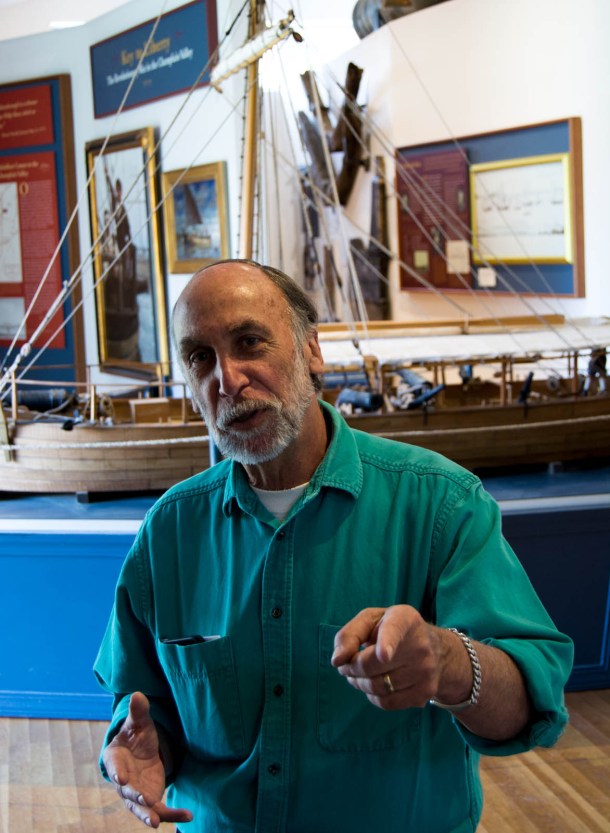
The Revolutionary War gunboat Spitfire sank after the Battle of Valcour Island in 1776.
After sustaining damage centuries ago at the hands of the British, it now faces another threat two decades after being found at its underwater resting place.
A survey of the lake’s bottom by the Lake Champlain Maritime Museum revealed the gunboat years ago. Since then, directors at the museum in Vergennes have been working on a plan, released to the public this year, to raise the boat from the depths.
“It was not a ‘pop the corks on the champagne’ moment, because I had preached for a long time that finding the shipwrecks was the easy part of the job,” said Art Cohn, director emeritus of the museum and principal investigator for the Spitfire management program. “Managing the shipwrecks as public value is hard.”
The new book “A Tale of Three Gunboats,” which Cohn co-wrote and the museum published in conjunction with the Smithsonian Institution, outlines a 25-year course of action for recovery, restoration and exhibit of the Spitfire.
The plan includes the construction of both a ship restoration facility in Burlington and a secondary location for exhibit post-rehab. The estimated cost for recovery alone is $4 million. With the construction of two facilities and about $1 million a year going into rehabilitation, the entire project is estimated at $45 million.

History of a gunboat
The 54-foot-long ship was equipped with eight swivel cannons, had room for 45 soldiers onboard, and also functioned as a rowing vessel. The hull and mast were constructed from white oak and the fastenings from iron, built in what is today known as the town of Whitehall on the New York side of the lake.
The Spitfire was one of several boats seriously damaged in the Battle of Valcour Island. The British won the battle, effectively seizing control of the lake and backing the Revolutionaries into the Northwest corner of the island. Fire ceased only as the night drew too dark to see the enemy, and the British waited to intercept the defeated Revolutionaries.
However, Gen. Benedict Arnold and his fleet were able to sneak away under cover of darkness, having greased their oarlocks and covered their oars with cloth to dampen the sound. The boats escaped silently, rowing single file past the enemy.
The British captured two abandoned boats the next day. The Spitfire sank.
“This boat is a tangible connection to all of this,” Cohn said. “It has enormous power to connect us to the early days of the United States. The boat is a priceless American artifact.”
The Spitfire came to rest on its bottom with the mast upright and the bow cannon in its original position. A thick layer of mud encompasses it and has acted as a preservative for the ship’s many fastenings.
Throughout Cohn’s career he’s helped identify more than 300 shipwrecks on the lake’s bottom, but it was the relatively unchanged condition of the Spitfire after more than 200 years under water, as well as its cultural significance, that prompted the idea to raise and restore the vessel.
“It’s the perfectly preserved time capsule for that moment in time,” Cohn said. “But we predict this boat will eventually be a pile of lumber on the bottom of Lake Champlain.”
An invasive enemy
What prompted the museum’s survey of the lake bottom 20 years ago was the introduction of the zebra mussel, an invasive species of mollusk that arrived around 1993 and proliferated quickly, according to the Lake Champlain Committee, an environmental advocacy group.
The biggest threat to the integrity of the Spitfire is the introduction someday of the quagga mussel into Lake Champlain, which many consider inevitable. The quagga, already abundant in the Great Lakes, can colonize at greater depths than the zebra and, according to Cohn, will eventually encrust the vessel. These mussels excrete sulphur-reducing bacteria that will destroy the fastenings keeping the boat intact.
“Quagga mussels are in all the Great Lakes and in the St. Lawrence,” he said. “Sooner or later some boat is going to transport them here. It’s just a matter of time.”
Although the recovery and restoration of the Spitfire would be expensive and complex, Cohn is not worried about how to fund it. He co-founded the maritime museum in 1986, only one building at the time, and has watched and helped it grow into a 14-building campus with floating replicas and youth outreach programs.
“If it’s right the money will come,” he said. “If you come up with a sound concept and a good idea that has the power to enrich the community, the community will fund the project.”
If not, the quagga mussel will destroy the fastenings that hold the ship together, that held the oars in place, allowing Benedict Arnold and crew to escape.
