

(This story is by Rob Wolfe, of the Valley News, in which it first appeared July 4, 2017.)
[M]aintenance workers and residents around the Upper Valley on Monday continued to shore up roads and restore their connections to the world after a train of thunderstorm cells buffeted the region over the weekend.
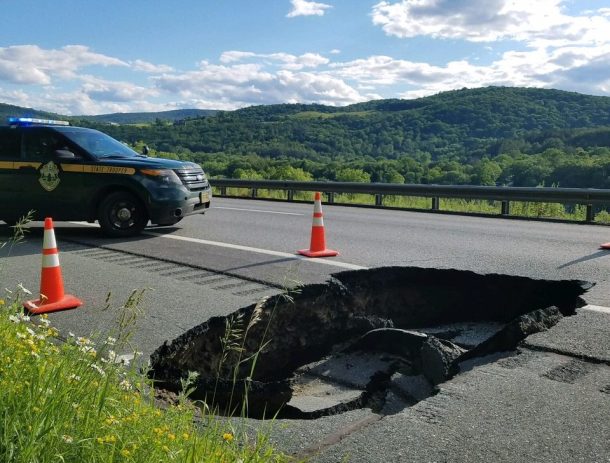
That work involved a shutdown of Interstate 89 northbound Monday evening as a large sinkhole developed between exits 1 and 2. The fissure filled the breakdown lane and had officials working late to try to reopen the interstate by morning. It was reopened by 4:30 a.m., according to a Vermont State Police news release.
In White River Junction, businesses and residents were displaced from a cluster of buildings near the intersection of VA Cutoff Road and Old River Road after a railroad berm failed and swamped the area with mud, water and debris, officials said.
In Norwich, the acting town manager said road damage was worse than in 2011 when Tropical Storm Irene washed through the region, took out roads and bridges, and drew significant disaster relief aid from the Federal Emergency Management Agency.
The repairs were especially urgent in Thetford, where the emergency management director estimated that up to a quarter of homes could have limited road access.
“The priority is people who are trapped,” Mariah Whitcomb, director of emergency management there, said in a telephone interview Monday. “We need to make sure we have emergency access and fire access. … The folks on the other side, we have made door-to-door, face-to-face contact with them, and they’re OK.”
Whitcomb said the number of households that were entirely cut off was constantly changing, but guessed that, including those homes and others that are inaccessible because of ruined driveways, “it still could be a quarter of our town.”
“I would like to thank our community for their patience and for their willingness to help their neighbors,” she added. “That has been a huge assistance to our work on the recovery.”
Selectboard Chairman Stuart Rogers on Sunday said that “50 residents at least” were stranded, though some areas since have been opened to cars.
Those reconnected roads included Van Norden Road and Potato Hill Road where they connect with Turnpike Road South.
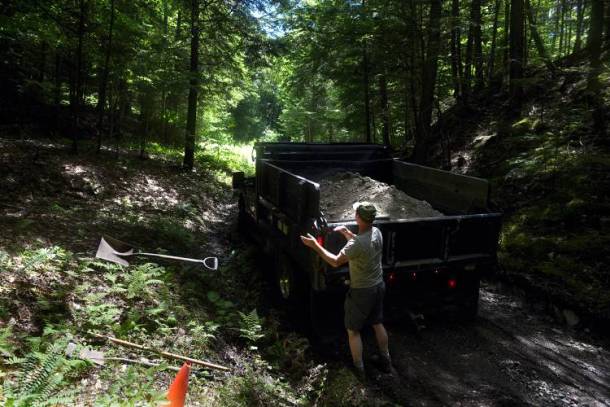
By Monday afternoon, road crews had filled the maw with earth, and cars were able to use side roads again.
Laura Caravella and Mike Watson, who live nearby, were out cleaning silt from their well Monday. They said they had been dug out around 6 p.m. Sunday. Caravella said they spent the night of the storm in their nearby cabin, to which they evacuated for fear that a tree might come down on their house.
A nearby stream that night had swelled into a rushing river under Turnpike Road, Caravella said, carrying away the roadbed and bringing down trees.
“The smell was amazing,” she said. “It was fresh earth everywhere. It sounded like thunder, the boulders crashing into each other.”
Once she got over the shock of it, she said, “it was amazing to see what nature could do.”
Hartford, the Upper Valley’s population center in Vermont, fared better than the northern reaches, according to town officials.
“Today, we’re not too bad,” Hartford Town Manager Leo Pullar said, adding that all roads had been reopened and that most damage had been residential. Repairs might cost between $200,000 and $400,000 for municipal infrastructure, he said.
Pullar said two households had had to be evacuated, both near the intersection of VA Cutoff Road and Old River Road, where a railroad berm failed. He said a mobile home had been knocked off its foundation and later was reset. A young family living above a beauty shop also was displaced because the building was condemned. Both families have been linked up with the Red Cross, he said.
Chuck Gordon, the owner of several buildings near that intersection that included the young family’s home, said his properties had been hit by water and debris carried by the mudslide. As of Monday evening, he had been unable to reach his lawyer or enter his building to assess the damage.
“It’s the not knowing that’s killing us,” he said. “It would make me feel a little better if I could get in there and start cleaning stuff up.”
In Norwich, acting Town Manager Phil Dechert said most areas with the worst road washouts, including Route 5 North, are now accessible, though in some areas to a limited extent, he said.
“We have a lot of road damage, definitely more so than we had in (Tropical Storm) Irene,” Dechert said in a telephone interview Monday. “(There was) a lot of water, a lot of rain. Very quickly it generated a lot of power and a tremendous amount of erosion that we have not seen before.”
As in Thetford, some Norwich residents off Turnpike Road have no access by car to their homes, Dechert said.
“Particularly on the back roads we are asking that people use extreme caution and be careful,” he said.
Dechert said repair cost estimates would be available later in the week after state transportation officials visit Norwich on Wednesday to assess the damage. State engineers went to Thetford on Monday to take a similar inventory.
Emergency management officials in West Fairlee and Bradford could not be reached for comment.
Despite the hard labor from emergency workers, transit disruptions continued into Monday evening as Vermont State Police closed Interstate 89 northbound at Exit 1 and diverted traffic.
A “large sinkhole” had developed near mile marker 7.8, Hartford emergency officials wrote on Facebook Monday evening.
Vermont Agency of Transportation spokeswoman Jacqui LeBlanc said Monday night that officials were working late to assess the damage and determine a cause.
She couldn’t definitively say whether the recent rain contributed to the situation, but said “it’s definitely a possibility.”
“We are doing the best we can to get it repaired in a timely and safe manner,” LeBlanc said.
The agency tweeted early Tuesday that the highway had reopened but was restricted to one lane because of the sinkhole.
/
