

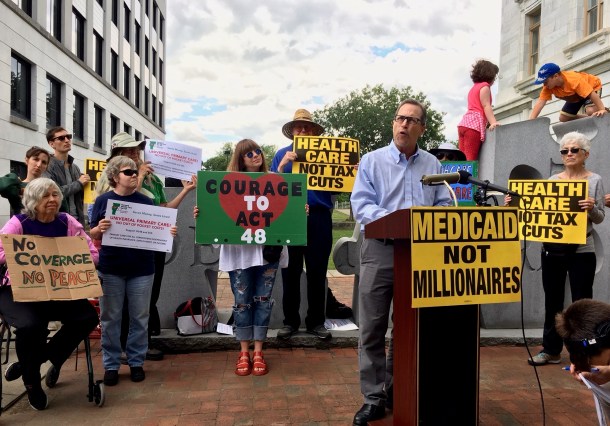
Roughly 60 people gathered on Main Street holding printed yellow signs that read “Medicaid not Millionaires,” while others held handmade signs bearing messages such as “No coverage, no peace” and “GOP to disabled Americans: Drop dead.”
Speakers Wednesday shared personal stories about their health care experiences, blasted the GOP legislation intended to replace the Affordable Care Act, and urged Vermont officials to press ahead with health care reforms at the state level.
Many expressed concern about the impact Medicaid cuts would have on people with disabilities who rely on the program to live independently.
Scott, a Republican, wrote to Senate leaders of both parties this week voicing “significant objections” to the House-passed American Health Care Act and to the Better Care Reconciliation Act currently in the Senate.
Both pieces of legislation would reduce federal support for Medicaid, which Scott said would undermine Vermont’s progress reducing its uninsured rate as well as its ability to fight opiate addiction — which is paid for largely through Medicaid.
The letter also raises alarm about what might happen to private insurance offered on the individual market, saying the bills would cause some customers to lose coverage while others would face higher premiums and out-of-pocket costs, placing their “financial security” at risk.
Despite his letter, the activists called on Scott to speak out more forcefully against the passage of the Senate health care bill and to press ahead on reforms to health care funding in Vermont.
Vermont officials have said a GOP bill that passed the U.S. House in May would result in a $200 million reduction in federal support for the state’s Medicaid program. A recent analysis by the Kaiser Family Foundation found the Senate bill currently under consideration would increase health insurance premiums on the state’s exchange by 21 percent.
Phil Fiermonte, state director for U.S. Sen. Bernie Sanders, I-Vt., read a statement from the senator panning the Senate bill as a massive tax break for the wealthy that would leave tens of thousands of Vermonters without adequate coverage.
“We had a win this week,” Fiermonte said, referring to Senate Republican leaders’ decision to put off a vote on the Better Coverage Reconciliation Act until after the July Fourth recess, apparently for lack of support.
“But the fight isn’t over,” Fiermonte added, urging Vermonters to continue to make their voices heard.
Kate Kanelstein, director of the Vermont Workers’ Center, said it’s not enough for Vermont activists to play defense against a disastrous health care bill in Congress. They need to apply pressure to leaders in state government to implement Act 48, legislation passed in 2011 that calls for publicly financed health care in Vermont. That could be a single-payer system or a public option offered alongside the private insurance sold through Vermont Health Connect.
“My message to Vermont’s politicians is, ‘You don’t have to stand by the sidelines either and say our hands are tied because of what’s happening in Washington,” Kanelstein said.
“We have an opportunity to set an example of a fundamentally different way in Vermont for our country, and we’re going to be counting on you to do that,” she said.
Dr. Alan Ramsay, a former member of the Green Mountain Care Board — Vermont’s health care regulatory body — said he agrees. The uncertainty in Washington should be seen as an opportunity for Vermont to press ahead with health care reforms. He mentioned, for example, an existing proposal for publicly financed universal primary care.
Ramsay said the BCRA would flood the People’s Health and Wellness Clinic in Barre where he works — a clinic that caters to the uninsured, Medicaid beneficiaries and people with insurance they can’t afford to use.
“There’s two things that are going to happen. No. 1, the emergency rooms are going to be full, and No. 2, I’m going to have to recruit a lot more volunteers at the People’s clinic, because I’m already getting busier and busier,” Ramsay said.
