

WikiCommons Photo
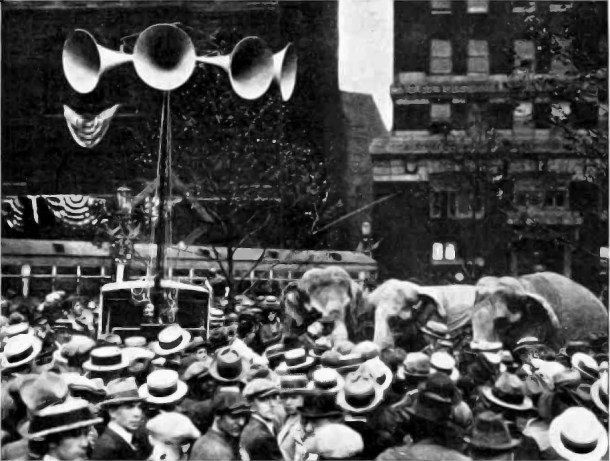
A crowd listens to speeches broadcast from speakers outside the Republican National Convention in Cleveland in 1924.
Coolidge wasn’t the first president to use the radio. Warren Harding had briefly done so before him. Harding gave the first presidential radio address in June 1922, but he died barely a year later, before he could truly take advantage of the medium. Upon Harding’s death, Coolidge became president. He would soon become the first president to use the airways as a campaigning tool.
With radio ownership expanding exponentially during the ’20s, the medium allowed Coolidge largely to avoid the campaign trail. He could leave the hand shaking, backslapping and baby kissing to his running mate, Charles Dawes, and instead remain in Washington to govern, while making the occasional speech that would still reach millions of Americans. At a time when Coolidge’s Republicans were outspending their Democratic rivals 3-to-1 for airtime, radio gave him a clear advantage.
The GOP’s plan to rely heavily on radio took shape in the run-up to the 1924 elections. The president had received a letter that March from a member of the public, suggesting he take advantage of radio during the race. Coolidge’s personal secretary, Campbell Bascom Slemp, responded by writing, somewhat stiffly, “(We) look to the utilization of this very valuable instrumentality in precisely the fashion which you suggest.”
The idea of a candidate being able to put himself before the people in voice, but not in body, struck some people as odd. “Thousands of people are going to vote for or against Mr. Coolidge on account of his voice,” observed the New Republic. “While Mr. Harding was known to most of us as a photograph, already to many, even to those who have never heard him, Mr. Coolidge is distinctly known as a voice, a nasal New England voice.”
In fact, some claimed that radio was kind to Coolidge’s nasal delivery, smoothing out its rough edges. “He developed talent as a radio speaker,” wrote William Allen White in his 1925 book, “Calvin Coolidge: The Man Who is President.” “He spoke slowly, used short sentences, discarded unusual words, was direct, forthright and unsophisticated in his utterances. And so, over the radio, he went to the popular heart.”
In typical Coolidge fashion, during the campaign he had “little to say and said it well,” White noted.
The same could be said of the speakers at that year’s Republican National Convention, which was the first ever to be broadcast on radio. Humorist Will Rogers quipped that the convention was so uneventful that “it could have been done by postcard.” But 20 million Americans, of a total population of about 115 million, had tuned in to hear the orderly nomination of Coolidge.
In contrast, the Democrats’ convention was anything but orderly. And radio did the party no favors in broadcasting that fact. The deep divisions within the party — about everything from Prohibition to the Ku Klux Klan to religious fundamentalism — were clear to the listening audience.
Where radio had been kind to Coolidge, it worked against his opponent, John Davis, a former U.S. ambassador to Britain. If not for radio, Davis might have won.
“Davis is tall, with a face that would fit in a group picture of the signers of the Declaration of Independence …” wrote political columnist Mark Sullivan in 1924. “Coolidge looks shorter than he is; his features are sharp and give a probably unjust impression of peevishness. Before an audience Davis glows, while the President always looks unhappy whether he is or not. …So the advent of radio must be listed as one more item in the total of the Coolidge luck or destiny or whatever it is that seem to make things come right for him politically.”
Coolidge knew the medium suited him.
“I can’t make an engaging rousing, or oratorical speech to a crowd like you can,” Coolidge once told Indiana Sen. James E. Watson, “…but I have a good radio voice, and now I can get my message across to them without acquainting them with my lack of oratorical ability or without making any rhetorical display in their presence.”
National Republican officials also put others before the microphone to promote their candidate. Ernest Carpenter, one of Coolidge’s childhood teachers in Vermont, had been sharing his memories of the president while touring high schools and branches of various civic groups like the Rotary Club. Carpenter wrote to Coolidge that the National Republican Committee had “made arrangements for me to broadcast some of this Plymouth stuff over the radio.”
Coolidge understood the power of radio for society as well, calling it a “great blessing.” But he feared its power could be misused. Coolidge admonished radio stations to ensure that “no malice of slander” be broadcast. He also warned that parents must “double-guard the radio,” because though parents could “exclude corrupting literature from the home, radio reaches directly to our children.”
Radio helped secure Coolidge’s re-election, so it is fitting that his inauguration on March 4, 1925 was the first one broadcast to a radio audience. When Harding had spoken at his inauguration in 1921, an amplifier carried his words to a live audience of at least 125,000. Four years later, radio carried Coolidge’s words to an estimated 23 million listeners.
Despite the electoral advantage radio had given them, Coolidge and his staff seem not to have realized the potential of the medium to push their policy positions. They rejected a suggestion by a member of the National Republican Committee that the president do a series of regular informal addresses to the nation. They thought that such casual talks wouldn’t prove popular. During the 1930s, Franklin Roosevelt would prove the Coolidge administration wrong with his “Fireside Chats.”
Coolidge chose not to seek another term in 1928, ceding the Republican nomination to his Commerce secretary, Herbert Hoover. That didn’t mean the men got along well. Coolidge once commented: “that man has offered me unsolicited advice for the past six years, all of it bad.” When Hoover’s acceptance speech at the Republicans’ nominating convention was broadcast on radio, Coolidge said he had missed it. He’d been out fishing.
As the election approached, Coolidge made a plea to the American people to exercise their right to vote. Much to Hoover’s dismay, the president made no endorsement, preferring to make the address a nonpartisan appeal.
Then he signed off with the words, “To my father who is listening in my old home in Vermont, and to my other invisible audience I say, ‘Good night.’ ”
