

(This story was updated June 20 at 10:15 p.m.)
[L]egislative leaders say they’ve reached a breakthrough in their impasse with the administration less than 24 hours before lawmakers return to tackle the budget and education tax bills Gov. Phil Scott vetoed.
The deal involves how to handle teacher health benefits to garner savings for taxpayers.
“I think we have a strong compromise that everybody will be able to say yes to,” said House Speaker Mitzi Johnson, D-South Hero, late Tuesday afternoon. She said the governor and the Legislature’s Democratic leadership are agreed on the major concepts and that was a “huge step forward from yesterday.”
The details were not available, she said, because legislative drafters must finish their work.
“It looks like there is an agreement that will be acceptable to all parties,” said House Minority Leader Don Turner, R-Milton.
When lawmakers went home last month they knew they would have to return for a veto session. The sticking point was whether to move teacher health care negotiations from local school districts to the state.
In April, Scott said he wanted to keep most bargaining local. But because all teacher contracts were in negotiations and are switching to less costly plans regardless, he wanted to garner up to $26 million in savings.
Democrats rejected the idea of statewide negotiations for teachers and offered counterproposals to capture savings.
Johnson said she was reluctant to talk about the details of the deal yet. But she did say every side gave up a lot and that they made as few changes to collective bargaining as possible because “it is so late.”
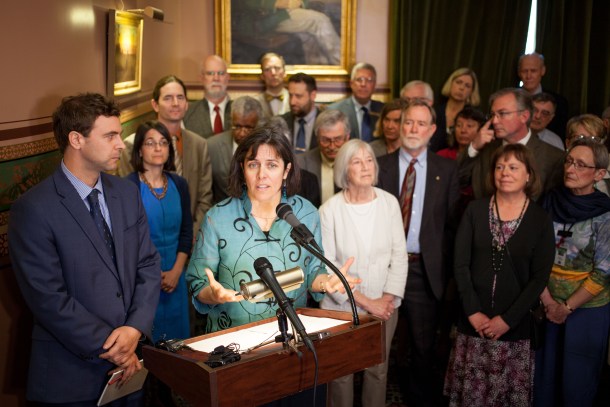
The afternoon was spent tweaking language and discussing procedure for the veto session. Johnson called in Turner to talk about how everything will play out when the veto session opens Wednesday.
Turner said if this deal goes through — and he characterized both sides as being “really close” — he thinks the Legislature can adjourn in a day.
He called the deal a compromise and said he didn’t know the details. But he said “neither party is jumping for joy” and that that is usually a sign of a good compromise.

The bill being drafted based on the compromise will go to the money committees in the morning. Then the House and Senate will vote, according to Turner.
“I don’t see any need to come back for another day,” he said.
Earlier Tuesday, the Vermont Superintendents Association and Vermont School Boards Association released a statement expressing concern that any fix might put more onus onto school districts to cut their budgets and return money to taxpayers. Legislative attempts to satisfy the governor near the end of the session would have done just that.
“We are concerned school districts will be left holding the bag,” said Jeff Francis, head of the superintendents association, in an interview. “That would be the wrong direction.”
At a news conference Tuesday in Burlington, Scott said he didn’t think the final plan would force school boards to revise their budgets.
“It should not affect their budgets. It should come out of the savings that are reached through these new [health care] plans,” Scott said.
Francis’ counterpart at the school boards association, Nicole Mace, said the General Assembly has been unwilling to make changes to collective bargaining. “Yet they are willing to recognize there are savings to be had and take those savings from school districts statewide. The savings aren’t available for the state’s purposes if the state hasn’t taken responsibility for collective bargaining. That is what this is about.”
Both the Vermont Superintendents Association and Vermont School Boards Association suggested moving contract negotiations for teacher health care to the state level as part of several options to stem the rise in education spending. But in the amount of time it has taken to debate this, somewhere between 17 and 25 contracts have already settled, and 25 more school districts are at impasse with their teachers unions.
Forty-three supervisory unions haven’t settled yet.
“It is getting late,” but “it would still be useful” to have the state handle negotiations over health benefits, Mace said. “But it is too late to interfere in budgets without any tangible benefit to school districts.”
Scott acknowledged that more contracts are being settled and said he isn’t sure it is possible to capture the savings he’d once projected for fiscal 2018. That would have been up to $13 million, because the new health plans will be in place for only half the fiscal year.
“You have to consider there are some contracts that have been ratified, that have been committed to, so that may make a difference to the bottom line,” he said.
Late Tuesday the offices of the governor, House speaker and Senate president issued a brief statement about the deal, offering no details.
The leaders said the agreement “will help the state achieve significant savings in the education fund and lower property tax rates.”
“As we finalize the proposal and work with the full Legislature to move it forward, we are confident it will have cross-party support,” the statement concluded. “We look forward to passing a balanced budget that does not raise taxes and fees, provides property tax relief, and makes critical investments in early care and learning, higher education, affordable housing, mental health, and economic development.”
(VTDigger reporter Morgan True contributed to this report.)
/
