

The law, which goes into effect Oct. 1, requires Vermont Medicaid and commercial insurance companies to reimburse doctors for using video technology to confer with patients who are calling from almost any distant location.
Currently, Vermont Medicaid and commercial insurers are required to reimburse doctors for such services only if the patient is connected through a health care facility, such as a hospital.
“The patient can be at a distant place like their home or their workplace, or perhaps even in a library where there’s a private setting and access to video,” said Rep. Bill Lippert, D-Hinesburg, the chair of the House Health Care Committee.
“This expands the opportunity for individuals to access mental health care and substance abuse care from a distant site,” he said. “We have a shortage of psychiatric care in Vermont, but also for ongoing mental health care and substance abuse treatment care.”
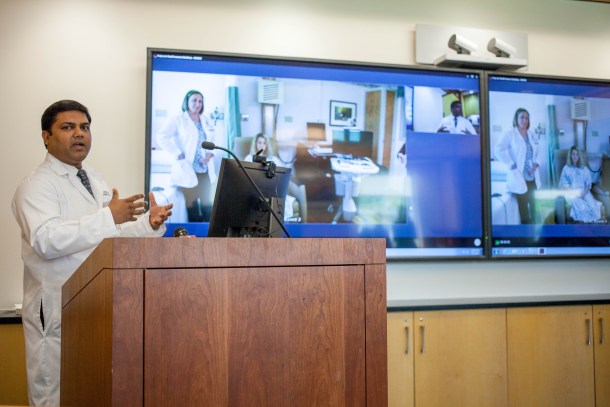
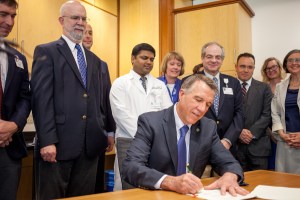
Scott signed the bill, S.50, at the University of Vermont Medical Center, where a neurologist demonstrated how his staff already uses video software to assess patients at Rutland Regional Medical Center, a two-hour drive away.
In Burlington, Dr. Ajay M. Tunguturi spoke with a nurse practitioner in Rutland who asked a mock patient to perform simple things, like watching a light as it moved. Tunguturi observed the patient during the exam.
Tunguturi said he has access to each patient’s electronic medical records and that he observes the remote patient the same as he would in his office.
“By expanding telemedicine, we will continue to improve Vermont’s outstanding record of health access, particularly in underserved and rural areas where people may need to travel longer distances for care,” Scott said. He said mental health care would also benefit.
At the time of the news conference, three psychiatric patients were being boarded in the UVM Medical Center’s emergency department while awaiting appropriate psychiatric care.
McGee also pointed to a nationwide shortage in psychiatrists. He said recruiting telepsychiatrists, and allowing them to work from where they are, can help patients get psychiatric services.
McGee said the hospital has one telepsychiatrist and is actively recruiting in hopes of hiring two more this year. The current telepsychiatrist was already working for the Brattleboro Retreat but wanted to keep her job when she moved to Boston.
Dr. Terry Rabinowitz, a psychiatrist at the UVM Medical Center, said in an interview that psychiatrists in the state already have their days booked full of appointments, so telemedicine won’t fix all access issues.
However, he said psychiatrists could use time freed up from cancellations and no-shows to practice telepsychiatry with other patients, such as those in nursing homes who need a short consult.
“It’s the quality of the provider that makes the difference,” he said. “So if I’m a good provider and I do my treatments by telemedicine, I’ll do just as well as if I had done it face to face. From a lousy provider, even if I’m face to face, I’m not going to do a very good job.”
Dr. Stephen Leffler,the chief population health and quality officer for the University of Vermont Health Network, said the hospital has done more than 500 consultations since 2014, and more than 99 percent of the patients considered the consult adequate. Only about 15 percent of the patients needed to have an in-person visit with a specialist.
Leffler said the UVM Medical Center is not yet ready to reach patients in their homes because telemedicine can be performed only over secure internet connections to ensure a patient’s medical information remains private. But he said S.50 moves the hospital in that direction.
“It helps us to get ready to be able to provide it in someone’s house on their laptop,” Leffler said. “When providers start asking for it, our tech people will deliver.”
