

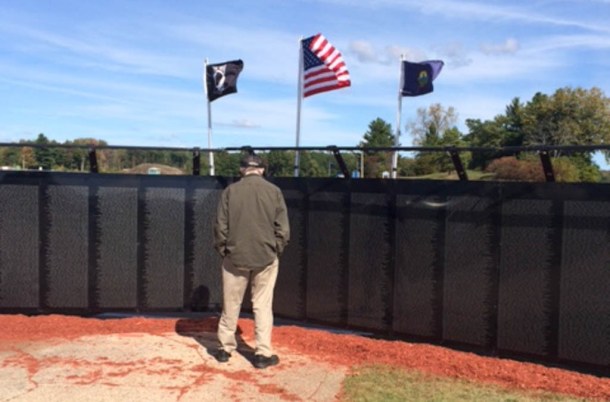
[J]ack Squires was a coal miner’s son, a mother’s favorite and a husband to a then 24-year-old wife and father to a 4-year old daughter. He was a Navy SEAL who had survived harrowing missions in the Vietnam War. Jack earned a Bronze Star for his bravery and a Presidential Citation for his heroics. He was my friend and a teammate.
In spring of 1975 while on a SEAL deployment to Europe, Jack was hit by an automobile while crossing a street in Athens, Greece. He fought to stay alive but eventually succumbed to his injuries. He died just sly of his 28th birthday.
Meanwhile, back in Virginia, Jack’s wife, Barbara, was shopping for groceries. She knew something was wrong when two Navy SEALs and her mother greeted her as she returned home. They told her Jack was badly hurt but still alive and preparations were being made to transport her to Athens. She never made it on a flight. Hours later a Navy Chaplin informed her Jack had died.
Life’s circumstances, particularly for those who serve in our military, can change in an instant. It doesn’t matter if you are in combat, or not. Our military personnel are often in harms way and can be killed in faraway places, or even here in the United States, doing their job. Or, in some instances, as with Jack, just doing common everyday things. For families that suffer this incredible loss—frequently when the military member is at the prime of their life—it feels as if the world is collapsing in on them. There is deep loneliness, even when surrounded by family and friends. There are questions about how and why. And, there are rarely any good answers. In Jack’s case, as with so many others, the reality of his death is stark: parents without a son; a wife without her husband; and a young daughter without a father.
Jack’s mother would spend countless hours talking about her son, convinced she was never told the real story about how Jack died. Jack’s father hardly ever spoke of his son’s death; everyone knew that it pained him beyond words. Jack’s sister, Mary, would weep whenever thinking of Jack’s death. Jack had sent a postcard to her while heading to Athens from Italy. It arrived two days after his funeral.
Eventually, Barbara met someone else who became an important part of her life and she remarried. For Jack’s daughter, Tracey, as is the case with many young children who lose a parent, there is a void. They carry an insatiable curiosity of who that parent was, or could have been. Now a grown woman in her 40s, Tracey spent years searching out those that knew her dad in order to understand who he was; and perhaps a little about who she is. She feels she is better for the experience.
I escorted Jack’s body back to Dover, Delaware where the military mortuary is located and then eventually to the funeral home in Virginia Beach and was reminded that none of us are invincible, not even the bravest and toughest guys like Jack Squires. We know this reality in the abstract, of course. And servicemen and women are surrounded by it everyday. But absorbing the fact that a friend has died hones it in a way that is difficult to describe.
The experience doesn’t change your passion for serving our country; and it doesn’t make you balk at your obligations. It does remind you of the possible outcome. And it gives you a greater perspective and appreciation of all of those who serve our country before, and after, you.
Military funerals are especially sad occasions. A U.S. flag is folded from the casket and given to the family; shots are fired in the air in honor of the deceased veteran; and the haunting sound of a bugle can be heard in the distance playing Taps.
We often think of Taps as signifying an end. It is that final heart retching reminder that a life is gone, many times much too early, and that a painful event—the funeral—is concluding. And supposedly, with an end there comes peace. But in reality, for family and friends, the pain of the loss never ends; it continues — likely for a lifetime.
Many will celebrate Memorial Day in Vermont running a marathon or enjoying a cookout with family and friends as well as other activities. It’s a chance to relax over a long weekend. And although it isn’t purposeful, sometimes our activities preoccupy us to the extent that we forget the reason behind this holiday.
On this Memorial Day weekend take a moment and remember the veterans who have died serving our country, but, in addition, the sacrifice and suffering of their families. Their pain is often overlooked.
And for you Jack, rest peacefully my friend.
(A version of this column appeared last year in The Times Argus and the Rutland Herald.)
