

[A]fter a long day of private conclaves between the governor, the House speaker and the Senate president, the smoke emitted from the golden dome was black, not white.
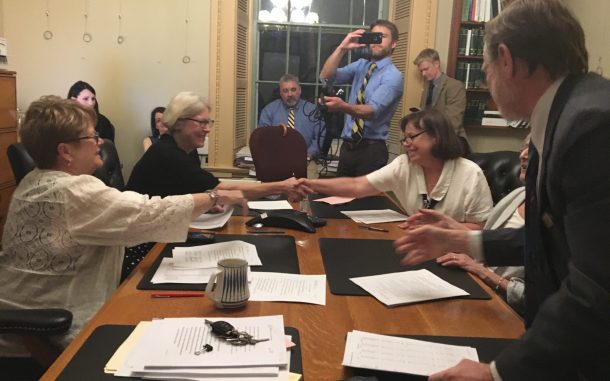
Lawmakers agreed on an education finance plan they said was the best they were going to get as negotiators from each chamber signed it after dark Thursday.
Both chambers adopted the legislation late Thursday night.
Education funding was the key issue that held up adjournment this year. The matter is at the heart of a disagreement over a proposal from Gov. Phil Scott to change how teachers’ health care benefits are negotiated.
He saw a chance to capture as much as $26 million in savings for the state. For a time, Democratic leaders sought to counter with proposals for similar savings while refusing to go along with him on the bargaining process.
In the end lawmakers abandoned the effort to lock in health care savings in the coming fiscal year, instead laying what they say is the groundwork to do that in the future.
“Given the circumstances that we are in, this is the best we are going to do,” Rep. Janet Ancel, D-Calais, told her Senate and House colleagues on the conference committee.
The plan will attempt to re-create the onetime situation the state is currently facing. Almost every teacher contract is being negotiated at the same time because their health care is moving to less-costly plans Jan. 1 as a result of the Affordable Care Act. The governor wanted to take that opportunity to move collective bargaining to the state level in hopes of capturing some of the savings, projected to be $75 million.
The governor wants to give $49 million of that back to teachers so their out-of-pocket costs won’t increase and put $26 million back into the education fund to lower property taxes and help pay for child care and the state colleges.
The plan lawmakers approved will end all teacher health care contracts on Sept. 1, 2019. At the same time, a commission will be set up to study a statewide teacher health care benefit. Contracts that have been settled before July 1 this year will not be subject to this plan.
The governor said this was not what he had hoped for, and lawmakers are now planning for a veto session on June 21 and 22. The new fiscal year starts July 1.
The governor’s spokesperson, Rebecca Kelley, said the plan doesn’t meet the administration’s goals. “The governor set clear principles to have a mechanism to have an opportunity to reach maximum savings for taxpayers,” she said.
The conclusion came after a new round of meetings on the governor’s proposal began Wednesday evening when House and Senate members were assigned to a conference committee on the education tax bill, H.509. But whatever work had been accomplished out of the public eye didn’t clear the bar Thursday morning.
All day, House Speaker Mitzi Johnson, D-South Hero, and Senate President Pro Tem Tim Ashe, D/P-Chittenden, walked in and out of the governor’s office. There were no press conferences, and no information released about what they were or were not considering.
The final proposal lawmakers crafted was attached to the education tax bill that sets key rates used to calculate local property taxes.
The bill represents a 1.5-cent property tax rate decrease for homeowners, Ancel said.
The language sets the so-called yield rate at $10,160 for those who pay based on their homestead’s value and $11,990 for those who qualify to pay based on income.
The nonresidential property tax rate will be $1.55 per $100 of assessed property value.
Those figures are higher than in the House and Senate versions of the yield bill that passed earlier. Higher yield rates correspond with lower local property tax rates.
Taxes are keyed to a statewide rate of $1. If a town spends $10,160 per pupil — the same as the yield rate the Legislature set — then the tax rate in that town will be $1 for every $100 of assessed property value. Any spending above the statewide yield rate is picked up by local taxpayers.
Average spending per pupil will be $15,380 in fiscal year 2018.
“We are giving real property tax relief to residential payers. We are doing a reset on this opportunity to look at these health care contracts in a different way,” said Ancel.
Sen. Ann Cummings, D-Washington, who was also on the conference committee, said the plan gives lawmakers the time they need to really consider this complicated issue. “It gives it the attention it deserves, but it moves us forward,” she said.
/
