


[G]ov. Phil Scott remained optimistic Wednesday a budget deal can still be brokered that would include $26 million in savings on teacher health care. However, no agreement was reached, and the governor said adjournment appeared unlikely before Friday.
Late Wednesday afternoon, Scott said he had just received another proposal from Senate President Tim Ashe, D/P-Chittenden, which the governor said he would look at but didn’t think, at first blush, would work. The governor said he was also waiting to see if Democratic House Speaker Mitzi Johnson had another proposal.
Scott, a Republican who served 16 years in the Legislature before being elected governor in November, said the end game this year between the administration, the House and the Senate was different.
Lawmakers and the governor have been holding discussions over the past several days. Scott has insisted the state capture some savings when teachers are scheduled to change to less expensive health plans because of the Affordable Care Act. The issue has held up adjournment, and Scott has alluded to vetoing the state budget if lawmakers “walk away” from the savings.
The day was filled with closed-door meetings in the capitol focused on saving $26 million from the health care switch. Lawmakers and stakeholders filed in and out of Scott’s ceremonial office, and Democratic leaders met in the speaker’s office.
The governor has been pushing a plan where the state would negotiate health care benefits for all teachers. Moving to new plans that have lower premiums will free up $75 million, according to officials. The idea is to give $48 million of those savings back to the teachers through health savings accounts to cover most of their out-of-pocket costs. The governor’s plan would split the remaining $26 million among tax relief, teacher retirement and the education fund.
Other proposals would return it all to taxpayers.

Scott said he proposed that the teachers could negotiate the health care benefits with a representative group of local school officials to satisfy the lawmakers’ goal of having teachers bargain with their employer.
“From what I’ve gathered, the collective bargaining aspect of dealing with the state is problematic because the state is not the employer,” Scott said.
He said there was not “real progress” Wednesday but also that the talks had “not gone backward.”
“All the stars have to align. We’re going to have to get creative in order to do it. I think they can,” Scott said.
Meanwhile, Wednesday afternoon senators delayed voting on some of Scott’s appointees, including Forests, Parks and Recreation Commissioner Michael Snyder, to try to apply pressure, several senators confirmed.
Scott was unfazed, saying officials can serve without an official confirmation.
“I’m not discouraged,” he said. “I’m realistic, I’m pragmatic. It’s just how the end of the session goes.”
As for reaching a deal and legislative adjournment, Scott said: “It’s not going to be done today. It’s not going to be done tomorrow. But if there’s an emphasis put on Friday, maybe that can happen.”
House Republicans caucused in the late afternoon, annoyed they had to deal with bills on the floor that had been dead but were resuscitated while the Legislature waits for the Senate and House leadership to come to an agreement on the issue they can take to the governor. Until that happens, the budget can’t be decided, nor the education tax bill.
It costs $250,000 a week to keep the Legislature going, but Scott said that’s a good investment if leaders can capture $26 million for taxpayers.
On another side of the building, on a different floor, the Working Vermonters’ Caucus met and discussed its opposition to the change in collective bargaining.
“The buzz outside this building is still being framed as $26 million savings. What is really at issue is very, very different — it is a fundamental right to collective bargaining,” said Rep. Jim Masland, D-Thetford.
Masland said it’s about control.
“The governor wants control of certain things he has never had control of before and he has been dying for all session, access to savings. It will let him run havoc in a number of other funds. We need to not let that happen,” Masland said.
Other caucus members were frustrated because they said the $26 million was fiction.
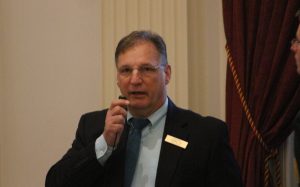
Mark Perrault, fiscal analyst at the Joint Fiscal Office, said the $26 million is not fiction but is based on several assumptions such as an 80/20 premium split and an exact amount of coverage of out-of-pocket costs, without localities increasing teacher pay too much.
The savings are there in the first year but not necessarily beyond that, according to Nicole Mace, executive director of the Vermont School Boards Association and a proponent of statewide negotiations.
“In the first year the savings are there no matter what. In future years it will be based on how teachers use their health care,” she said.
The new plans are structured to encourage teachers to choose urgent care instead of hospital emergency rooms, and generic drugs instead of brand name.
Lawmakers in the caucus also argued that teachers are healthier than the rest of the state.
“We already know [teachers] are highly educated and they use way less health care, and that is why the plans are already cheaper, because they use less health care,” Till said.
But a study performed in 2015 for the previous administration showed that teacher medical costs over time are similar to those for state employees, according to Laura Soares, CEO at the Vermont Education Health Initiative, which handles employee benefits for school districts.
“VEHI covers more than teachers. We cover all school employees and their spouses and dependents,” said Soares. “Our health analytics shows we are similar on health outcomes overall to the rest of (Blue Cross Blue Shield of Vermont’s) book of business.”
Rep. Adam Greshin, I-Warren, a co-sponsor of the failed amendment by Rep. Scott Beck, R-St. Johnsbury, that pushed the governor’s plan, said calling the savings fiction was willfully avoiding the facts.
“Leaving aside the well-accepted connection between cost and utilization, VEHI testified to using two sets of actuaries to develop their premium rates and worked with BCBSVT to dial in the details,” he said. “The plans were sanctioned by the Department of Financial Regulation. It seems to me we have the health care equivalent of climate change denial going on here.”
