

This story is by freelance outdoors writer Darren Marcy.
[V]ermonters who love the outdoors have been warned that 2017 is expected to be a bad year for ticks and the Lyme disease many of them carry. But a little-known tick-borne virus is adding another reason to take prevention seriously, and experts are concerned its risk will only grow.
The Powassan virus, while very rare, has a mortality rate of 10 percent, and researchers are looking into whether it might also play a role in Lyme disease patients.
It is being discovered in more places in the Northeast, including Vermont.
“Powassan virus is most definitely here in Vermont,” said Bradley Tompkins, vector-borne epidemiologist with the Vermont Department of Health. “We know it’s here.”
Tompkins said the state’s only human case, so far, was found in 1999, but with more ticks and increased testing, officials expect to find more.
State officials were sure the Powassan virus was in Vermont in the years after 1999, but there were no positive tests to confirm it until 2016 when an Agriculture Agency survey of 244 black-legged ticks found three carrying the virus.

Vermont is home to 13 species of ticks, of which only five bite humans and four can transmit disease, according to the Department of Health. Of those four, the black-legged tick — commonly referred to as the deer tick — accounts for 99 percent of tick-borne diseases.
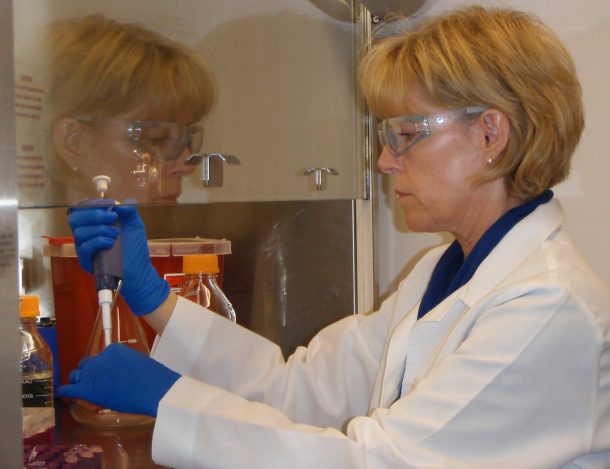
Konstance Knox is a virologist, microbiologist and founder of Coppe Laboratories in Waukesha, Wisconsin, the only commercial lab that tests for Powassan. Knox has been studying Powassan and the potential that it may play a role in whether Lyme disease patients suffer more serious illness and how quickly they recover.
“There has been a very slowly emerging awareness of the Powassan virus,” Knox said.
The majority of patients will show only very mild symptoms brought about by many viral infections: fever and headache, with slightly more serious symptoms including vomiting, weakness and confusion.
But if you have these symptoms after having been bitten by a tick, you’re likely going to be treated with antibiotics for Lyme disease with or without a positive Lyme test.
Knox’s advice for people who are being treated for Lyme and struggling to recover: Look for Powassan.
“It’s not being tested for,” she said. “Frankly, most (patients) are going to go undiagnosed. It is only the tip of the iceberg. It’s probably out there to a much higher prevalence than people appreciate.”
More serious symptoms can include loss of coordination, speech difficulties, seizures, and eventually meningitis and encephalitis.
It’s only these extreme cases that are likely to send a person to the hospital, where Powassan is probably going to be well down the list of potential illnesses doctors will check for.
In fact, Knox said, Powassan is usually diagnosed only in cases of brain swelling (encephalitis) when most all other diagnoses have been exhausted.
“No one will test you for Powassan virus,” Knox said. “The only testing for Powassan that is done is done by the CDC and a couple of public health labs.”
Factor in persistent Lyme?
First discovered in Powassan, Ontario, in 1958, the virus was first diagnosed in the Northeast in 1997.
There have been human cases at Vermont’s borders in New York, New Hampshire and Massachusetts, as well as Maine, New Jersey, Virginia, Pennsylvania, Wisconsin and Minnesota.
From 2006 to 2015, the Centers for Disease Control and Prevention reported 77 cases of Powassan virus — an average of 7.7 per year. But eight of those 77 patients died.
And about 50 percent of survivors end up with permanent neurological damage, according to the CDC.
In the Agriculture Agency’s survey, of the three ticks that tested positive for Powassan, two had co-infections with Lyme.
That’s where Knox’s research has been focusing as she has looked at whether co-infections of Lyme and Powassan might help explain why some people have a mild reaction to Lyme while others get very sick.
Also, her research has looked at cases where a person was diagnosed with Lyme and treated aggressively but didn’t get well.
A study Knox was involved with in Wisconsin showed that among patients who got the sickest from Lyme disease, a high percentage also tested positive for Powassan.
While the two have not been scientifically proven to be linked, it has raised scientific eyebrows.
“In some of these patients that get severe Lyme disease, after getting appropriate treatment, they don’t make a full recovery,” Knox said. “The data (from our studies) are that in almost 16.4 percent of patients with acute Lyme disease, we also find Powassan virus. That’s a lot. There is something going on.”
Knox said the study is expected to be published soon in the Journal of Vector-Borne and Zoonotic Diseases.
Another study by Coppe Laboratories that is to be published later this year by the CDC reports findings from 106 patients with tick-borne illnesses.
Nine had co-infections of Powassan virus and Lyme disease.
“Six of the nine that were co-positive had evidence of acute infection of both,” Knox said. “We don’t know or understand the relationship of Powassan and some of the other tick-borne pathogens, particularly Lyme.”
Found with Lyme, but different
Lyme, along with anaplasmosis and babesiosis, is caused by bacteria passed from the tick. In most cases the tick must be attached to a human for 24 to 48 hours for the disease to be transmitted.
Powassan is a virus, more akin to West Nile and Zika, which can be transmitted within minutes of a bite.
“Where you have deer ticks and you have Lyme,” you have Powassan, Knox said. “There’s a lot more Powassan in these ticks than people appreciate.”

In Vermont, there have been no tests for co-infections conducted on patients with Lyme disease, but co-infections have been confirmed in ticks, according to the state Health Department.
“We do have cases of co-infections of Lyme and other tick-borne diseases here in Vermont,” Tompkins said.
A Health Department study showed 5 percent of black-legged ticks tested positive for more than one type of illness in Vermont, with anaplasmosis and Lyme disease being the most common at 4 percent.
About 1 percent of ticks carried the combination of Lyme and Powassan. Vermont researchers will be looking for more and won’t be surprised to find it, Tompkins said.
“One of the things we’re going to be doing this year is doing more active surveillance for Powassan virus,” Tompkins said.
He said the state will be testing patients who have some sort of encephalitis that is negative for other diseases.
“I won’t be surprised if we do stumble upon some cases,” Tompkins said.
Tompkins wants people to be informed, but not alarmed.
“We want people to take the precautions to prevent tick bites,” Tompkins said. “This is definitely something we want to be on people’s radar. We feel pretty strongly that these diseases are all serious, and we want providers to be aware of them.”
Knox agrees.
“It’s a very, very serious situation right now,” she said. “It’s just now being talked about. Lyme is still the most common infection transmitted by ticks by far, but these other agents are growing in frequency. Powassan virus is the sneaky one. The medical community needs to be learning more about this.”
(Darren Marcy can be contacted at darren@darrenmarcyoutdoors.com.)
