


“This was terrible,” Comey told the Judiciary Committee during its annual FBI oversight hearing. “It makes me mildly nauseous to think that we might have had some impact on the election. But honestly, it wouldn’t change the decision. Everybody who disagrees with me has to come back to Oct. 28 with me and stare at this and tell me what you would do. Would you speak or would you conceal?”
In a letter to Congress on Oct. 28 — roughly one week before the presidential election — Comey said that, after initially clearing her of any wrongdoing around her handling of classified information, the agency had discovered Clinton emails “that appear to be pertinent to the investigation.”
Clinton this week blamed Comey’s letter for her loss to Donald Trump, telling a panel in New York, “If the election had been on Oct. 27, I would be your president.” The polling news site FiveThirtyEight supported Clinton’s hypothesis Wednesday, releasing a data-heavy breakdown of presidential polling before and after the letter was made public.
Justice Department guidelines discourage any public action that could affect a political candidate close to an election, and the department’s inspector general is investigating Comey’s handling of the Clinton probe.
Comey said the FBI didn’t confirm the existence of the Clinton case until months after it began, the same procedure, Comey argued, that the FBI took with the Trump inquiry.
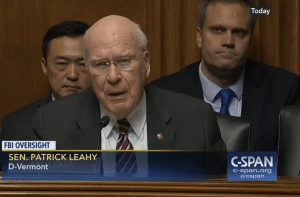
In two rounds of questioning, U.S. Sen. Patrick Leahy, D-Vt., faulted Comey for his handling of the Clinton case, saying it broke with department precedent and “had a great effect” on the 2016 election outcome.
“Americans across the country have been confused and disappointed with your judgment in handling the investigation into Secretary Clinton’s emails,” Leahy said. “On a number of occasions you chose to comment directly and extensively on that investigation. You even released internal FBI memos and interview notes. I may have missed this, but in my 42 years here I’ve never seen anything like that.”
Comey challenged the Vermonter’s version of events. “In October of 2015 we confirmed (the Clinton case) existed and then said not another word,” Comey responded. “Not a peep about it, not until we were finished.”
“No,” Leahy interjected. “Not until the most critical time possible, a couple weeks before the election.”
Republicans were more complimentary of Comey, saying the Clinton investigation was merited, as was the public disclosure of it.
“You were given an impossible choice to make, and you did the best you could in light of the situation that you were presented with,” said Sen. John Cornyn, R-Texas. “It strikes me as somewhat sad for people here and elsewhere to condemn you for notifying Congress.”
Leahy also expressed concern over remarks made during the campaign by former New York Mayor Rudy Giuliani, a Trump supporter, that suggested Giuliani had inside sources at the FBI.
Days before the October Comey letter, Giuliani said on Fox that there was “a surprise or two that you’re going to hear about in the next few days.”
Leahy asked if FBI officials had contact with Giuliani or other Trump surrogates, to which Comey responded, “I don’t know yet.”
“But if I find out that people were leaking information about our investigations — whether it’s to reporters or to private parties — there will be severe consequences,” Comey continued.
Leahy also asked Comey to respond to Trump’s campaign rhetoric advocating a Muslim ban, saying such a political position “goes beyond being stupid.”
Comey did not respond directly to Trump’s rhetoric but said no one could cast suspicions on a group of American citizens.
“A perception, or a reality, of hostility towards any community — in this particular the Muslim American community — makes our jobs harder,” Comey said.
After a series of critical questions, Leahy wrapped up by praising the FBI’s response to a series of threats made to members of the South Burlington High School community. He called it a “textbook example of collaboration between state, local and federal authorities.”
Still, Leahy said he left the hearing with overall disappointment in the FBI director.
“Today was painful,” Leahy said on MSNBC shortly after the hearing ended. “He made a very bad mistake.”
