

The House endorsed the bill, H.196, in a voice vote, largely along party lines. The bill will be voted on one more time before moving to the Senate, which is expected to consider it next year.
Gov. Phil Scott already threatened to veto the bill the day it was introduced because it would raise taxes.
Labor Commissioner Lindsay Kurrle said in a statement that the administration’s position has not changed: “We do not support raising taxes, fees or the cost of living for hardworking Vermonters who should be able to choose whether or not to opt in to a benefit like this one.”

After working for a company for at least a year and paying into the program, workers would be able to take up to six weeks off to bond with a new child or take care of a close family member who is sick.
The insurance program would reimburse workers for up to 80 percent of their wages, maxing out at $1,000 a week. The 0.141 percent payroll tax would apply only to the first $150,000 of wages earned.
The program would not provide short-term disability leave to injured workers. Employers would have the option of paying the tax in lieu of their employees.
California, Rhode Island and New Jersey have offered state-based paid family leave since at least 2014, according to The Washington Post. New York will begin offering paid family leave Jan. 1. Vermont would be the fifth state to offer the benefit.
The federal Family and Medical Leave Act from 1993 already provides certain employees across the country with up to 12 weeks of leave. The main difference between the federal law and the Vermont proposal is getting paid during that time off.
Rep. George Till, D-Jericho, an obstetrician and gynecologist, said that while a pregnancy is divided into three trimesters, doctors sometimes call the time after a baby is born the “fourth trimester.”
“This gives every new father in Vermont the ability to take some time off without losing all their income to bond with the baby and to help care for their wife who has just given birth,” Till said.
Rep. Barbara Rachelson, D-Burlington, supported the bill. She said the idea of paid family leave has already been tested because Vermont would be the fifth state, and California has offered paid family leave for 10 years.
“There has been quite a bit of research, and these are big, populous states, and the research has shown that it hasn’t cost as much as people have feared,” Rachelson said. “It does not have an impact on the bottom line” for businesses.
Opponents of H.196 said the bill would create an administrative burden on small businesses, raise too much in taxes from Vermonters’ paychecks, and place the tax burden on people who will never need to take family or parental leave.

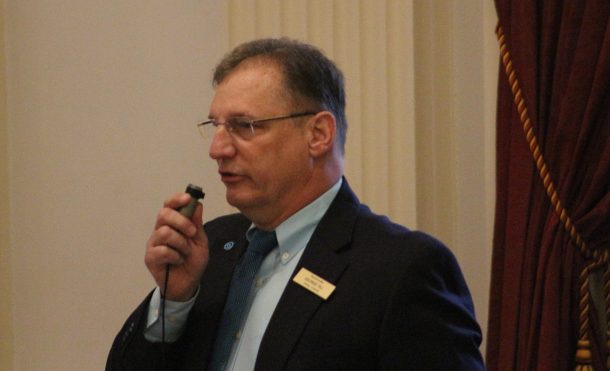
Donahue criticized the 0.141 percent tax as a “guestimate” of how much the program would cost.
“I don’t think there’s any question that a program like this would be a benefit to folks,” Donahue said. “I do question what the cost is and what the impact of that cost would be.”
Till said the tax had been “extensively modeled” and, if anything, is higher than what would be needed to run the program, so the Legislature would need to lower the tax rate in the future.
Donahue then offered an amendment that would have created a voluntary family leave insurance program for people who want to sign up. That amendment failed 88-57, largely along party lines.
Till said a voluntary program would create a situation in insurance called “adverse selection,” in which only the people who need insurance sign up, therefore raising how much the program costs the people who need it.
Rep. Corey Parent, R-St. Albans, questioned the fiscal calculations behind the payroll tax. “We’ve been talking about these expenses run 200 times, but there should be a single math equation to get us there,” he said.

Rep. Ron Hubert, R-Milton, said he has been running a small business for 30 years, but “once again this body for whatever reason is attempting to harm small businesses with a thousand paper cuts.”
Hubert said: “You’re looking at the owner. You’re looking at the bookkeeper. You’re looking at the manager. You’re looking at the scheduler. You’re looking at the (human resources) person. And believe it or not there are only 24 hours in the day for a small businessman.”
Rep. Sarah Copeland Hanzas, D-Bradford, said she is also a small business owner. She said she wants her workers to have access to paid family leave, and that deducting the payroll tax from their paychecks is not an administrative burden.
Copeland Hanzas referenced her 3-year-old nephew who often comes to the Statehouse with her. She said the boy started going to work with his mother at 3 weeks old because the mother could not afford to take unpaid time off.
She said making the new payroll deduction would not be an issue. “With the miracle of QuickBooks it’s a couple of clicks and a few more clicks on the state website to make those payments,” she said.
“It’s really no burden, in the grand scheme of things, if it means that my employees can stay home with their child a little bit longer and give that child a good start,” she said. “The businesses that we run are only as strong as the individuals who fill all of those positions.”
The bill is scheduled to be passed Wednesday before moving to the Senate.
