


Racing returns this weekend to Thunder Road under new ownership and with a surprise driver behind the wheel.
Sports announcing icon Ken Squier and partner Tom Curley sold the short-track speedway in Barre recently to real-estate developer Pat Malone and champion racer Chris Michaud.
On Saturday, Gov. Phil Scott, who it appeared might need to give up his racing career when he won the governorship, will practice with the hope of qualifying for Sunday’s races.
The sale marks a transition and an end of an era for “the nation’s site of excitement.”
Scott said Vermonters owe Squier and Curley a debt of gratitude.
“They’ve left a lasting legacy that will live on under the track’s new leadership. Racing at Thunder Road has been an important part of my life, and I’m not quite ready to hang up my helmet yet, so I look forward to competing in a few races this year,” Scott said this week.
Malone and Michaud say they intend to keep the speedway as it’s long been, with a six-pack limit for spectators on Bud Hill, with Thursday night racing, with pits open to fans over 14 years of age, and with a focus on keeping the sport affordable for racers of all varieties.
Malone said he bought into the track in part because he’s been watching car racing at Thunder Road since he was 10 years old. But he also views it as an interesting challenge, in business terms.
“I tend to like to buy fixer-uppers and rejuvenate them,” he said.
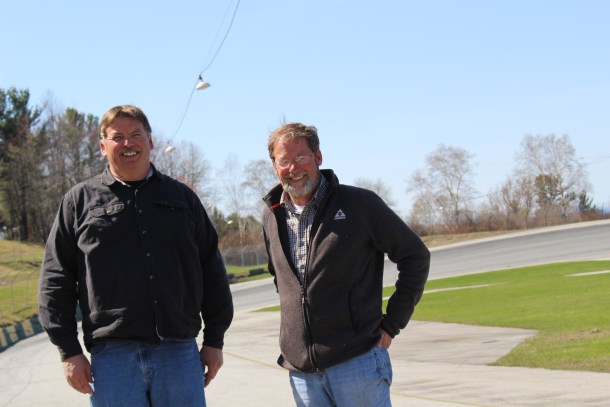
Race tracks have for years been folding, on the East Coast and across the country, the two new owners said, but with Thunder Road there doesn’t appear to be a lot in need of fixing up.
The pair plan to perform work on the driveways, and the parking lots, and some other minor maintenance, Malone said. They’ve already done a lot of work on the track since buying it mid-April, in preparation for the first race of the season, to be held this Sunday, he said.
But with one of the most storied race tracks in the country, they say there’s not much need for innovation in order to keep fans happy.
“The fans are very supportive, and very loyal,” Michaud said. “If you give them a good product, they’re going to reward you in spades with attendance.”
The two do plan to begin a go-cart racing series, for kids between ages 6 and 14 (“Once they’re 14, hopefully they’ll move up to Street Stock,” Michaud said), with 10 races this summer.
Scott, the winningest driver in Thunder Road history, said the track was in good hands with Malone and Michaud.
“Thunder Road has been a part of the social fabric of central Vermont, and arguably for all of Vermont and the Northeast, for more than 50 years. It’s considered ‘one of the toughest short tracks in the country,’ and for good reason. I’m confident Thunder Road is in great hands and that its strong reputation will continue under the leadership of Pat Malone and Chris Michaud,” Scott said.
“Both share a love for auto racing, and care deeply for Vermont. Additionally, Pat has been a very successful developer with a proven track record for improving infrastructure throughout the state,” the governor said.

Vermont has a storied history in racing, and so although Barre might seem like an unusual place for one of the most beloved race tracks in the country, Squier said auto racing is a part of the state’s culture.
The state had 23 race tracks in the years following World War II, he said; Burlington alone had five of them.
The first national championship auto race in the United States after World War II was held in Essex Junction, Squier said.
“It was just as true here as anywhere — the American psyche wanted believable heroes,” he said.
Squier landed his first announcing gig then, in 1949, at the Morrisville Speedway, at age 14.

Back then, auto racers were mainly soldiers returned from the war and still eager for action. A quarter of the country’s gross national product came from car manufacturing, and they were cheap enough that young men would find a passenger car, “slap a number on the side … and go racing,” Squier said.
“They wanted to play, and they wanted it noisy and loud — and they wanted risk,” he said. “What really drove it was all these kids came home and they said, ‘we’re not going to play baseball.’”
Races often killed participants, and so auto racers were much more committed to the sport, Squier said.
“They were really dangerous — these guys never lasted long,” he said. “If you go [to the race] and you (screwed) up, you were dead, so it had this whole mystery to it.”
“Not so much,” Squier said, when asked whether auto racers today carry the same aura today, but he said the sport still gets under people’s skin. Thunder Road, for instance, attracts all sorts of entrants, from youths who’d otherwise pursue a life of crime, to rich kids, to youngsters living in poverty, he said.
“Once they get into it, they do it with all the intention they can throw at it,” he said. “It’s cost a lot of marriages.
“There’s a lot more character in that environment … and it doesn’t matter if they’re rural or whatever, their passion is so deep they won’t accept anything but the very best they can perform,” Squier said. “It sounds so stupid, because they’re going around in a circle.”
Squier will be announcing the race this Sunday, which begins at 1:00 p.m.
Terms of the sale were not disclosed.
