

[A] bill that would give a competitive edge in state contracts to businesses that limit their contribution to climate change has hit a roadblock in the governor’s office.
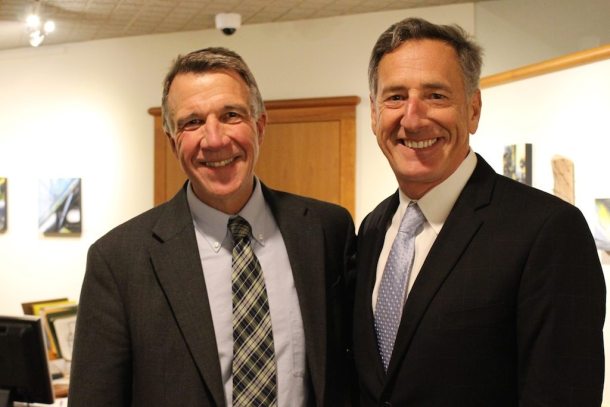
The bill mirrors an executive order signed by former Gov. Peter Shumlin in July, which says that if two companies submit substantially similar bids for a state contract, preference should be given to the company with certain environmental protections in place, when possible.
Though the executive order raised no red flags among agencies at the time, now that environmental advocates are seeking to put it into law, Gov. Phil Scott wants to hit the brakes.
Advocates for the bill said they sought to enshrine Shumlin’s order in law in order to prevent Scott from repealing it.
Administration officials say they’ve been too busy with other priorities, including boosting the economy, to have evaluated whether to rescind it.
Scott supports the state’s renewable-energy goals and supports environmental initiatives, but the bill would “add subjectivity and complexity … and bureaucracy and complication to the procurement process,” said Scott’s communications director, Rebecca Kelley.
Denise Gumpper, chief of contract administration for the Vermont Agency of Transportation said S.32 would effectively block federal funding for most of VTrans’ projects.
VTrans has asked legislators to exempt most transportation projects from the requirements in the bill.
Gumpper said she was aware of Shumlin’s executive order at the time it was adopted in July. The order remains in effect, and it currently applies to VTrans contracts.
Gumpper said she does not know why VTrans shifted gears on the subject since the time of Shumlin’s executive order. She said she wasn’t worried at the time that it would threaten federal funding.
“It wasn’t something on my personal radar .. but it could well have been a huge concern” for agency heads, Gumpper said.
The executive order was meant to apply to all contracts involving state money and even those involving federal funds, said Justin Johnson, former secretary of the Agency of Administration.
Though Gumpper says federal rules prohibit the preference S.32 puts into law, others disagree with her interpretation. Johnson said agency heads never raised the issue when Shumlin issued the executive order.
“I don’t remember that that concern was raised at the time,” he said.
“The lion’s share” of VTrans projects rely on federal funding, Gumpper said, and the type of federal funding VTrans receives doesn’t allow “bidding requirements that unduly restrict competition” among bidders and giving preference to companies that reduce their contribution to climate change would do just that.
“It’s not that we don’t like the climate or environmental things … it’s the fact that it’s an additional procurement restriction” that would prevent VTrans from accessing the type of federal funding most of their projects depend on, Gumpper said.
VTrans has asked for an amendment to the bill that would eliminate the threat of losing federal funding that the bill represents, Gumpper said. This amendment would exempt most VTrans projects from the bill’s provisions, she said.
Environmental advocates sought to turn Shumlin’s executive order into a law through S.32 in part because it wasn’t clear whether Scott would uphold the order.
“We weren’t getting a clear message from Gov. Scott about whether he supported it, or would let it stand,” said Dan Barlow of Vermont Businesses for Social Responsibility.
S.32 represents a win for the state, said Don Mayer, CEO of Waitsfield-based Small Dog Electronics.
The bill allows the state to meaningfully combat global climate change without spending any additional money, Mayer said.
Small Dog previously won a contract to supply computing equipment to the state, and it’s “certainly possible” the company will bid on other state contracts in the future, Mayer said.
“We don’t have to spend the money that the company’s spending” on climate-related measures, he said. “We’re basically using procurement and tax policy to effect change.”
Chris Cole, head of the Agency of Administration’s Building and General Services Department, however, said that the bill could drive costs up for state contracts, and said it could limit the number of applicants as well.
The state should award contracts based on two criteria, he said: cost and quality.
A law established several years ago giving preference in state contracts to in-state companies, Cole said, may have actually raised the price Vermont pays for some projects.
Cole said the bill could set a precedent for contract awards to businesses that offer health care, or child care, or any number of other criteria.
“Where,” he said, “do you draw the line?”
But Mayer and Barlow say they actually do hope legislators will soon give preferential treatment to state contractors who treat their workers better than other bidders. If a company that doesn’t provide health insurance underbids one that does, for instance, the state will probably end up subsidizing health care for the cheaper company’s employees, Mayer said.
“Procurement policy that recognizes when a company is doing the right thing, in the long run, makes more sense,” he said.
The bill is important even in the limited form, said its sponsor, Sen. Virginia “Ginny” Lyons, D-Chittenden.
“It says something about who we are, and what our values are, and that the state is stepping up to the plate” at a time when federal agencies are unlikely to protect the environment, Lyons said.
The bill, Lyons said, promotes “Vermont values,” and it acts to promote Vermont businesses that embrace those same values.
Lawmakers in the Senate Committee on Institutions are seeking to make necessary changes to protect federal funding first.
The committee’s chairwoman, Sen. Peg Flory, R-Pittsford, has committed to moving the bill forward once those changes are made, Barlow said. It should appear before the Institutions Committee on Tuesday, Barlow said.
Flory did not respond to a request for comment.
