

[T]he House Education Committee is considering a bill that would effectively remove sitting lawmakers from the board of the state’s largest university.
The bill, H.41, would stop the Legislature from appointing nine members of the board of trustees at the University of Vermont.
H.41 would instead allow the university to appoint three members more than they do now. That means the total number of trustees would be 19, instead of the current 25.
Under the bill, the governor would continue to sit on the UVM board of trustees as an ex-officio member, and the governor would still appoint 3 people to the board. But the influence of lawmakers would be diminished.
Currently, five of the nine legislative appointees to the board are sitting lawmakers: Rep. John Bartholomew, D-Hartland; Rep. Johannah Donovan, D-Burlington; Rep. Bernard Juskiewicz, R-Cambridge; Rep. Curt McCormack, D-Burlington; and Rep. Tristan Toleno, D-Brattleboro.
The other four legislative appointees are former lawmakers: Anne O’Brien, Donna Sweany, Jeff Wilson, and Shap Smith, who was Speaker of the House from 2009 to 2017.
Rep. Adam Greshin, I-Warren, is the lead sponsor of the bill. He said he could not find another state that appoints lawmakers to the board of a public universities, and having lawmakers on the board creates potential conflicts of interest.
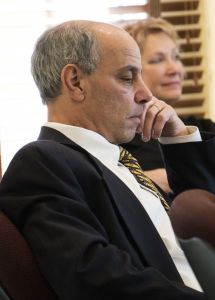
He said lawmakers who sit on the board of trustees could face conflicts of serving their constituents or the university when voting on budget items.
Rep. David Sharpe, D-Bristol, the chair of the House Education Committee, asked Greshin whether other members of the board of trustees would also have conflicts of interest.
Rep. Albert “Chuck” Pearce, R-Richford, asked why the Legislature should take lawmakers off the board of UVM but not off the board of the Vermont State Colleges.
Greshin called the Vermont State Colleges “a very different institution” from UVM. He said the Vermont State Colleges get most of their money from the state, while UVM now gets the majority of its money from tuition from out-of-state students.
Greshin said the main reason for the bill is that freeing up positions on the board of trustees would allow UVM to bring on more talent from the private sector who would help the university be competitive within higher education.
“I wrote this bill because the current governance structure for UVM (is) obsolete,” Greshin said. “The state appropriation used to be a dominant share of the (UVM) budget, and it is no longer.”
The bill would specifically prohibit lawmakers from serving on the board. If a current board member is elected to the Legislature, he or she must give up their seat on the board before being sworn in, according to the bill.
Greshin also argued that UVM would be dealing with declining enrollment in the near future, in the same way that K-12 schools have. He said since lawmakers addressed declining enrollment through school governance changes in Act 46, they should support governance changes for UVM too.
David Daigle, the chair of the UVM board of trustees, told the committee that the university has changed dramatically since the current governance structure was created in 1865 and revised in 1955.
In 1956, according to Daigle, about half of the university’s students came from inside Vermont, and more than half of the university’s general budget—$1.6 million—was appropriated by the Legislature.
Today, according to data Daigle presented, the majority of UVM’s students come from out-of-state, and the Legislature appropriates just 6.5 percent of UVM’s operating budget—or $42.5 million. About half of that money goes directly to providing financial aid to students.
“It has become predominantly an out-of-state institution as far as the student body goes,” Daigle said. “I am deeply concerned, and I’d say the board is universally concerned, about maintaining access for Vermont students.”
Daigle said UVM now faces unique challenges. “We need to find ways to grow our resources and protect ourselves from what might happen at the federal and state levels from a funding perspective,” he said.
Steven Finner, a senior consultant for United Academics, the union that represents faculty at UVM, opposes the bill. He said there is a “significant difference in accessibility to board members” who are appointed by the Legislature versus from the private sector.
“We have found that the legislative trustees, regardless of party, are dedicated public servants,” Finner said. “They are available, they listen to expressions of public concern by faculty, by students, and other employees.”
He said: “The opinion of the United Professionals is that the current structure of the UVM board, including the election of 9 legislatively elected board members is not broken and does not need fixing.”
Rep. Emily Long, D-Newfane, asked Greshin if he would consider reducing the number of people the Legislature appoints to the board.
Greshin said in an interview he was open to that idea.
