

[B]URLINGTON — Victoria Medina wants the public to know that her cousin, Richard Medina, who was stabbed to death on Church Street last week, was not, in her opinion, a transient.
That’s how Burlington Police Chief Brandon del Pozo described Richard Medina and his alleged killer, Louis Fortier, on the day he was stabbed to death.
“He’s not a transient. He has family,” Victoria Medina told VTDigger in a recent phone interview. Richard Medina, 43, came from a large family in Rochester, New York, she said.
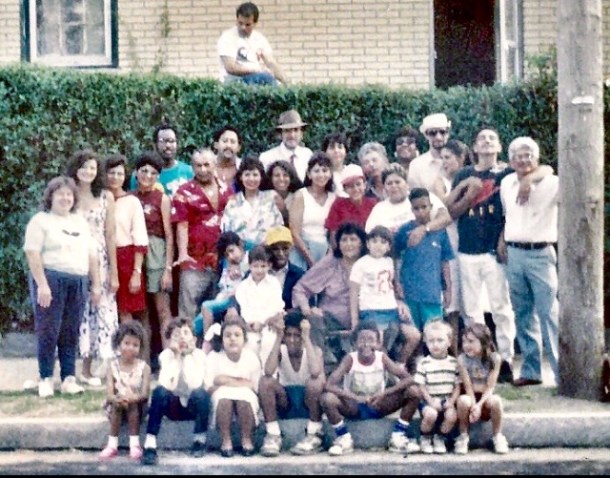
“My grandmother had 10 kids and 25 grandkids and we’re all close. We have family gatherings, family dinners. We’re a strong Catholic family,” she said.

After losing his mother and grandmother in a short span, Richard Medina moved to Burlington in 2013. He lived there continuously until his killing last week. Victoria Medina spoke with her cousin periodically. When they last spoke a few months ago, he told her he was living in an apartment but facing eviction.
Del Pozo said police had many interactions with Richard Medina, but never had a fixed address for him. While he wasn’t always homeless, he bounced between the shelters and a number of transitional housing programs. Del Pozo said it’s the police department’s responsibility to provide the public with context when a daytime killing happens in a popular civic space, so that people can make an informed decision about the threat to public safety. The chief said he chose the term “transient” because he thought it was “less judgmental and more clinical” than other descriptors such as vagrant or undomiciled.
Jay Diaz, a staff attorney with the American Civil Liberties Union of Vermont, said the term transient “immediately ‘others’ the person as someone who doesn’t belong in the community.”
He’s seen Burlington police write “transient” on no trespass tickets issued on Church Street for members of the homeless community who have lived their entire lives in Vermont, Diaz said.
“A person can be sheltered or unsheltered, housed or without housing. Bottomline, ‘transient’ is no more acceptable than ‘hobo’ or ‘bum,’” he said.
Diaz said that, in the wake of Richard Medina’s slaying, city police may look to more stringently enforce Burlington’s panhandling ordinance. That’s a response unlikely to help homeless people or make downtown safer, he said. There are also questions about the constitutionality of the ordinance, Diaz said, and further enforcement could increase Burlington’s liability.
Del Pozo said his department has no intentions of stepping up panhandling enforcement in the wake of last week’s killing. “This wasn’t caused by panhandling,” he said.

“This was caused by people with serious struggles who were attracted to (Burlington) because it has just enough services to make it hospitable, but too few to lead them to rehabilitation,” the chief said.
Facing substance abuse and possible mental health issues, combined with a lack of stable housing, places people at a greater risk of committing or being the victim of a violent crime, del Pozo said.
Richard Medina had over 125 “involvements” with police in Chittenden County, many of which were at the Church Street Marketplace and on North Street in the Old North End, del Pozo told media the day of the killing.
“Very few people have had more police involvement in recent years than the deceased — to include violent incidents,” del Pozo said of Richard Medina.
He was a person of interest, arrestee or suspect in various assault, trespass, intoxication, disturbance, domestic and mental health calls, the chief said. Court records show that as recently as the Friday before his killing, Medina pleaded guilty to simple assault on a police officer and other minor charges.
Louis Fortier, Richard Medina’s alleged killer, also has a long arrest record in Massachusetts and Alabama, including violent crimes. His sister said he has a long history with mental illness.
Still, Victoria Medina said the chief’s description of her cousin as a transient and a criminal has added to her family’s suffering. The resulting news reports cast him in a negative light “without ever really knowing him,” she said.
Victoria Medina said that, to her knowledge, Richard Medina wasn’t addicted to drugs, but he did drink alcohol and had long had been in trouble with the police. Those facts weren’t a fair summation of his life, she said.
“He was very smart. He was very caring. We were very close. Our family was very close. We had family gatherings. He said he missed the family but he didn’t want to come back yet,” she said.
Richard Medina enjoyed puttering on home repairs, and he loved watching history programs, she said. He had a teenage son, and his son lives with his mother in Rochester, Victoria Medina said.
The Medina family was given $7,000 by the Vermont judiciary to help them take his body home to Rochester for burial and to help defray funeral costs, she said.
Members of the Medina family plan to attend the court proceedings against Fortier, and Victoria Medina said she agrees with prosecutors’ decision to charge him with first-degree murder.
“That guy had intent. In that video he was watching him. He had it planned in his head to do what he did,” she said, after having viewed surveillance video from the incident that made its way to YouTube.
After reading reports that several people tried to stem Richard Medina’s bleeding or held his hand during his final moments, Victoria Medina said the family would like the opportunity to thank those individuals.
A history of mental illness
Rose Fortier Sauray is Louis Fortier’s sister. She said in a Facebook message that her brother has a diagnosis of schizophrenia. When his condition is being properly treated he is not a violent person, Sauray said.
Fortier, 36, “has consistently sought help from numerous hospitals” only to be released after a few days because he was determined to no longer be a danger to himself or others.
Police described Fortier as a recent arrival, and Suaray confirmed that he had only been in Vermont for a few weeks. To her knowledge, Suaray said she did not believe Fortier had attempted to enter a mental hospital in Vermont or seek mental health services.
“I truly hope that the system can help others like Louis,” she said.
Del Pozo said he was unable to comment directly on Fortier’s mental health because it may have a bearing on his case. Chittenden County State’s Attorney Sarah George said she didn’t have any information at this time but “We don’t believe (mental health) had anything to do with the incident.”

On March 6 Fortier delivered a “typed letter” to the state’s attorney’s office that was “rambling” and “referenced numerous conspiracy theories,” according to the affidavit. George confirmed her office received the letter, and she said they turned it over to police Wednesday once they realized it was written by the suspect.
Police have thus far declined to release the letter in response to a public records request from VTDigger.
A Facebook page in Fortier’s name has several posts from Saturday, including: “I’m still in Burlington Vermont — can’t get away from pizza gate” and “They’ll molest you and yours too.”
Pizzagate is the name of a conspiracy theory that emerged on the internet during the 2016 presidential election. It alleges without evidence that Hillary Clinton and her campaign chair, John Podesta, were involved in a child prostitution ring run out of a Washington, D.C., pizzeria.
Police reported in an affidavit that Fortier said, without prompting, while he was in a police cruiser, “They were molesting me at the shelter. They were molesting me in the shelter.”
Once Fortier was inside the police station, he was read his Miranda rights and requested a lawyer. The affidavit doesn’t include any further statements from Fortier.
Fortier appeared able to follow the proceedings during a video arraignment last week and told the judge that he planned to represent himself against the first-degree murder charge.
Judge James Crucitti asked that he discuss his intent with his court appointed attorney before making a final decision.

