


In Windham Northeast Supervisory Union, a four-town merger failed.
And in Windham Central, only half of a two-tiered Act 46 plan gained approval. While voters in four of the five Leland & Gray union towns voted to merge, a companion plan in Dover, Marlboro and Wardsboro was rejected.
Even as he sorted through the complicated results Tuesday night, Windham Central Superintendent Bill Anton struck an optimistic chord about what comes next under Act 46.
“I think this is a wonderful time to take a deep breath and reflect on what path we’re going to take as we go forward,” Anton said.
Merging under Act 46, the controversial 2015 state education governance law, was a difficult proposition in both supervisory unions.
Windham Central encompasses a dozen school boards overseeing varying degrees of school choice, and officials early on decided to not pursue a so-called accelerated merger of all the union’s districts.
Rather, they came up with a “side-by-side” merger plan that would create two consolidated districts.
Voters in the five Leland & Gray union towns – Brookline, Jamaica, Newfane, Townshend and Windham – were considering a merger into what was dubbed the West River Education District, designed to educate students from pre-kindergarten through grade 12.
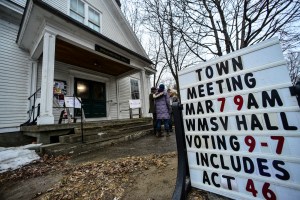
In Bellows Falls-based Windham Northeast, Act 46 studies produced a plan to combine five districts operating seven schools into one pre-K-through-12 district governed by a 10-member board. The affected towns were Athens, Grafton, Rockingham and Westminster.
Like the Windham Central plan, the Windham Northeast proposal did not call for any immediate school closures. But the merger plans were controversial in part because they changed educational structures in some of the affected towns.
For instance, Marlboro would have given up its seventh- and eighth-grade classrooms. In January, three Marlboro school board members traveled to Montpelier to ask lawmakers to extend Act 46 deadlines in order to provide more time and clarity for merger discussions.
And Windham Northeast’s plan called for school choice to end for seventh- and eighth-graders in Athens, Grafton and Westminster, though students who were tuitioned into other schools in the 2017-18 school year would have been “grandfathered” to continue that arrangement for a few years.
Reflecting the complexity of the two unions’ merger plans, Tuesday’s voting results were a mixed bag.
In Windham Central, the Leland & Gray towns of Brookline, Newfane, Jamaica and Townshend approved a merger. Windham voters rejected it by a 74 to 66 margin, but that town was “advisable” – meaning its vote couldn’t sink the merger plan.
Anton was still working to confirm the ramifications of the result Tuesday night, but it appears the four towns that voted yes will join together. Windham either will have to find another merger partner or rely on the State Board of Education to decide the school district’s fate next year — an authority granted to the state under Act 46.
In the other half of the Windham Central Act 46 plan, the proposed union of Dover, Wardsboro and Marlboro failed because the latter two towns voted against it.
Marlboro was “advisable,” so the plan could have withstood that town’s rejection. But Wardsboro was considered “necessary” to the merger.
The vote in Wardsboro was 79 to 62 against the merger, and Anton raised the possibility that residents there could ask for a revote – thus possibly salvaging a merger with Dover.
But in Marlboro, where the plan went down by a 264 to 66 tally, the result “was so overwhelming that I wouldn’t think (a revote) would be a consideration,” he said. Anton expects Marlboro school officials to explore alternative merger structures under Act 46.
“It’s pretty clear … that they definitely want to go down the alternative structure path,” Anton said. “And as superintendent, I’ll support them on any path they want to take.”
Windham Northeast’s vote was more straightforward. Though numbers from Rockingham and Westminster weren’t available late Tuesday, voters in Grafton and Athens overwhelmingly rejected the merger.
All four towns had been deemed “necessary” to the merger plan, so it failed.
Rick Gordon, a Westminster School Board member and outspoken critic of Act 46, said he doesn’t think people disagree with the goals of the law – “the idea that we should look for ways of being more efficient and look for equity and ways to work well together.”
But there is concern about losing local control, including Town Meeting Day school budget votes. That may be “too big of a cost for what didn’t seem to be a lot of gains under the (merger) model that was expected of everyone,” Gordon said Tuesday night.
He believes there is widespread sentiment that Vermont towns need more time to look into alternative school governance structures under Act 46.
“Hopefully, the legislators will hear that and work with local districts to do what’s best for kids and best for communities,” Gordon said.
